Vermiculite Coco Coir Bulk Substrate Calculator
Estimate hydrated coco coir and vermiculite substrate, gypsum, water, field capacity, spawn ratio, tub count, coir bricks, and waste buffer for clean edible mushroom bulk substrate planning.
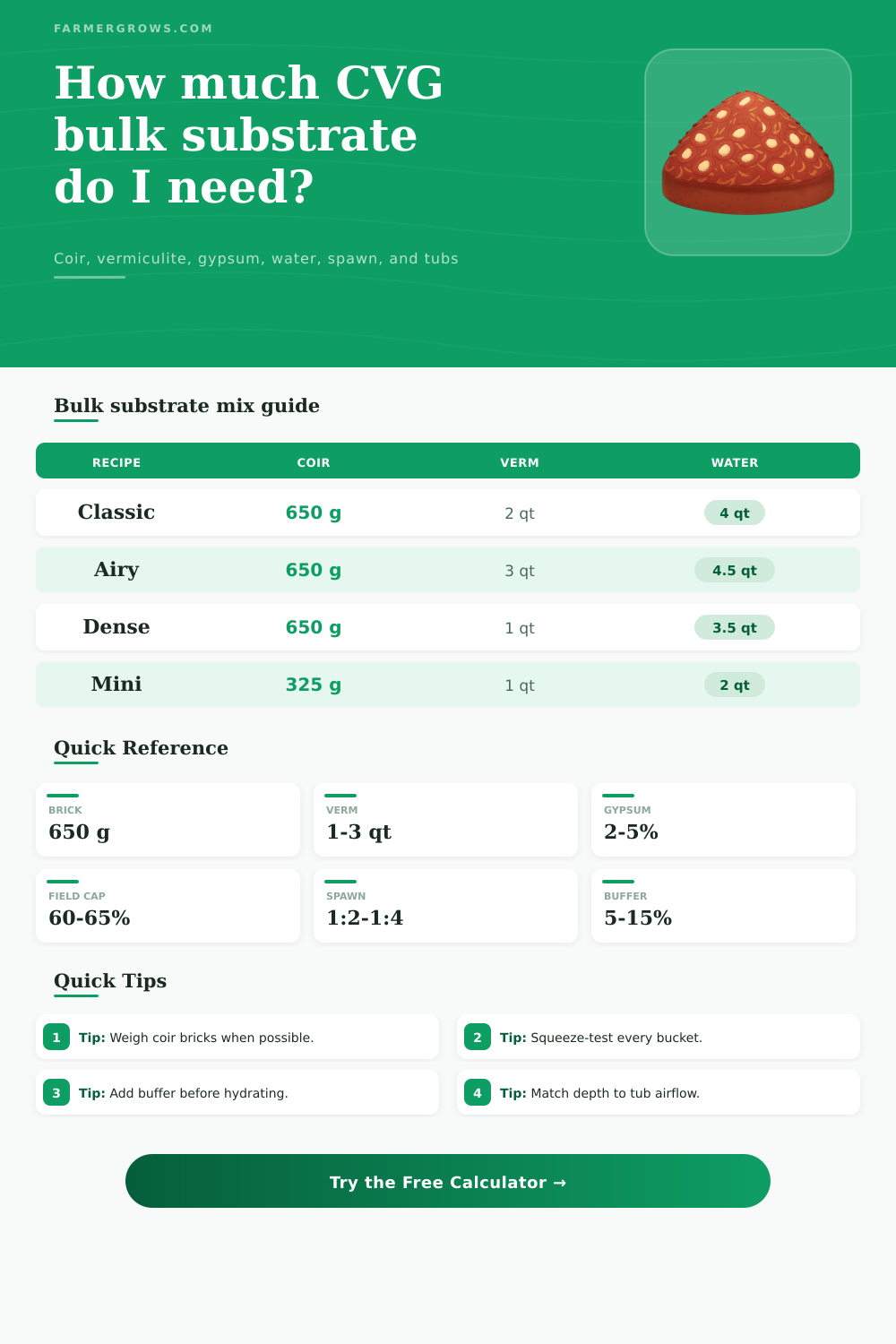
Pick a preset to load realistic CVG settings. The calculator uses quart-volume planning because most tub recipes are measured by hydrated substrate and spawn volume.
Bulk Substrate Batch Results
Results include the contamination and waste buffer, then split the batch into substrate, spawn, coir bricks, vermiculite, gypsum, and hydration water.
Use the grid to compare how coir and vermiculite choices affect water retention, structure, and practical edible mushroom tub handling.
| Recipe style | Dry base ratio | Gypsum | Field capacity | Best use |
|---|---|---|---|---|
| Classic CVG | 70% coir / 30% vermiculite | 2-5% | 60-65% | General edible mushroom monotubs and trays |
| Coir-heavy | 80% coir / 20% vermiculite | 2-4% | 58-63% | Warmer rooms or growers who prefer less retained water |
| Airy high-verm | 60% coir / 40% vermiculite | 2-5% | 62-66% | Shallow tubs, drier rooms, and looser texture |
| Coir-only | 100% coir / 0% vermiculite | 0-3% | 58-63% | Very simple prep when vermiculite is not available |
| Test batch | 65% coir / 35% vermiculite | 3% | 61-64% | Small bucket trials before scaling a new material |
| Target | Water by hydrated weight | Squeeze-test sign | Water formula | Planning note |
|---|---|---|---|---|
| 58% | 0.58 lb water per 1 lb wet mix | Few drops with firm squeeze | water = dry x 1.38 | Better for dense or humid conditions |
| 60% | 0.60 lb water per 1 lb wet mix | Small bead or light drip | water = dry x 1.50 | Conservative CVG hydration target |
| 62% | 0.62 lb water per 1 lb wet mix | Several drops, no stream | water = dry x 1.63 | Common bucket-tek target for balanced CVG |
| 65% | 0.65 lb water per 1 lb wet mix | Short drip, not running | water = dry x 1.86 | Useful for dry rooms or high vermiculite blends |
| 68% | 0.68 lb water per 1 lb wet mix | Risk of wet spots | water = dry x 2.13 | Use only when the substrate can still stay airy |
| Spawn ratio | Spawn share of mixed tub | Bulk share | Colonization speed | Use case |
|---|---|---|---|---|
| 1:1 | 50% | 50% | Fast | Small tests, cold rooms, or high confidence spawn |
| 1:1.5 | 40% | 60% | Fast | Shoeboxes and small tubs with quick turnaround |
| 1:2 | 33% | 67% | Balanced | Reliable default for many edible mushroom tubs |
| 1:3 | 25% | 75% | Moderate | Efficient spawn use when conditions are dialed in |
| 1:4 | 20% | 80% | Slower | Large clean batches where spawn is limited |
| Tub style | Mixed fill volume | At 1:2 spawn | Bulk substrate | Suggested buffer |
|---|---|---|---|---|
| 6 qt shoebox | 4-6 qt | 1.3-2 qt spawn | 2.7-4 qt bulk | 5-10% |
| 16 qt mini tub | 8-12 qt | 2.7-4 qt spawn | 5.3-8 qt bulk | 8-12% |
| 32 qt tub | 14-20 qt | 4.7-6.7 qt spawn | 9.3-13.3 qt bulk | 10-15% |
| 56 qt monotub | 24-34 qt | 8-11.3 qt spawn | 16-22.7 qt bulk | 10-15% |
| Production run | Any repeat size | Scale by tub count | Add before hydrating | 12-20% |
bulk volume = mixed tub volume x bulk ratio share x tub count x (1 + buffer)spawn volume = mixed tub volume x spawn share x tub counthydration water weight = dry substrate weight x field capacity / (1 - field capacity)hydrated weight = dry substrate weight + water weight
This calculator is for edible mushroom substrate planning. Local material density, coir grind, vermiculite grade, bucket temperature, and actual squeeze-test results can change the final water adjustment.
Growing mushrooms at home requires a substrate in order to successfully cultivate the mushrooms. The two primary materials use to create such a substrate are coco coir and vermiculite. These two materials work together to create a substrate that is both clean and consistent, and they enable the substrate to hold water yet not turn into mud.
A vermiculite coco coir bulk substrate calculator can help to determine the amount of each of these material (as well as gypsum and water) that is required to create such a substrate. It is necessary to use the calculator in creating the substrate due to the difficulty of the mathematics that would otherwise be required. If the amount of water or the amount of spawn (mycelium) to be added to the substrate isnt correct, it is possible that the resulting substrate will either not contain enough substrate to support the mycelium, or will become too wet for to long.
Use a Coir and Vermiculite Calculator to Make Mushroom Substrate
Coco coir is a material that is harvested form the husks of coconuts; it is typically sold in large compressed brick. When water is added to the coco coir, the material expands. Vermiculite is a lightweight material that contains numerous air pockets within its substance; these pockets allow for increased water retention within the substrate.
Finally, gypsum is a mineral that can be added to the substrate, which ensure that the substrate contains the appropriate amount of minerals. When combined in the proper ratio, coco coir, vermiculite, and gypsum will provide the mycelium with the food and air that it needs to perform. The calculator allows for the grower to adjust the ratio of coco coir to vermiculite within the substrate; some individuals may desire a substrate that contains more air pocket than others.
Field capacity is a measurement of the amount of water that the substrate can hold. Field capacity can be measured by taking a handful of substrate; the substrate will be damp to the touch, yet not dripping with water. If the substrate is too wet, you can dry it by allowing it to air dry.
If the substrate is too dry, water can be added until it is at field capacity. The calculator determines the amount of water in the substrate that will allow the substrate to reach field capacity; it is essential to use the calculator rather than guessing at how much water to add to the substrate. If too much water is added, there will be portions of the substrate that become too wet; if too little water is added, there will be portions of the substrate that dry too quick.
Spawn ratio is a setting that determines the amount of grain spawn that should be added to the bulk substrate. A higher ratio of spawn to bulk substrate will ensure that the mycelium will colonize the substrate at a faster rate. However, a higher ratio of spawn will require having a higher amount of colonized grain available for the mycelium.
A lower ratio of spawn will require the substrate to be cleaned more often, as well as require more patience while the mycelium colonizes the substrate. The calculator will provide information regarding the amount of bulk substrate that will contain enough spawn to fill each tub. Buffer percentage is an amount of substrate that is added to the substrate mixture.
This extra portion of substrate is necessary to account for the amount of substrate that may adhere to the tubs when they are being filled, as well as to account for the amount of substrate that may be lost at the edge of the tubs. A buffer percentage of 10% or 15% will ensure that each of the tubs will be filled with the desired amount of substrate. The calculator will apply the buffer to the bulk portion of the recipe, prior to converting the bulk substrate to bricks and quarts of vermiculite.
This ensures that each container will contain the same amount of substrate and spawn. Coco coir bricks have certain weights, as well as the amount of substrate that can be created by using that brick of coco coir. The amount of substrate that will be created will vary depending upon the strength with which the coco coir brick was compressed.
The calculator will ask for the weight and yield of each brick of coco coir; this will allow for the calculator to provide information to the grower of how many bricks of coco coir should of been opened. The density of vermiculite can impact the substrate’s performance. Coarse horticultural vermiculite will be lighter than fine vermiculite, and fine vermiculite will be heavier than coarse vermiculite.
By adjusting the density of the vermiculite within the substrate in the calculator, the dry weight of the vermiculite will change, as will the amount of water that is targeted for the substrate. The reference tables can contain information regarding common recipes for bulk substrate. These tables can include the percentage of coir to vermiculite within the substrate, how much water the substrate should contain, field capacity targets for specific conditions within the grow room, and information about spawn ratios, such as how fast the mycelium will colonize the substrate if using 1 part spawn to 2 parts bulk substrate, or 1 part spawn to 4 parts bulk substrate.
It is necessary to weigh the coco coir rather than assuming its weight. While most coco coir bricks will weigh 650 grams, the actual weight of each brick may differ slightly from 650 grams. By entering the actual weight of the coco coir bricks into the calculator, the information provided will be accurate.
It is also important to test the substrate after it is mixed. The calculator will indicate the amount of water to be added to the bulk substrate, but the grower will need to perform a squeeze test prior to adding the substrate to the tubs; if the substrate is too dry, more water will need to be added. The conditions within the grow room may impact certain variables within the bulk substrate recipe.
For instance, if the grow room maintains a consistent temperature of 72 degrees with moderate humidity, a slightly wetter substrate may be utilized. In contrast, if the grow room is dry or warm, a substrate with more water retention properties will be required; this can be accomplished by increasing the amount of vermiculite. Thus, field capacity can be used to adjust the bulk substrate recipe to account for the conditions within the grow room.
By running the substrate recipe through the calculator, the grower can ensure that each variable will be accounted for. The calculator will tell the grower the number of coco coir bricks to be opened, the amount of vermiculite to be measured, the amount of water to be added to the substrate, how much grain spawn will go into each tub, and whether or not the buffer will be large enough to account for substrate that may be lost in the filling of the tubs. Thus, the calculator removes the guesswork from the process; however, the grower will still have to perform the squeeze test prior to adding the substrate to the culture containers.
By utilizing the substrate calculator, the grower can ensure that each portion of the substrate will behave in the same way. The mycelium will colonize at the same rate, the conditions will even within each tub, and the first flush of mushrooms will emerge at the same time.