
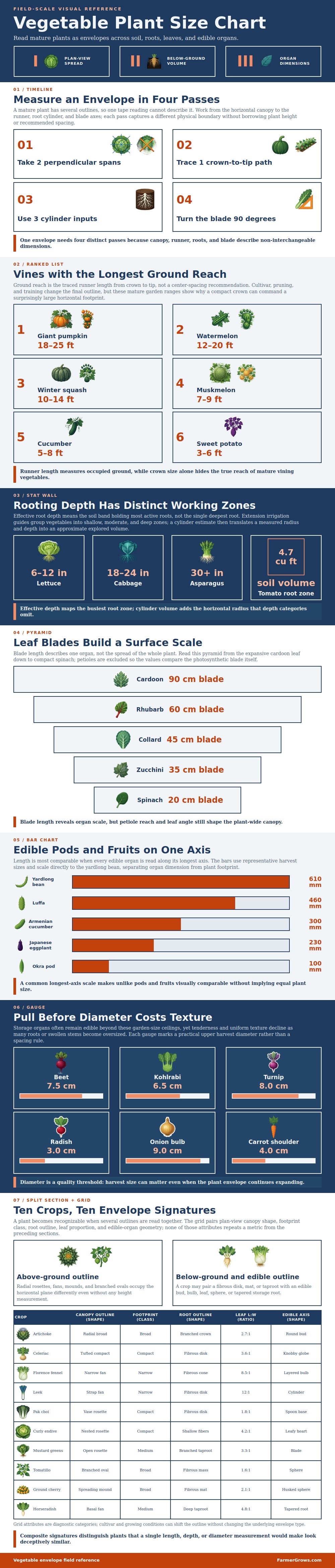
Thinking small: If you’ve ever stood in the garden center clutching your little plastic pots of something and couldn’t picture how big it would be come August, you are not alone. There’s a misjudgment of scale here. Because the plants is little now, we buy them accordingly; we don’t factor in what the plant will eventually occupy.
A vegetable plant isn’t just vertical. It’s a three-dimensional thing that takes up ground, air, soil. When you forget about all that, you’re not growing things; you’re jamming them in tight and then watching one after another fail because they can’t get enough room to do there thing.
Why You Need More Space for Your Plants
Breaking it out like this (above), with each part of the plant treated as a boundary, is helpful. It says: Measure the root cylinder, then the length of the runners, then the width of the canopy, then the size of one leaf blade. Why all those steps? Because no one step tell the whole story.
Two tomato plants spaced two feet apart seem like plenty of room, but do their root zones overlaps so much that they’ll be competing for nitrogen even before the first flower opens? That’s where the mental aspect come in; the bulk of the game is visualizing what you can’t yet see on your plants. Until it’s too late.
Or think about the vines. The visual reference shows you how far out they can reach; for example, a giant pumpkin can reach twenty-five feet from its center. This is not a spacing suggestion. This is a caution.
Watermelons are spaced at six feet apart for most gardeners, because that’s what the seed packet suggests for small ones. But then the runners go tromping on some poor Zucchini. Plan for the worst-case scenario; plan for the largest possible space they will take up, not the smallest amount of space you hope for. Yes, pruning can help; yes, cultivars vary. Still, the need to cover area isn’t easily stopped. Cucumber? Better give that thing eight feet of elbow room or it’ll just come get it from your tomatoes anyhow.
The story below ground is more subtle, but similar. No, roots don’t grow in tidy lines. Instead, they takes up space; they’re three-dimensional. The infographic explains that some plants are shallow-rooted (lettuce) and others deep-divers (asparagus). That’s key to what you can layer where.
Deep-rooted things like carrots don’t mind living near shallow-rooted things like radishes, which occupy different levels of soil. Two deep-ones planted too closely compete with each other for water, and nobody wins.
Effective root depth isn’t just the deepest taproot. It is the layer of soil where most of the roots is active. Knowing that band will allow you to irrigate smarter. Not just on the surface, but within a cylinder of soil.
You can also know a little something about the plant’s light requirements from the size of its individual leaves above ground. A giant cardoon leaf relative to a spinach one means it will be blocking more light and catching more rain. That impacts air flow. Humidity gets trapped by dense foliage, inviting mildew. Not only do plants need space for their roots, they need space for their leaves to breathe.
And the length of those blades: that’s how much surface they have to make food, or get diseased.
And then there’s the final factor: harvest size. When it comes to root vegetables, it’s tempting to let them go a little longer, bigger is better, right? Wrong. There’s such a thing as too big. Beyond the point where they’re no longer tender (the upper limit of each vegetable type), the roots become fibrous and woody. An onion bulb will stretch so far and then start to rot and split apart; a beet at maximum prime diameter won’t be good eating anymore.
The gauge sections on the chart indicate sensible limits to how large you want your vegetables to get before harvest time. It’s not all about when they are ripe… It’s also about keeping that edible portion intact.
Gardeners learn spatial empathy. It’s a negotiation between yourself and other living creatures who don’t care about your ideas of what looks good or where your property line lies. Your garden becomes more of a landscape when you begin to perceive plants not as pretty sticks in dirt, but as volumes of space. Then you direct their growth instead of fighting it; then it isn’t a battle anymore.
Believe the envelope, not the seedling in the pot.