
Vegetables appear to be a separate thing. As if you reach in the fridge and get a carrot for soup, a tomato for sauce. It is as if those tomatoes and carrots has nothing to do with each other, or like each crop have its own set of rules for care.
That’s harvest making us see separation where there realy isn’t any. All these crops are running the same biological software in the ground. Roots grabs whatever they can get hold of, stems carry it around, and leaves converts light to food. Knowing that, knowing how that common machinery works, transforms not only your planting but also your troubleshooting when something goes wrong. From there we stop memorizing long lists of “how-to” charts, and start thinking about what the heck the plant is trying do.
Think Like a Plant
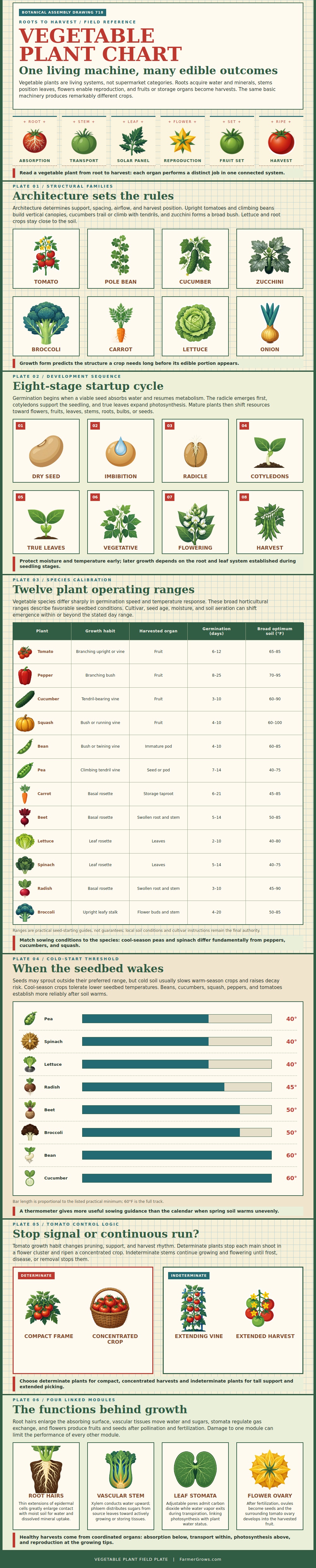
Structure also dictates needs in the garden: Its architecture determines if you need trellises or cages, how much room to leave between plants, and how far apart to plant the rows. Do you have a sprawling zucchini bush or a tall vertical pole bean? They can’t be handled similarly; one will want lots of room, so its vines don’t touch each other (and create an airless situation where disease spreads). The other will want something sturdy for it to grow up on so that its fruits doesn’t sit on the ground. Its very form of growth say how to handle it… Again, long before anything is harvested.
The chart above makes the structures easy to identify because each plant family have a similar shape. It also shows how growth habit predicts what infrastructure a plant will need or won’t need for its success. Don’t fight nature; work with it and pay attention to how the plant is built.
Then there’s the matter of timing: When is the right time? Biology outsmarts calendar days here, too. Each seed have its own temperature range, its optimal range of temperatures at which it will sprout. For example, a pea seed is hard-wired to come awake when the soil around it is cool; it’ll push itself up even if the ground is still on the chilly side in early spring. But a tomato seed don’t do well sitting in the cold earth, and is much more likely to simply rot without ever emerging.
The chart details those temperature limits, and what you can see is that while some seeds (like spinach and peas) like the soil to be cold, others (beans and cucumbers) likes it to be warm. That’s why you have weeks between a row of tomatoes coming up and a row of peas, no error in planning! It’s just part of their species’ nature. Soil doesn’t heat up uniformly, so using a soil thermometer is infinitely more helpful than reading an almanac. Match the seed to the temperature, not the reverse.
Growth logic, even among plants within the same species, can be wild. A great example of this can be found in the world of tomatoes. Some are determinate (meaning they will reach a certain size and stop, bearing a huge crop all at once) while others is indeterminate (continuing to flower and grow indefinitely, stopping only with frost). The former is best for canning season; the latter is better for a long summer of fresh salad.
Because a determinate tomato has limited nodes for fruit set, pruning one too hard will ruin your harvest. An indeterminate tomato benefit from some pruning, it will help you control its size. Knowing which kind of logic your tomato runs is the difference between a confused garden and a bountiful yield.
What happens inside matters as much as what looks outside. Roots aren’t just anchors; they are also how the plant feeds. They absorbs water and minerals through their roots hairs, which grow to expand the root’s surface area. But if the roots can’t reach out because the soil’s compacted, the hairs won’t be able to. And then the vascular system will fail to move water up into the leaves. Photosynthesis slows without water getting to the leaves. One part of the machine is blocked, and the entire thing stall.
A healthy plant grows as a chain reaction. Keep things flowing, from the soil, through the stem, to the leaf, and all goes well. View the garden as a connected system, not just a group of individual veggies, and it makes sense how to care for it. Start looking for blockages in the flow, instead of simply watering on schedule.
Understanding these biological constraints helps you succeed in the garden. That’s where understanding how the machine works help you offer the appropriate environment for it to function. If you look at the leaves, stems and even roots of plants, you’ll start to notice the common thread, which will make the details of each crop more manageable.
No more guesswork. Now it’s all about helping. Letting the plant know what to do, and letting it do it.