Vegetable Garden Water Calculator
Estimate weekly vegetable garden water needs, gallons per bed, irrigation runtime, rainfall credit, watering frequency, and soil moisture risk from real garden conditions.
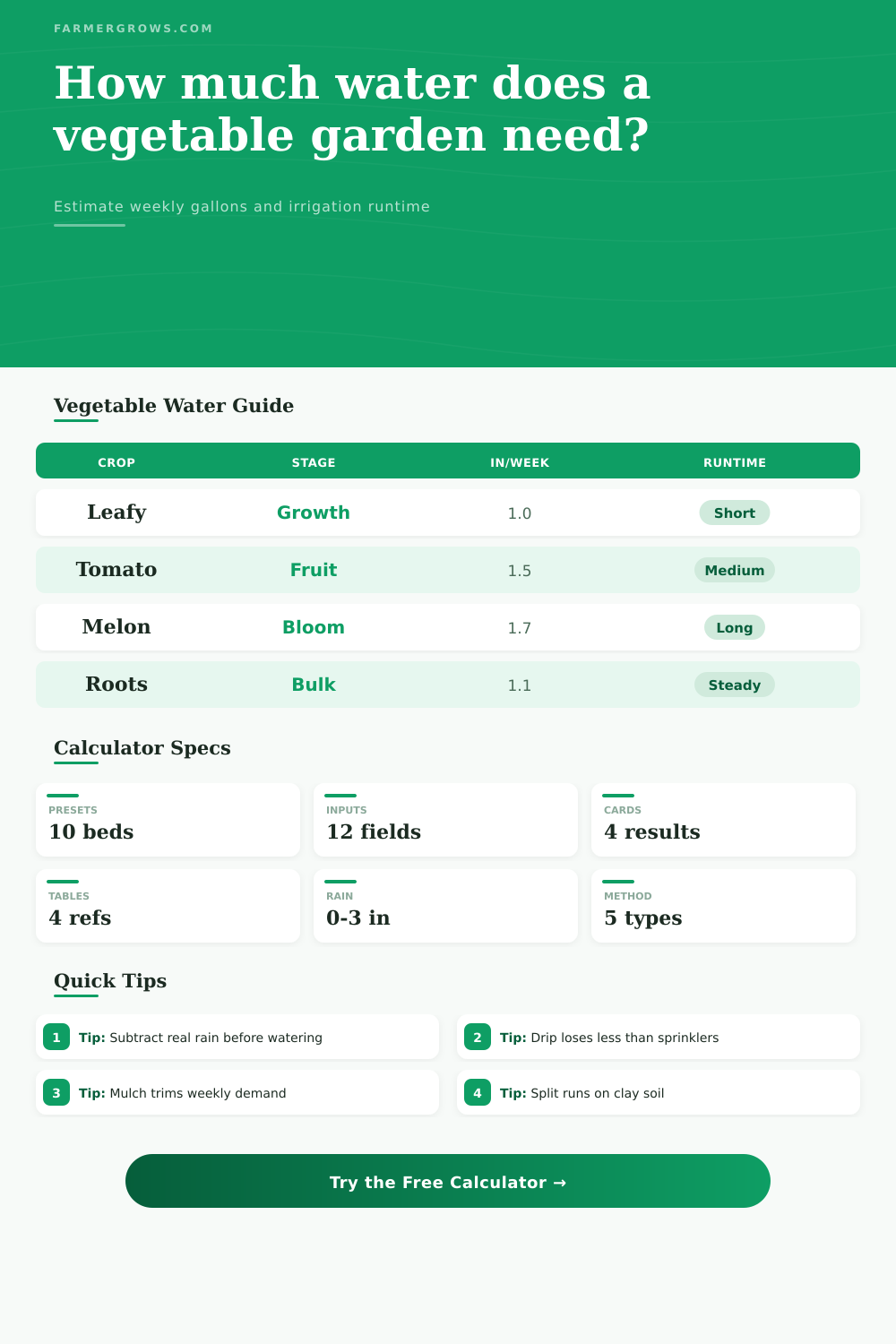
This calculator converts vegetable water demand into gallons and runtime. It adjusts the base crop inches for growth stage, weather, soil texture, mulch, slope, rainfall, irrigation efficiency, and emitter flow.
Fruit fill, flowering, and fast leafy growth raise weekly inches more than seedling stages.
Rainfall is capped by soil intake, mulch, and runoff so storms do not over-credit the bed.
Sandy soil needs shorter, more frequent runs while clay soil often benefits from slower cycles.
Drip tape, emitters, sprinklers, soaker hose, and hand watering lose different amounts.
Vegetable Water Plan
Your calculated garden watering plan will appear here.
| Garden area | 0.75 in/week | 1.00 in/week | 1.50 in/week | 2.00 in/week |
|---|---|---|---|---|
| 25 sq ft patio bed | 12 gal | 16 gal | 23 gal | 31 gal |
| 32 sq ft 4 x 8 bed | 15 gal | 20 gal | 30 gal | 40 gal |
| 100 sq ft row block | 47 gal | 62 gal | 94 gal | 125 gal |
| 250 sq ft market bed | 117 gal | 156 gal | 234 gal | 312 gal |
| Method | Typical efficiency | Best use | Runtime note |
|---|---|---|---|
| Drip tape or line | 90% | Rows and beds | Longest but most targeted. |
| Point emitters | 88% | Containers and plants | Use total emitter flow. |
| Soaker hose | 80% | Dense raised beds | Check uneven old hoses. |
| Overhead sprinkler | 70% | Seedlings or broad beds | Wind and leaves add loss. |
| Hand watering wand | 75% | Small gardens | Move slowly and evenly. |
| Condition | Water adjustment | Frequency effect | Watch for |
|---|---|---|---|
| Sandy soil | +10% | More frequent | Dry edges and fast wilt. |
| Loam soil | Base rate | Moderate | Even moisture after watering. |
| Clay soil | -8% | Slower cycles | Runoff or saturation. |
| 2-3 in mulch | -12% | Fewer dry spikes | Moisture under mulch, not surface. |
| Container mix | +25% | Short daily checks | Drainage and afternoon wilt. |
| Garden setup | Typical crop | Weekly target | Watering rhythm |
|---|---|---|---|
| 4 x 8 raised bed | Greens or roots | 20-35 gal | 2-4 runs weekly. |
| Tomato row, 3 x 12 | Fruiting tomato | 35-55 gal | Deep soak 2-3 times. |
| Melon patch, 10 x 12 | Vining fruit | 115-180 gal | Long drip runs in heat. |
| Container bench | Herbs or peppers | 10-25 gal | Short frequent watering. |
| Market bed, 30 x 3 | Mixed vegetables | 60-100 gal | Split by soil texture. |
Measure the system. Catch water from drip lines, emitters, or sprinklers for a timed test if the label flow rate is unknown. Runtime accuracy depends on total output.
Check the root zone. After watering, dig or probe 4-8 inches down. The surface can look dry while the active root zone still has enough moisture.
Water management shouldn’t be an on-and-off-at-the-faucet kind of deal; think of it more like a planned task. In the lawn, where root systems is shallow and uniformity are the objective, it’s effective. This approach does not work for the vegetable garden where soil conditions differ and each plant have its own requirement.
Understanding that watering is about both depth and timing, not just volume, makes all the difference between a tomato patch that thrives and one that cracks open and turns salty. How do you know when you’ve got enough moisture in a certain bed to run off or soak into surrounding area? First: Examine your crop. Is it a fruiting tomato vine, or a head of lettuce? Do you really need to soak the latter as consistantly as the former?
How to Water Your Garden Correctly
Once you identify the crop and its growth stage, the guessing game of how much water any one plant actualy needs is gone. Then the calculator up top do the math for you. The baseline water demand goes way up during fruit fill stages where the plant is investing heavily in producing some delicious produce. That’s not “keeping it alive” time but fueling-the-harvest time.
Soil matters in the underground world, particularly its texture. Heavy clay will hold water well (if it has time), but won’t let it drain fast, leading to runoff that wastes gallons; sandy soil work like a sieve, letting it right through before any roots get a chance to take a big sip. That’s what makes split irrigation runs so important. On heavy clay, pouring on an hour’s worth all at one time might only sit there puddling on top, then evaporating off, and not making it below, where the deeper-lying roots wants it.
By breaking it up into two shorter cycles, the soil have a chance to soak up the first round before you add another. Your soil may be different than your neighbor’s. The tool factors this in by telling you how often to water if your ground drains slowly or quickly. This means you won’t under-water or over-water anymore.
And then there’s the issue with rain: Some doesn’t count; for example, a light sprinkle may moisten the mulch without penetrating deeply enough to soak the active roots below. The calculator gives credit for rainfall but limits it based off how well soil can take it in. For example, it accounts for risks like hills or crusty soils that cause stormwater to run off instead of soaking in. People often assume that every drop is hitting the root zone. As a result, they end up underwatering when dry weather comes around because they believe they’d gotten their fill from Tuesday’s shower.
The runtime will depend on how efficiently your irrigation is set up. For example, drip tape is far more efficient than an overhead sprinkler system; it loses much less water to wind and evaporation. Seedlings may be easier to irrigate with a sprinkle system. However, they waste a lot of water in the air. They also gets their leaves wet, which creates conditions ripe for disease, and are otherwise inefficient.
So when you change to drip in the set-up, the fact that so much more of the water makes it into soil means the required run time will have changed, too. That’s a key tradeoff. Spending money on a better way to deliver water would of pay off in less time at the tap and also lower overall water use.
The power of mulch: Organic mulch acts as an insulator, slowing evaporation from the soil surface. Organic mulch in particular is a great insulator, slowing the loss of water from the surface of the soil; it also holds water longer between waterings, keeping the root zone cooler by shading it. If you don’t have mulch, you are battling the sun each and every day. Less evaporation (into the air) equals fewer calculations to make. That’s why heavy mulching lowers your calculated need.
And last: Check your system’s flow rate. You can’t calculate run time accurately unless you know how much water your hoses or emitters provide each hour (in gallons). Guess? Wrong. Test: Catch what comes out in a bucket for a minute and scale upward. When you’ve got actual numbers, your weeklong plan will work.
It’s not about poking around in the dirt every hour. It’s about finding a watering rhythm that matches each of your garden bed. Get it right, and chaos transforms to something predictably easy: Plants does well without your hand holding them.