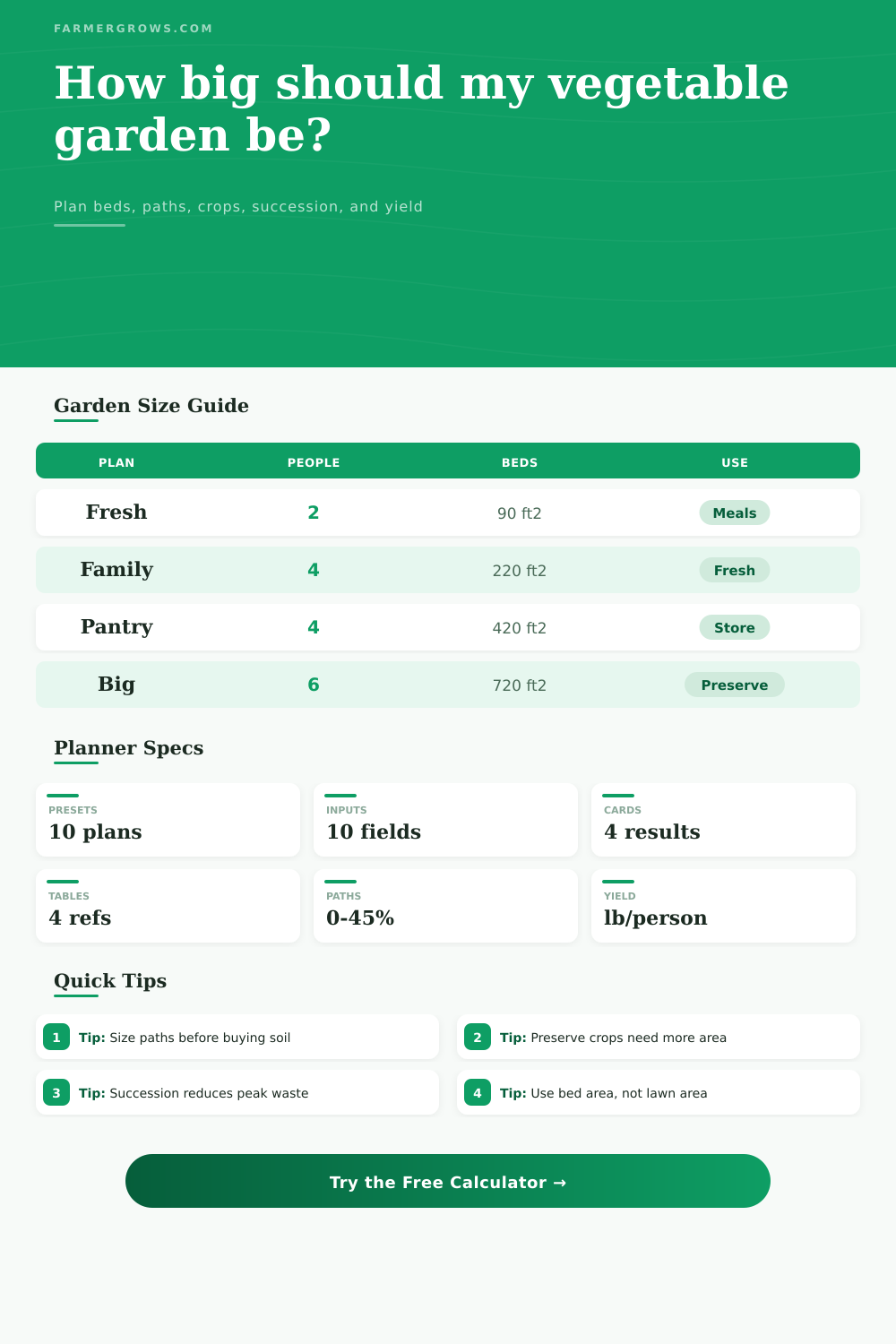
Vegetable Garden Size Calculator
Estimate the bed area and total garden footprint needed for a household vegetable garden using crop mix, yield goals, succession planting, preservation share, paths, and intensive or traditional spacing.
Use the harvestable bed area for crops, then add paths and access space separately. Presets are starting plans based on recognizable garden styles, crop families, and preservation goals.
Emphasizes salad greens, herbs, tomatoes, cucumbers, peppers, and steady weekly harvest.
Combines fresh crops with some beans, roots, onions, and squash for longer kitchen use.
Needs extra bed space for canning tomatoes, dry beans, potatoes, onions, winter squash, and storage roots.
Uses fast crops repeatedly so the same bed produces lettuce, radish, spinach, cilantro, or beans more than once.
Your Vegetable Garden Size Plan
The result separates harvestable crop beds from the full footprint so paths, access, and preservation crops are visible.
| Household plan | Adult shares | Fresh bed area | Pantry bed area | Typical footprint |
|---|---|---|---|---|
| One cook, mostly fresh | 1.0 | 55 to 90 sq ft | 110 to 160 sq ft | 75 to 225 sq ft |
| Couple kitchen garden | 2.0 | 110 to 180 sq ft | 220 to 330 sq ft | 155 to 460 sq ft |
| Family of four | 3.2 to 4.0 | 190 to 360 sq ft | 420 to 650 sq ft | 265 to 900 sq ft |
| Preserving household | 4.0 to 6.0 | 360 to 540 sq ft | 700 to 1200 sq ft | 500 to 1665 sq ft |
| Planting style | Yield factor | Path share | Best fit | Watch point |
|---|---|---|---|---|
| Intensive raised bed | High | 20 to 35% | Small gardens, drip irrigation, rich soil | Needs fertility and airflow |
| Market garden close rows | High | 15 to 28% | Repeat beds, tarps, broadforked soil | Requires disciplined crop rotation |
| Standard home rows | Medium | 28 to 40% | Mixed tools and easy harvest access | Some open soil between rows |
| Traditional wide rows | Lower | 35 to 50% | Large tiller gardens and sprawling crops | Needs more land for same yield |
| Strategy | Multiplier | Works well for | Area effect | Planning note |
|---|---|---|---|---|
| Single warm-season planting | 1.00 | Tomato, pepper, squash, melon | No area credit | One crop occupies the bed most of the season |
| Light succession | 1.15 to 1.30 | Beans, cucumbers, lettuce, radish | Modest area credit | Useful for replacing early failures or bolting greens |
| Strong succession | 1.35 to 1.80 | Salad greens, spinach, cilantro, beets | Large area credit | Needs seed on hand and open harvest windows |
| Preservation block | Add 20 to 70% | Tomato sauce, beans, roots, onions | More area needed | Plant for peak harvest and storage quality |
| Layout | Planted area | Good for | Typical yield | Footprint note |
|---|---|---|---|---|
| Two 4 x 8 beds | 64 sq ft | Beginner fresh herbs and salads | 50 to 90 lb | About 90 to 120 sq ft with paths |
| Four 4 x 10 beds | 160 sq ft | Couple kitchen garden | 130 to 230 lb | About 220 to 300 sq ft with paths |
| Six 4 x 12 beds | 288 sq ft | Family fresh and some storage | 230 to 420 lb | About 400 to 540 sq ft with paths |
| Twelve 30-inch x 25-ft beds | 750 sq ft | Preserving or mini market style | 550 to 1000 lb | About 950 to 1300 sq ft with paths |
Tip: Size the garden from harvestable bed area first. After that, add paths, compost access, trellis clearance, gates, and turning room for carts or hoses.
Tip: Preservation crops behave differently from fresh eating crops. A few tomato plants feed salads, but sauce, salsa, frozen beans, potatoes, onions, and winter squash need extra blocks.
It is tempting to think that garden size is simply a matter of adding up lawn space you can spare, eyeballing your backyard, and marking out an area near the hose bib, but that mindset usually lead to mistakes. It sounds logical, but such thinking almost always produces one (or both) of two results: either you overdo things in early spring, then struggle with weeds so long that your produce wilts on the vines, unpicked. Or else you underdo things, rue the fact that you don’t have twice as many tomatoes or whatever all summer, and still wind up buying a head of salad greens at the supermarket.
Learning to tell the difference between total footprint and planted area is often dividing line between a productive food source and a tedious hobby garden. When starting out, most people estimates their garden space as if they’ll have perfect straight lines of lettuce and carrots, edge-to-edge planting. They take no account of walking through the place or compacting soil around fragile roots! And then there’s the paths: they takes up real estate, sometimes thirty percent or more of your total space depending on how wide you make them for wheelbarrow access.
How to Choose the Right Garden Size
The math gets done for you with the above calculator, and all you do is plug in your preferences on paths, and it divides out the real deal harvestable soil from the stuff you merely have to step over. It avoids the too-common error of ordering a truckload of compost based off one hundred square feet and finding half of it is really just stepping-stones or gravel.
The density equation are very much dependent on what crop you grow. Young, small, leafy things like leaf lettuce can be harvested young, creating an astonishing amount of food per square foot. What about tomatoes? Those guys wants some breathing room and air circulation. They also require trellising. In short: One tomato plant take up quite a bit more space then one head of lettuce.
If your family eats fresh salads every night, your total area needed will differ from that of a family that wants to make salsa for the winter; so there’s lots of canning in their future. That means you will need a lot of extra space when it comes time to plant. Without knowing your preservation goals, it’d be easy to underplant your fresh-produce beds and starve yourself in the process. The tool caters to the preservation share, so you can adjust accordingly if you’re looking to scale up for storage crops.
Succession planting is another variable that turns a small plot into a high-output system. You don’t leave a bed fallow once those radishes comes up in spring; instead, right then and there, you plant something else, summer squash, maybe, or beans (in the same soil). This effectively multiplies what you get out of the same patch of ground. The calculator factors all this in: a well-managed four-by-eight foot bed of fast-growing crops can provide three different meals through rotation. No magic here (just smart land use). The reward for doing this is a big payoff for the work. But you’ve got to be ready to get dirty over and again.
In fact, the inputs takes into account the true appetite level of everyone in your household. A family of two light snackers needs less garden space than a family of two hungry diners. Kids tend to be part of the equation, depending on how many years they’ve been at table and whether or not they are picky eaters. This is important because your yield goal is set here. If you set out to grow half a ton of vegetables for yourself, you’ll probably burn out from trying to keep up with all that produce long before frost sets in. Go too small, though, and you won’t get any sense of accomplishment when you pull a meal from your own soil.
Begin where you know what you wish to eat, and work out from there. If winter meals top the list of priorities, begin by checking what you need to preserve. Use the numbers to help plan beds; don’t guess at size based off how it will look. You should of checked the math first. Not all gardens have to be big to be well sized. Choose only the ones that fit onto your dinner plate and your capacity for working in them.
Begin small. Get the design correct. Let success tell you when to enlarge. Sustainable abundance is not always the largest amount of square feet or luxurius garden space.