
Before any planting takes place, make a map. And no, I don’t mean just making a list of seeds, I’m talking about mapping out your physical space before you plant.
While most gardeners begin by making a list of what they want to plant: Oh yes, those are the heirloom tomatoes I’ll sow, and some fresh radishes, too. That’s great enthusiasm, but all too often means not knowing what will go where (and then having everything crowded in), with mixed-up timing for harvest. A physical map helps prevent a muddled mess of trampled foliage. Knowing what goes where make a difference. It matters more different than selecting the correct variety. G E O M E T R Y (not botany), is where it all starts.
Map Your Garden Space First
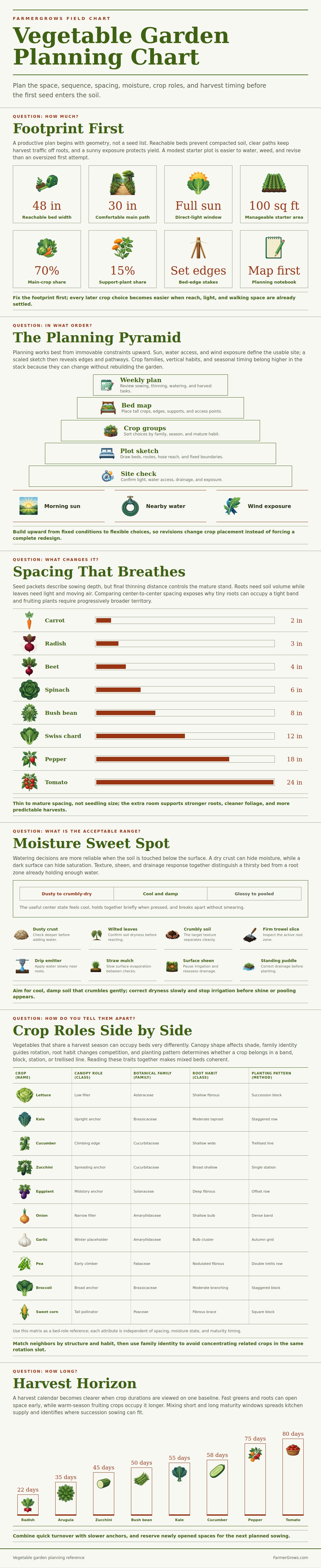
Before deciding what goes in the space, first establish its physical parameters: Draw a line around the perimeter of what you can handle, starting at maybe a hundred square feet. It is far better to avoid an overambitious sprawl, no matter how lovely it looks on paper, because you will end up running ragged trying to keep up.
Make your beds narrow, so you can work both sides by reaching into the middle. This prevents you from walking on the bed surface and compacting the soil. Compacted soil cause poor drainage and smothers roots. And plan for a generous main pathway, wide enough for hauling things home and buckets of goodies.
Fail to respect your space and you’re in for constant battle with yourself all growing season, instead of with your plants.
After that you can view the timeline. How do various crops plays together in time? By knowing what to plant when (and when not), you can have a harvest calendar. The quickies, roots and greens, can spend several weeks in a spot, then leave it so a slower crop can fill in. That’s where succession planting comes into play: It helps your garden keep on producing rather than going fallow for months. Basically, you’re filling in the blanks between long-duration plants with short-duration ones. For example, as the infographic above explains, radishes create space quickly and will let something bigger (like tomatoes or peppers) take their place later on.
An additional layer to trip people up is water management. Looking at the surface is how many gardeners water. No good. A dark surface may only indicate a very thin film of water; what looks like a dry crust can in fact be hiding moist soil beneath. Dig around to feel what’s going on. Cool, damp soil that crumbles apart easily yet holds briefly when squeezed between your fingers is the sweet spot. Water slowly by the roots if it feels dusty. Stop right away if it puddles or goes shiny. Better a bit less frequently with good drainage than lots with poor.
Then consider how every plant fit into the bed: use climbers along its edge, tall anchors, and low fillers. That adds up to coherence in the garden: Put a cucumber trellis where it doesn’t block a lettuce patch hungry for sun, for instance. Knowing your plants’ root habits (and even their canopy shapes) allows you to put neighbors together who help one another instead of competing. This helps you make the most of your space. Using this system of crop roles transforms what would be a chaotic mix into a structured ecosystem.
Last: Keep the planning pyramid in mind. Lay down those fixed elements, water access, wind and sun exposure… And draw your paths and beds next. Next, position individual crops. That way you don’t have to go back and replan after discovering that the tomatoes is in the shade!
The final key element is spacing. Make sure to thin out your seedlings to the eventual distance right away. Tossing a little baby plant feels so wasteful… But crowded conditions mean more disease, and inferior produce. Let your plants have some breathing room.
But there’s one more thing: Gardening involves logistics just as much as it involves nature. Define the boundaries. Make your garden into a kind of project, with distinct steps or phases. And the madness will ease. Manage the system; don’t just react to problems. Keep the soil loose, and let the harvest roll in on cue.
And eat what you grow. Enjoy it. How? Measure the territory and set the edges first. Get the geometry right, and the rest follows.