
Most gardeners count pounds of tomatoes, or count heads of lettuce (to make inventory of their crops). That’s as far as most think: They maintain a mental account of the yield from the soil, but not much about unseen processes behind it.
The difference between a patch that looks good and one that actualy produces lies in understanding biomass accumulation. It is not merely big. How efficiently does each plant turn sun, water and nutrients into edible tissue? Step back from scale of individual plants and you’ll begin to see the garden more clearly.
Why Biomass Matters for Better Gardens
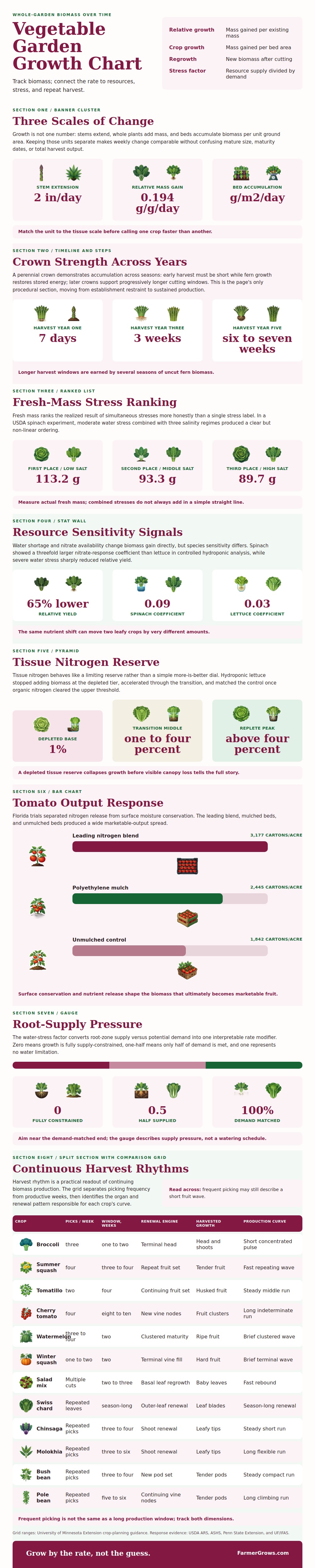
Splitting growth out by scale (above) are one way to help plan more effectively. For instance, how quickly does a plant extend its stem? How rapidly it accumulates mass relative to other plant? The most useful measure, particularly for what’s on your kitchen table, is bed accumulation in grams per square meter per day.
This is the metric that forces you to compare your crops on an even playing field, whether they’re low and close like spinach or tall and reaching for light like sunflowers. And this help avoid a common mistake: mistaking a fast-growing seedling for a high-yielding crop.
The total effect of perennial beds can be seen here: In each successive year, light picking in the first year save up energy reserves for years to come. From barely a handful of days in year one, I see almost a month’s worth by year five (chart). As the root system develops over time so does the reward. You get a much longer period of production as the plant rewards your patience with what it lacked when it was young.
This is a lesson in delayed gratification that goes against every instinct to pick what seems ripe now.
Also, far more then most gardeners acknowledge, other stress factors figure in. Water availability isn’t just a tweak on growing conditions; it’s actualy a basic change in the shape of the yield curve. For example, controlled trials shows that the fresh mass of spinach declined sharply under different levels of salt stress. The relationship is hardly linear, though. Multiple stressors affects each other in complex ways: A little drought may or may not be significant, unless coupled with poor drainage, for instance. Monitoring true fresh mass provides a better picture than any one measure off an environment.
All plants are different: Some species are far more sensitive to nutrients than others (for example, spinach reacts quite dramatically to available nitrate compared to lettuce). Underfeeding spinach will cost you yield; overfeeding lettuce risks flavor dilution if nothing else. And there’s that reserve system we call tissue nitrogen levels. Growth shuts down long before you see weakness or yellowing leaves. This happens when the reserve fall below a critical level. Manage the reserve, don’t merely manage the soil.
Another hidden variable is water supply pressure. When the roots are fully constrained (zero), it’s a stress factor; when their demands are fully met (one), it isn’t. Between those two adult-sized sofa are most gardeners, not knowing how many tomatoes or other crops they’re leaving on the table by not pushing for maximum yield. In tomato trials, combining nitrogen release with surface mulching drastically increased marketable output compared to unmulched controls. Why? This happens because of moisture conservation, which keeps the stress factor higher so that plants can still grow at the same rate during hot spells.
The last part of the puzzle is the harvest rhythm. That’s different than production window; cherry tomatoes may produce for 10 weeks, but you pick them four times per week. Broccoli may go intense for just a week or two before being done for good. That rhythm will guide your succession-planting plans, helping ensure that you’re never drowning in one crop and starving for another. It transforms a chaos patch into a predictable source of supply.
The garden is a lot of guesswork, or so we think. It’s actualy a collection of understandable rates that can be tuned once you know what you are tuning. Start looking at biomass instead of just beauty. This helps you guess less about when to plant and know more about why things happen in your crop.
And then the garden isn’t a mystery anymore; it’s a system. You should of looked at the data sooner.