
Then the weather app tells you: Frost Warning. What to do? Panic.
Go out and survey your garden; what won’t make it through the night? Don’t just cover everything! No. Most likely that tactic won’t work; each vegetable has its own reaction to cold.
How to Protect Your Garden from Frost
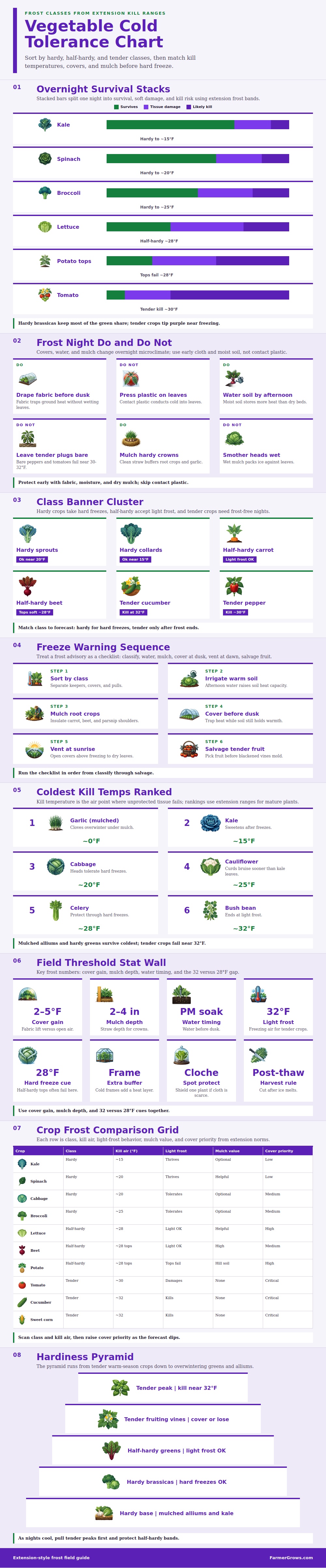
How does knowing which ones are tender (and which is half-hardy or even downright hardy) affect how you garden? It turns random scrambling into a planned strategy. These tolerance levels breaks down on the chart above in simple categories.
On one end of the spectrum you have those truly tough crops (spinach, kale and collards) that is made for colder weather. In fact, many home gardeners says a light freeze makes their greens taste better. It’s because they turns some of their starches into sugars. There is no reason to cover them unless it gets super-cold out. These toughies form the bottom of the hardy pyramid on the chart. That’s why they’re the backbone of a winter garden.
When the temperature starts dropping, what do you do? You just leave these ones outdoors. Save your energy for more tender ones.
Half-hardy vegetables are in middle ground. Carrots, beets, lettuce is tolerant of a light frost, but will really suffer (and in some cases perish) if conditions is too cold for too long; 28ish is the danger zone. Protection works best with these guys. Even something as easy as simple row cover or perhaps a layer of mulch over the crown can mean the difference between a crop and no crop.
As the chart makes clear, it’s these crops that requires your extra eye when the prediction says 28ish or so, which is not really a hard freeze but a possible dangerous dip. That’s what you’re trying to avoid: not a hard freeze but the shock of a sudden drop.
How many gardeners assumes that all greens are equally hearty? Not at all. That’s where they loses points.
Peppers, tomatoes, cucumbers, and beans is tender crops. They are basically tropical plants. Why are they in your garden? Because summer heat tricked them into thinking it was safe. As the chart shows, these guys will dies below about thirty-two degrees. No matter how much wishful thinking you use, there’s no way a tomato vine survives a hard freeze.
When frost threatens, these crops becomes your top priority immediately. Unlike the carrots, for instance, you won’t be able to mulch tender things into safety. It is time to cover, pull out, or give up on them. The graphic spells it out, and does so with a warning that’s blunt: Freezing temps take unprotected tender tissues down fast.
The easiest and best defense is to understand how heat works in the soil and follow simple actions.
WET: Moist soil holds heat longer than dry; so, watering during the day means more heat will be held in the soil throughout the evening hours. That stored heat will then radiate upwards overnight.
Floating row fabric is placed over plants before dark to capture ground heat and create a microclimate that is somewhat warmer than the air above it. Don’t let the fabric touch the foliage directly; cold fabric touching a plant’s tissue will freeze it. Hoops or other devices creates a tent-like structure so air can flow under but the cold cannot enter. Remove the covers around dawn, as condensation could rot plants.
Regarding the mulch thing, it is more about root crops. To protect your carrots and beets’ roots, for instance, you can put a layer of straw down around their base. That insulation will keep the ground from freezing solid.
That doesn’t do anything good for a tomato plant. Why? Because tomato plants are above-ground plants and are therefore exposed to the air temperature. Remember, it’s all in how you applies this thinking, to protect the leaves or the roots. For storage crops, you want to buffer the soil. With warm-season plants like tomatoes, you want to shield their leaves.
Using one technique on the wrong crop causes trouble and leads to dissapointment. It could of been better if you used a different method.
You do what you can with what you’ve got. Work with the weather, don’t fight it. This means sacrificing some things and saving others. It saves time and energy along the way. Focusing on the most important crops in the current moment.
You know where to find your row covers when the cold front arrives. Which beds require watering. No more guesswork; now action.
The garden’s no longer a crisis, just a series of decisions that make sense. And nothing is more valuable than that kind of clarity, not even a single harvest.