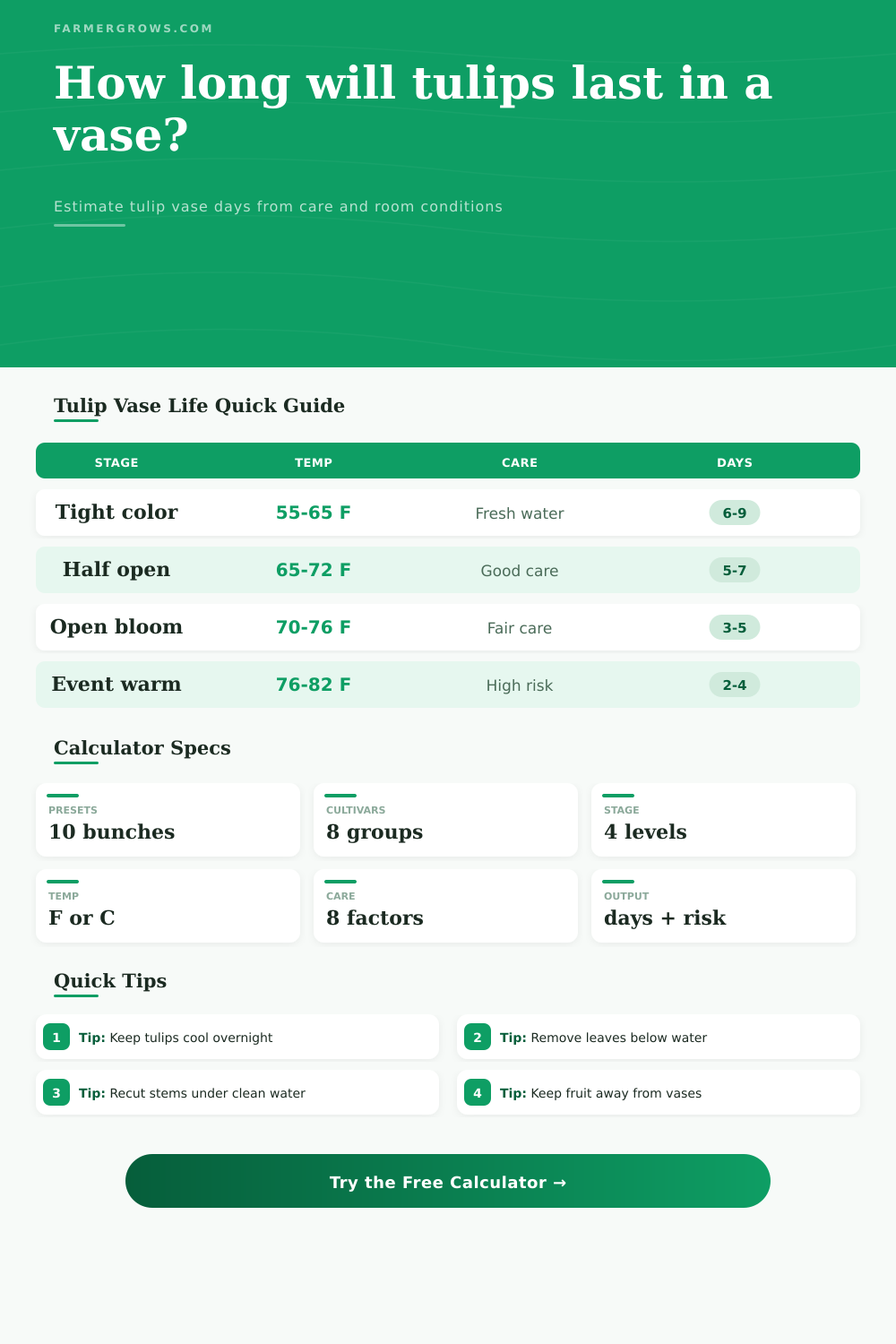
Tulip Flower Vase Life Calculator
Estimate how many display days a cut tulip bunch has left from cultivar group, harvest stage, room temperature, cooler time, stem crowding, water care, recutting, and ethylene exposure.
Choose a real tulip handling scenario, then fine-tune the cultivar, opening stage, temperature, vase size, water routine, and event timing.
Tulip Vase Life Estimate
Adjust the tulip care inputs to see the estimate.
Tight colored Triumph or Darwin stems, plain cool water, lower leaves removed, fresh cut every 2 days, no fruit nearby.
Use half-open stems 1 to 2 days before the event, hold cool overnight, then bring to room temperature for controlled opening.
Open or half-open stems in a warmer room give quick impact, but the calculator applies a shorter display window and higher droop risk.
Wrapped colored buds kept cool and clean usually travel better than open blooms, especially when customers arrange them the same day.
| Tulip group | Baseline vase days | Typical cut-flower behavior | Calculator note |
|---|---|---|---|
| Darwin Hybrid | 7.5 days | Sturdy stems, large classic flowers | Good choice for longer home display |
| Triumph | 6.7 days | Reliable commercial bunch tulip | Balanced baseline for most mixed colors |
| Viridiflora | 7.0 days | Often firmer petals and slower aging | Longer estimate when kept cool |
| Lily-flowered | 6.2 days | Graceful narrow bloom, visible movement | Watch leaning in bright rooms |
| Single Early | 5.8 days | Shorter stems, early openers | Best used from tight colored bud |
| Double Late | 5.0 days | Heavy peony-like flowers | Needs supportive vase and cool room |
| Parrot or Fringed | 4.8 days | Decorative petals, more fragile edges | High-impact event tulip, shorter vase life |
| Species-style short tulips | 5.4 days | Compact stems and smaller blooms | Often best in small shallow vessels |
| Opening stage | Stage factor | Best use | Risk to watch |
|---|---|---|---|
| Tight colored bud | 1.18x | Longest home display, farm pickup, subscriptions | May need warm room time before an event |
| Half-colored bud | 1.05x | Balanced vase life and visible bloom shape | Can open fast above 72°F |
| Open bloom | 0.82x | Same-day arrangements and photo-ready designs | Shorter remaining vase life |
| Fully open bloom | 0.62x | Immediate impact for short events | Petal drop, stretching, and leaning |
| Display temperature | Temp factor | What happens | Practical use |
|---|---|---|---|
| 36-45°F / 2-7°C | 1.22x hold | Opening slows sharply; stems stay firmer | Cooler storage or overnight holding |
| 55-65°F / 13-18°C | 1.08x | Good hydration with slower bloom aging | Best display range for long vase life |
| 66-72°F / 19-22°C | 0.98x | Normal home opening speed | Common kitchen or dining room vase |
| 73-78°F / 23-26°C | 0.84x | Faster opening, more stem lean | Event rooms need later staging |
| 79°F+ / 26°C+ | 0.66x | Rapid bloom expansion and water stress | Avoid sun, vents, and hot windows |
| Care factor | Best range | Calculator effect | Why it matters |
|---|---|---|---|
| Fresh water depth | 3-6 inches / 8-15 cm | Full hydration credit | Tulips drink steadily and lose life when stem ends dry |
| Water change interval | 24-48 hours | 1.00x to 1.07x | Clean water limits bacteria that block xylem flow |
| Stem recut routine | Every 2 days | 1.07x | Restores uptake after cut ends seal or clog |
| Leaves below water | None | 1.05x | Submerged foliage feeds bacteria and clouds water |
| Ethylene exposure | Away from fruit and smoke | No penalty | Ripening produce and exhaust speed senescence in many cut flowers |
Use cool clean water and a clean vase. Tulips are water-driven cut flowers, so bacterial blockage and submerged leaves can shorten the display faster than the cultivar name alone predicts.
Stage tulips by temperature. Hold tight buds cool to slow them down, or give half-open stems a warmer room for quicker event color, then move them back cool overnight.
Buying tulips has its own particular variety of heartbreak. When you take them home, all those fancy buds is tightly closed and lovely; a few days later, they’re hanging out of the window, all limp and sad and guilty-looking, like maybe they’ve been doing something wrong.
Maybe I have a black thumb, you think, or perhaps I bought the wrong flowers? Usually it’s somewhere in-between. As any expert will tell you, tulips make lousy cut flower: They are, in fact, alive. Still alive.
How to Keep Tulips Fresh and Happy
They don’t sit up straight like still decorations. Instead, they keep drinking water and opening. They keep growing and going through their natural processes long after their bulbs were pull from the ground. It is this biology; why else would we love them so much?, that makes them so vulnerable. Only by understanding this dynamic can you hope to keeps your tulips upright and alive.
It calculates how long that flower will last using data from your own living-room conditions (see the calculator above). It also help you visualize how things like water quality, light, and temperature impact the plant biology inside the vase, which is more than just a vessel.
Yes, tulip variety counts; sturdy Darwin hybrids last longer then delicate Parrot tulips. But the thing that often matters more than variety is your care routine. Even a dainty tulip will outlast a robust one if it’s bathed in cool clean water versus warm filthy stuff.
Is there ethylene exposure? Is there stem-crowding? The calculator crunches those numbers for you, and converts them into something you can understand: a time frame.
The only lever you’ve got is temperature. Warmth makes tulips want to pop open fast. Keep the flowers out of any area that’s more than seventy-five degrees Fahrenheit, whether it’s your dining room or otherwise, and the flowers will rush to complete their life cycle as soon as they can. That’s why florists advise keeping vases cool.
With an event coming up, you can use the calculator to stage the blooms. By holding them in a cooler place (or even refrigerating them) overnight, you can slow the plants down. Bringing them to room temperature a day ahead of the party tricks them into waiting until the very last minute.
There is a good reason for this. In the cold, the flower’s metabolic rate slows down, preserving its bud structure.
Most home set-ups go wrong on the water-quality front. Or else we let the leaves hang down into the water, which means they’ll rot. Rot is bacterial growth, and bacteria plug the microscopic xylem vessels in the stem’s base. Even if you fill up the vase, nothing will happen: No water gets up to the flower once its vessels are plugged. This is a major downside; so many people do this wrong.
A little work, though, and you can take out all foliage that will be underwater. Also, recut your stems every couple of days. The cut end heals over slightly forming a seal that prevents uptake. Make a clean diagonal cut again to expose fresh tissue. This will open the spigot again.
Light plays a small part. Tulips need light to color up, but they also bend toward it. That phototropism can cause a vase to look lopsided as the stems bend toward the window. Rotate the thing daily if possible, but for longer-lasting results keep the tulip container out of direct sun and the room itself cooler.
Even better, do not put them beside a fruit bowl. The ripening process of fruit gives off ethylene gas, which causes cut flowers to age faster. An invisible killer, it’ll make their stems soften and their petals curl early. Smoke will do similar damage so keep it as far away as possible.
It’s all about preserving the beauty and life of those flowers throughout the length of your display or event. That means thinking about both structure (a flower needs to stay attached to something!) and the timing (when should a flower be open?). A loose open bloom might fall apart in a day or two; a tight bud will last longer but look more blah when first opened. The calculator lets you consider these tradeoffs.
It allows you to plan out the right moment to stage your arrangement based off the expected timeline. Whether it’s a Saturday wedding or a Tuesday evening dinner, you’ll know how long it will stay at its best.
Tulips really repay attention, though. This isn’t a low-maintenance thing; they ask for things: timely cutting back, clean water, and cool nights. But when you manage to do that part right, they’ll realy show off. They’ll stay bright longer than you might think, and will even perk up from a drooping mess if cooled overnight.
Again, it’s usually not luck; it’s more about being cool and fresh rather then warm and stagnant. Nurture them like the growing things that they are, and they will repay you with a few actual days of glory.