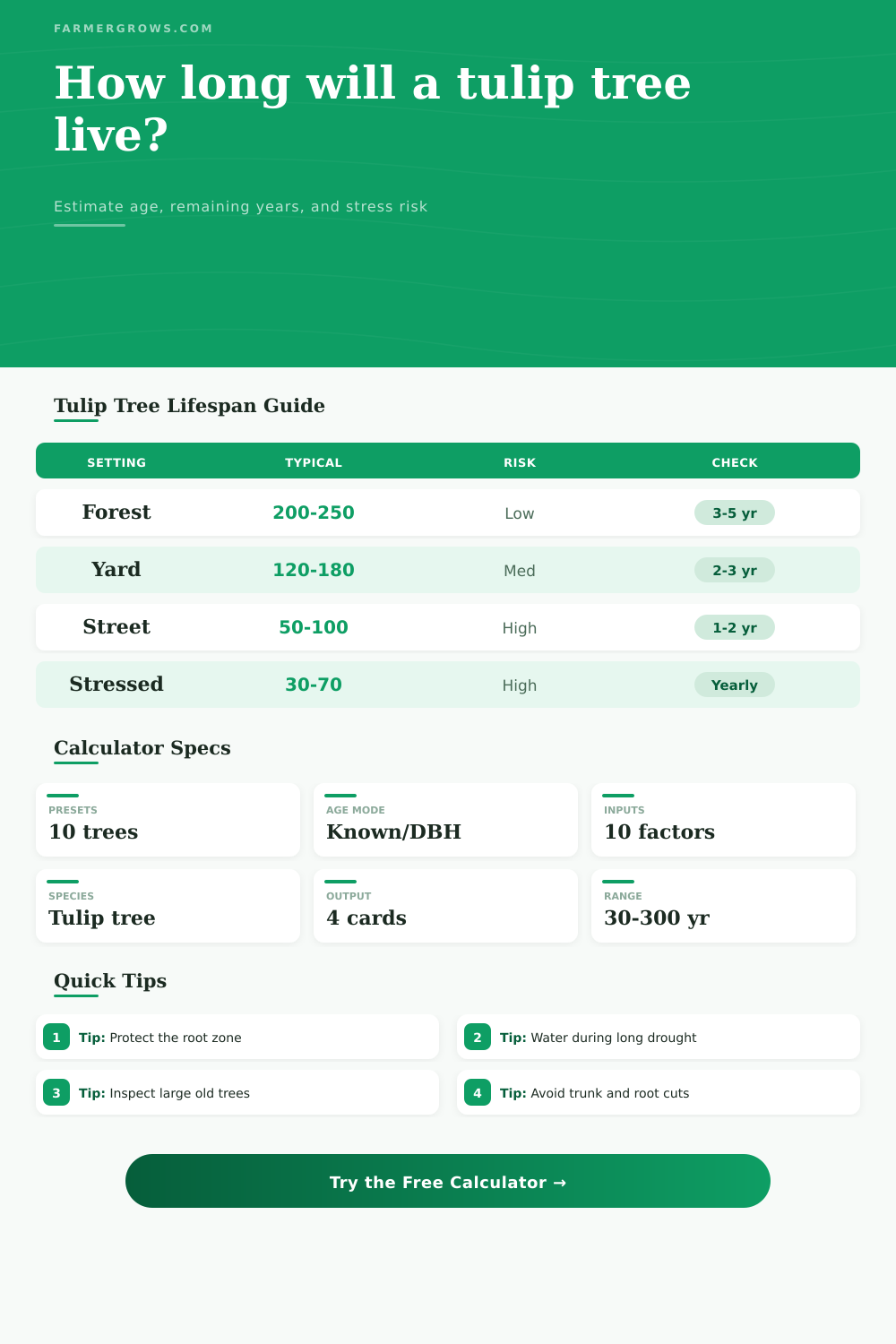
Tulip Tree Lifespan Calculator
Estimate a tulip tree's likely age, remaining useful life, stress risk, and inspection schedule from trunk size, growing site, moisture, soil limits, crown condition, and care history.
Choose a real tulip tree setting, then adjust the age, DBH, site, moisture, symptoms, and care factors to match the tree in front of you.
Tulip Tree Lifespan Estimate
Enter tree details to estimate lifespan and remaining years.
Deep, moist, well-drained soils and root competition without paving can support 200 years or more.
Open lawn trees can live well over a century when root zones are protected from trenching and compaction.
Heat, salt, pavement, root restriction, and drought often lower the practical planning horizon.
Large limbs, cavities, dieback, and storm wounds shift the question from age to managed risk.
| Setting | Planning lifespan | Why it changes | Inspection rhythm |
|---|---|---|---|
| Protected forest or ravine | 200-250 years, sometimes older | Deep soil, natural root area, lower heat load | Every 3-5 years if no targets nearby |
| Open park or large yard | 140-210 years | Good light and space, but lawn traffic may compact soil | Every 2-3 years for large trees |
| Typical residential lawn | 100-170 years | Mowing injury, drought, grade changes, and root cuts shorten life | Every 1-3 years depending on targets |
| Street strip or paved edge | 50-110 years | Restricted roots, reflected heat, salt, and utility cuts | Yearly to every 2 years |
| Severely stressed fill soil | 30-80 years | Low oxygen, poor drainage, drought swings, and root loss | Yearly plus after major storms |
| Current age | Life stage | Expected traits | Main lifespan risk |
|---|---|---|---|
| 0-10 years | Establishment | Rapid height gain, small trunk, sensitive roots | Drought, mower injury, poor planting depth |
| 10-25 years | Juvenile to early flowering | Strong vertical growth; flowers may begin around this stage | Competing turf and insufficient soil volume |
| 25-75 years | Expanding shade tree | Large leaves, tall straight trunk, broad crown | Included bark, storm exposure, construction impacts |
| 75-150 years | Mature landscape tree | Major shade, heavy limbs, seed crop, broad root spread | Root cuts, decay, drought stress, large limb failure |
| 150+ years | Veteran tree | High habitat value and high load-bearing structure | Cavities, decay columns, target risk, storm damage |
| Site factor | Best condition | Short-life condition | Calculator effect |
|---|---|---|---|
| Soil moisture | Moist but well drained | Repeated drought or wet soil oxygen stress | Changes lifespan multiplier and stress score |
| Root volume | Deep, loose, broad root zone | Pavement, fill, hardpan, or trenching | Can remove decades from the plan |
| Crown condition | Full crown with normal leaf color | Dieback, sparse foliage, cavities, or decay signs | Raises risk and shortens remaining range |
| Storm exposure | Sheltered or well-structured crown | Recent large limb loss or exposed ice loading | Reduces useful life near targets |
| Care history | Mulch, watering, no trunk wounds | Topping, repeated wounding, grade changes | Adjusts both useful lifespan and interval |
| DBH class | Approx age in good growth | Height often seen | Use this clue carefully |
|---|---|---|---|
| 4-8 in | 10-25 years | 25-50 ft | Nursery age and transplant shock can distort estimates |
| 10-18 in | 25-55 years | 50-90 ft | Open-grown crowns widen faster than forest crowns |
| 20-32 in | 55-110 years | 80-120 ft | Good soil can make a tree younger than DBH suggests |
| 34-48 in | 100-170 years | 100-150 ft | Old trees need condition checks more than age guesses |
| 50+ in | 150+ years | 120+ ft | Confirm structure, decay, and targets with an arborist |
Protect roots first. Tulip trees decline quickly when large roots are cut, compacted, buried, or heated under pavement. Keep mulch wide, shallow, and off the trunk flare.
Treat large old trees as living structures. A long-lived tulip tree can still need professional risk assessment if it overhangs roofs, driveways, play areas, livestock yards, or paths.
The calculator (above) will give you an idea about how much longer your tulip tree will last. It uses your site conditions and trunk size to calculate potential risk occurring under surface. You no longer have to guess.
With tulips, you get a fast-growing tree that gets big in relatively short order. In exchange, you trade that early height for long-term structural complexity. The question with tulips is how many good years the tree has left. A healthy asset can become a liability when decay or storm damage occur.
How to Keep Your Tulip Tree Healthy
Everyone talks about how much shade a canopy casts. But what matters most for longevity is the health of rootzone. The rootzone of tulip trees are broad and shallow, prone to damage from compaction. Piling up mulch against the trunk will smother it; so will parking your car above the roots. That’s a major consideration in math of the calculator.
A tree growing in loose, deep forest soil can easily outlive its owner by a century. One growing in a tight street-strip may be lucky if it survives half as long. That is just how city gardening works. The location is more important then the planting date.
A healthy tree in a large yard with shelter (such as a protected ravine) will have a base life expectancy of two hundred years or longer. Such ideal conditions promotes full growth and good wood. A tree next to a driveway and sidewalk faces stress. Winter salt on the pavement, heat from ground, and poor soil oxygen all speed its decline.
You might not see the rot in roots until it shows up as dieback in branches. Often it’s too late by then. It then asks about health of crown, as well as its recent growing conditions. Are the roots struggling? Stressed trees has smaller, sparse foliage. If the ground becomes waterlogged or construction projects damages the feeder roots, it will weaken tree over decades and hurt its ability to contain decay. The inspection interval shifts accordingly. Inspect a healthy tree every few years. Inspect a stressed tree annually. Monitor struggling specimen closely.
Stable doesn’t necessarily equal old. If the tree’s structure is sound, even an old tulip tree (like this one at 150) may stay that way for decades or even centuries. Poor site conditions and structural defects threatens stability. Enter those in the calculator, age gets separated out. Your answers adjusts its estimated life span. Because nature isn’t precise, the calculator offers a range instead of just one number.
If a tree will live eighty to a hundred years, that’s plenty of time to do some planning. And it’s no reason to delay doing it. The single best investment is to protect the root flare. No mulch on the trunk. Don’t grade around it and submerge roots. Deep watering in times of drought reduces stress. All these things prolong life of tree. They feed the biology beneath ground. Roots is what the rest of the tree depends on for good health.
Treat the tree like a living thing, not a piece of decoration you can ignore. Tulip trees ask you for something. For time. For room. For attention. In return they offers beauty. Shade. Generations of it. If not cared for properly? Decline is inevitable. A poorly sited tree cannot be saved no matter how much pruning it recieve. Give her what she wants and she’ll give back to you. Keep the root zone safe, the crown will follow.