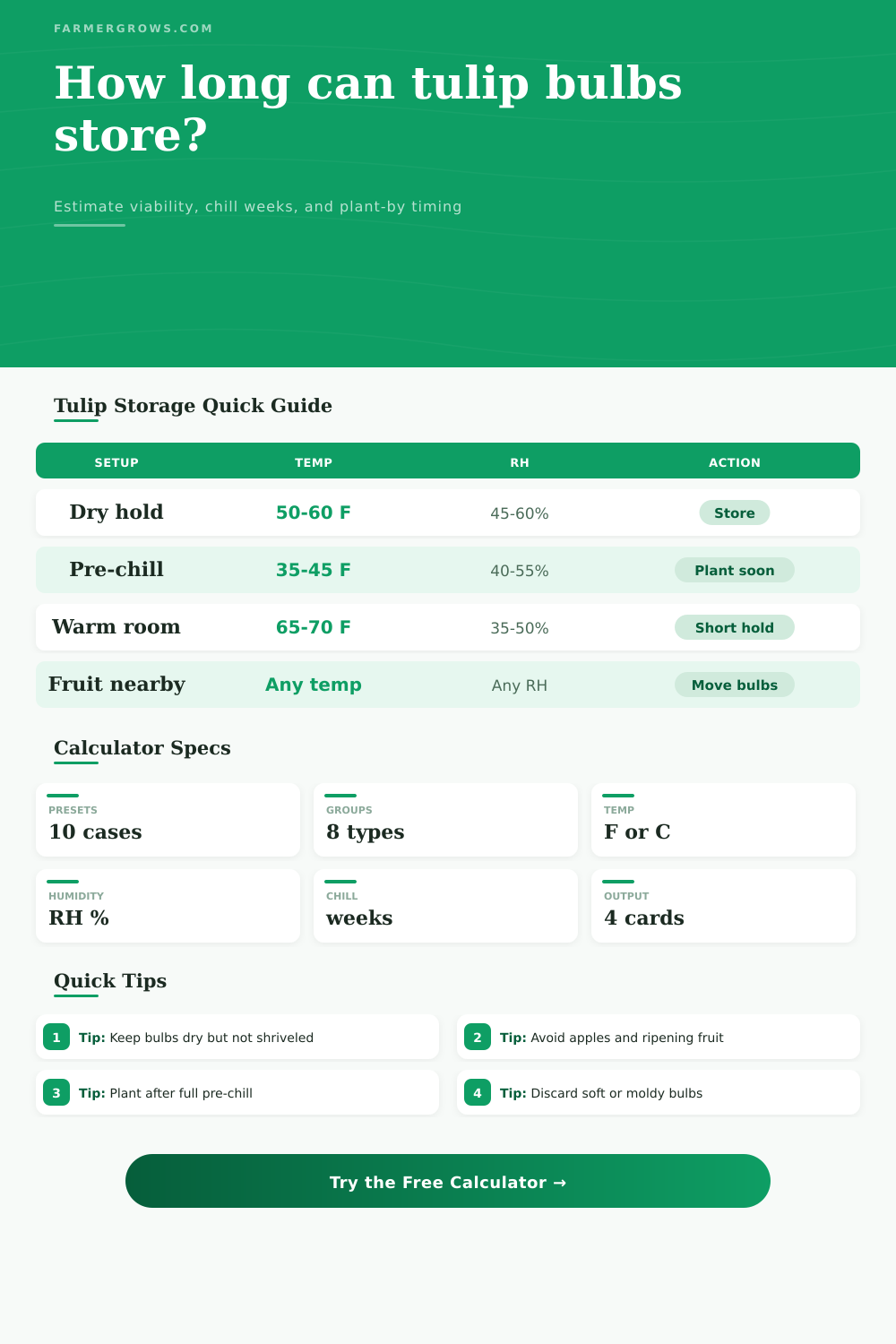
Tulip Bulb Storage Life Calculator
Estimate how long tulip bulbs can stay in storage, how much bloom quality remains, whether their cold requirement is on track, and when to plant or pot them.
Choose a real bulb-handling situation, then adjust temperature, humidity, cultivar group, packaging, and days until planting.
Storage Life Estimate
Storage estimate will appear here.
Works well when temperatures stay near 50 to 60°F and bulbs sit in one layer or mesh with steady air movement.
Counts strongly toward the cold period at 35 to 45°F, but it should not share space with ripening fruit.
Acceptable for brief handling, but temperatures above 65°F speed moisture loss and can shorten the usable window.
Low airflow traps moisture. Use only very briefly with dry bulbs and inspect often for soft spots.
| Temperature band | Storage meaning | Chill credit | Typical action |
|---|---|---|---|
| 32 to 34°F | Near-freezing; avoid actual freezing injury | Partial | Raise slightly if bulbs are dry stored |
| 35 to 45°F | Good refrigerator pre-chill range | Full | Use paper or mesh and keep away from fruit |
| 46 to 55°F | Cool dry storage with some chill effect | Partial | Good for holding before final planting window |
| 56 to 60°F | Acceptable cool dry hold | Low | Monitor shrivel and plant on schedule |
| 61 to 70°F | Warm storage, faster aging | None | Use for short holds only |
| Above 70°F | Heat stress and sprout quality risk | None | Move to cooler storage or plant promptly |
| Tulip group | Typical chill target | Storage tolerance | Notes |
|---|---|---|---|
| Darwin hybrid | 14 weeks | Strong | Robust bulbs, good landscape performance |
| Triumph | 13 weeks | Good | Reliable garden and forcing class |
| Single late | 14 weeks | Good | Large flowers, avoid extended heat |
| Double late | 14 weeks | Moderate | Heavy flowers reward firm top-size bulbs |
| Parrot | 14 weeks | Moderate | More sensitive to poor storage and soft bulbs |
| Species | 10 weeks | Moderate | Often smaller bulbs; avoid excessive drying |
| Relative humidity | Bulb response | Best packaging | Inspection cue |
|---|---|---|---|
| Below 35% | Drying and shrivel risk | Paper bag or dry medium | Bulbs feel light or wrinkled |
| 35 to 44% | Usable but dry | Paper bag, check often | Outer tunics loosen |
| 45 to 60% | Balanced storage | Mesh, tray, or open crate | Firm bulbs with dry skins |
| 61 to 70% | Mold risk rises | Open tray with airflow | Dusty mold on tunics |
| Above 70% | High rot pressure | Avoid closed storage | Soft basal plates or sour smell |
| Warning sign | Likely cause | Effect on storage life | Next action |
|---|---|---|---|
| Soft basal plate | Rot or physical damage | Severe loss | Discard affected bulbs |
| Green shoot elongating | Warmth after chilling | Window is closing | Plant or pot soon |
| Blue-gray surface mold | High humidity, low airflow | Moderate to severe | Dry, separate, and inspect |
| Strong shrivel | Low humidity or long warm hold | Bloom size reduced | Plant if still firm |
| Stored with apples | Ethylene exposure | Flower quality risk | Move bulbs immediately |
Separate storage from fruit. Ripening apples, pears, bananas, and some stored produce release ethylene, which can impair flower development even when the temperature looks right.
Use firmness as the final check. The calculator estimates quality, but individual bulbs still decide the planting tray. Keep firm bulbs, discard soft bulbs, and plant any lot that starts sprouting.
In late summer, when you buy your tulip bulbs, you remember: Oh yes, I have to do something with those things, though what it is, or for that long interval, escapes you. While they rest in their storage, you may not even think of them again as anything but inert onions, but there’s a plant in there, using up its stores gradualy. If you don’t tend to the bulbs all this quiet time, consequences will show not only next spring, but right now in your garden: did they flower well? Or not at all? It comes down to who’s got the power: You, or the bulb.
And here’s where the calculator gets really helpful: It gives exact numbers to both the rate at which something has cooled off and how viable your bulbs is right now. Too damp? Too warm? You won’t have to wonder, since most gardeners thinks a firm bulb is a fine one, but nope; a bulb may be rock-hard and still exhausted from spending two weeks in a hot room. That’s why the tool show when they’ve lost their energy in some unseen way, before you shove them into the ground.
How to Store Your Tulip Bulbs
How much time do the bulbs have in storage depends on temperature. To break dormancy, most garden tulips requires a period of cold… Between 35 and 45 degrees Fahrenheit. At warmer temperatures, they use up their own stored carbohydrates and does not sit still. The closer they are to 50, the less time they has in storage. That’s the ideal range the calculator uses for comparison with your storage temperature. It shows, if you have Darwin hybrids in a warm garage, that your planting window is closing. You might have calendar days remaining…but the bulbs is aging out.
Bulbs are also very sensitive to humidity levels: Wet air will promote molding of bulbs; dry air will cause them to shrink (and become lighter). Ideal conditions is moderate humidity (around 45-60 percent), but with adequate air circulation. Plastic, sealed storage containers hold in moisture and invite rot; mesh bags or open crates let the air circulate. Different packing methods impact the risk, as indicated in the tables above.
In fact, don’t chill your bulbs in a refrigerator that holds apples, which emit a gas that makes their stems grow long and flowers fails. How good was the starting bulb? That also factors in to the equation. For instance, bulbs that enter storage in peak shape; meaning they are large and have a full wrapper, tolerate bad storage conditions better than a lighter one. A smallish, light bulb is less forgiving.
Bulbs dug up in your own garden need to be allowed to dry off and heal before being stored; otherwise, they’ll rot. Drying time is key; the calculator consider how well they were stored at the start. It’s a race to storage versus biology: to keep the bulb going long enough so that it can do its thing when fall comes and the ground cools off. By displaying the chill status of each bulb as well as a viability percentage, the tool help you track the progress.
Is there high risk? Plant them early. Maybe it wasn’t cool enough for them after all, time to rethink the strategy. PREPARING A good garden for spring starts in cool weather; pay attention then to detail when it comes to bulb storage, so as to keep those future blooms fresh. It’s a little math (with help from the calculator), but also a lot of eyeball-and-fingertip work checking air and bulbs. You should of trust your fingertips…and the numbers. Planting bulbs in the fall is facts-based faith in hope.