Tulip Bulb Sprouting Time Calculator
Estimate when tulip bulbs will show shoots from planting date, chill weeks, bulb group, forcing temperature, soil warmth, depth, moisture, mulch, and bulb size.
Choose a real tulip planting scenario, then adjust the chill, temperatures, depth, and moisture to match your bed, container, refrigerator pot, or prechilled bulb batch.
Tulip Sprouting Estimate
Timeline will appear here after calculation.
Best when winter reliably supplies cold soil. Shoots usually wait for spring soil warming even though roots grow earlier.
Use for timed indoor bloom. Keep pots moist, ventilated, and away from ethylene-producing fruit.
Works for warm climates or late planting. The calculator treats purchased chill as completed cold weeks.
Slower than a warm room but produces stronger stems and a longer display after shoots appear.
| Tulip group | Typical chill target | First shoot after warming | Bloom after warming |
|---|---|---|---|
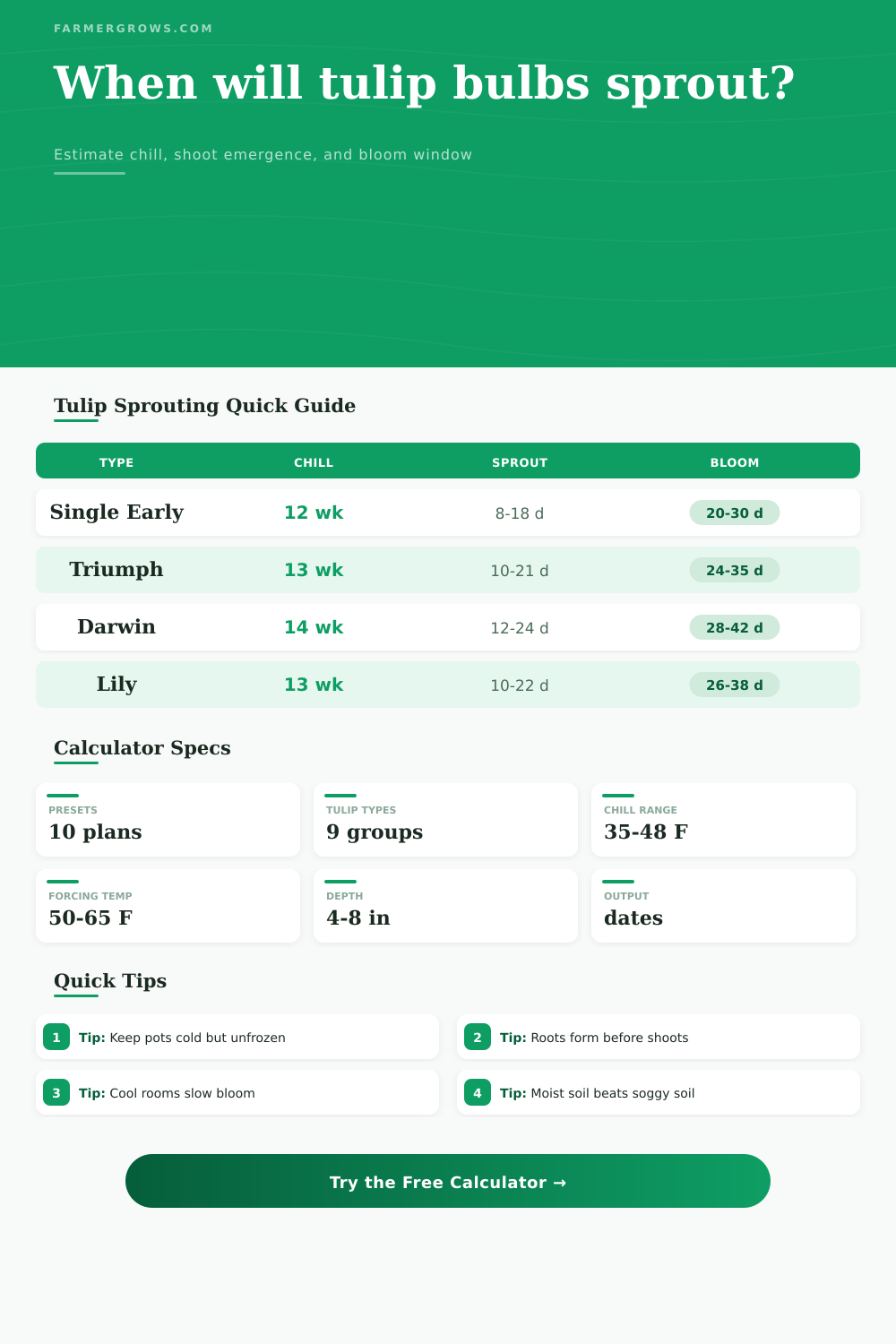
| Single Early | 12 weeks | 8 to 18 days | 20 to 30 days |
| Triumph | 13 weeks | 10 to 21 days | 24 to 35 days |
| Darwin Hybrid | 14 weeks | 12 to 24 days | 28 to 42 days |
| Fosteriana | 12.5 weeks | 8 to 18 days | 21 to 32 days |
| Lily-flowered | 13 weeks | 10 to 22 days | 26 to 38 days |
| Parrot | 14 weeks | 12 to 25 days | 30 to 44 days |
| Double Late | 14 weeks | 12 to 25 days | 32 to 46 days |
| Viridiflora | 13.5 weeks | 11 to 23 days | 28 to 42 days |
| Species tulip | 10 to 12 weeks | 7 to 16 days | 18 to 30 days |
| Temperature condition | Calculator treatment | Sprouting effect | Practical note |
|---|---|---|---|
| 35 to 48°F chill | Full chill credit | Builds readiness | Good refrigerator, cellar, cold frame, or winter soil range |
| 30 to 34°F chill | Partial chill credit | Slower readiness | Bulbs should not freeze solid in pots |
| 49 to 55°F chill | Partial chill credit | Longer schedule | Useful but less efficient than colder storage |
| 50 to 60°F forcing | Near ideal shoot pace | Balanced stems | Cool bright rooms give sturdier tulips |
| 65 to 70°F forcing | Fast but stretched | Earlier shoots | Blooms may be shorter lived indoors |
| Planting setup | Common depth | Timeline adjustment | Sprouting cue |
|---|---|---|---|
| Indoor forcing pot | About 4 inches | Neutral to slightly faster | Roots at drainage holes before top growth |
| Outdoor tulip bed | 6 to 8 inches | Moderate delay | Spring shoots emerge after soil warms |
| Sandy soil | 1 to 2 inches deeper | May warm faster | Needs moisture checks during dry falls |
| Clay-heavy soil | 1 to 2 inches shallower | Can delay in cold wet years | Avoid waterlogged planting pockets |
| Mulched bed | 2 to 3 inches mulch | Buffers temperature swings | Shoots may appear steadier, not necessarily earlier |
| Project scenario | Planting date | Likely first shoots | Likely bloom window |
|---|---|---|---|
| Triumph refrigerator pot | October 15 | Late January to early February | Mid to late February |
| Darwin outdoor Zone 5 bed | October 20 | March to April | April to May |
| Prechilled warm-zone bulbs | December 15 | Late December to January | January to February |
| Species tulip rock garden | October 1 | Late winter to early spring | Early spring |
| Double Late outdoor bed | November 1 | Spring after soil warming | Late spring |
Separate root growth from shoot emergence. Tulips can root during cold storage or winter soil while the green shoot stays hidden. A pot with visible white roots is often on schedule even before any top growth appears.
Use cool brightness after chilling. After the cold requirement is met, a cool bright location around 50 to 60°F usually gives sturdier stems and a better display than a hot windowsill.
When you plant tulip bulbs in october, forget about them until april, and a certain sort of panic sets in: You go out to the garden, thinking there will be color and all you see is grass. The ground looks innocent. Did I buy dead bulbs? You begin to wonder. Maybe the rodents got in. Maybe I need new soil.
Most times, it’s a matter of timing. Tulips isn’t lazy; they’re simply biding their time. They are waiting for the right signal. And knowing what that signal is makes the difference between having a garden that blooms when you want to see it… And one that blooms on its own clock.
How Tulips Need Cold to Grow
Once you know what kind of chill conditions your area has, and when you planted, plugging it into the above calculator does all the work for you. You don’t have to wonder if “mild” equals adequate cold storage to wake the bulbs up. This is the concept behind vernalization, which is what tulips need to grow. It means they need a long time in the cold with the right temperature. That’s not just a matter of having a day or two of chilly weather. It’s about having enough total cold hours in the bulb.
When the bulb reach a certain number of hours, it flips its biological on switch inside to signal the roots to get moving. If there wasn’t enough chill, the bulb stay dormant. Looks good? Yes. It might even be pushing out a few roots at the base already. But there is no sign of that green shoot. And it won’t emerge until it gets the chill it needs.
The calculator guides you if you got your chill or if you should pre-chill the bulbs yourself in the fridge. The number one thing that everyone screws up when they try refrigerator forcing is throwing the bulbs in a crisper drawer with some bananas, apples, etc. Produce emits ethylene gas. Ethylene will cause the tulip flowers to not open propery, and the stem will get all spindly. Separate those bulbs from the fruit.
Dampen some vermiculite or peat moss and wrap the bulbs in it. Tuck them in a plastic bag (with holes punched for ventilation) and store them in a cool location (between 35 and 48 degrees Fahrenheit). That’s important; too cold (below freezing) and the bulb tissue will rot, or even freeze. Too warm (above about 50ish) and you’ll have no “chill credit.”
That’s why there are temperature bands on the page above. The tool factors in these temperature bands and adjusts the predicted date of emergence to match (if your fridge temperature was ideal, or if it fluctuated enough to be considered the partial-credit zone).
Once chilled thoroughy, it moves from a resting state (dormant) to an active growing state. That’s touchy. And if you force a pre-chilled potted thing into a warm spot prematurely, the plant may race for the heavens with no roots to hold it down. Flop-flop-stem, and flop again when the flower heft takes over. No. Roots first, then green-nose.
Moisture in the soil matters greatly here. Rot loves soggy soil. Dry soil halts progress. Think of your goal as evenly moist. Like a wrung out sponge. It should not drip. It should not be dusty, either. Get that balance right and the whole cellular action will be humming along, not drowning the poor bulb.
Many gardeners don’t know that how deep bulbs are planted makes a difference. Bulbs planted deeper have added insulation from temperature changes. Six to eight inches deep is typical outdoors in the ground. It helps the bulb stay cool in spring, and shields it from any late frost. Shallower planting is okay in pots; four inches or so may be fine. Pots typically warms faster than the ground outside because warmer soil warms faster. The calculator will adjust for this based on depth.
Warmer = sooner; but sooner isn’t always better. Cool roots equal strong stems. Keeping things cooler till the shoot emerges clearly is key to longer-lasting blooms.
On the page, it lays out the difference among tulip groups in this handy-dandy reference table. Tulips from the earlier groups require fewer chill hours; those from the later ones, more. Some may require as many as fourteen weeks of cold; others maybe just a dozen from an early variety. You’re bound to be disappointed if you use the wrong variety for your forcing method or climate, as early varieties needs less chill and late varieties need more. Match the bulb to the time frame needed.
For example: Want things in flower by mid-February? Then you’ll want a variety that’s quick to respond to warming up once it has had its chill. Or if you plant outdoors in a bed, well…you have less control there. The schedule is set by what the ground temperature happens to be. The tool helps you predict that schedule. It provides a window for when shoots will emerge and bloom.
They say we fight nature in gardening. With bulbs, we cooperate with her. You give them light; you give them water; you give them cold. They do the rest. All that’s left for you is patience. A tulip doesn’t rush things. You can only prepare the environment so it will feel safe to grow. When you do that, though, the timing is right, the payoff is big. Those stems push up straight and true. Color is vivid. Shape of the flower holds. To get the numbers right is worth the effort.
The soil may look innocent. But under there, it’s all happening. You just have to trust the process. And now, because of some planning, you know exactly when to watch.