Tulip Bulb Planting Depth Calculator
Estimate tulip planting depth, total hole depth, bed capacity, spacing, and moisture risk from bulb size, tulip group, soil texture, drainage, hardiness zone, mulch, and bed shape.
Tulip depth is reported from finished soil surface to bulb base, with separate soil cover above the bulb top. Packet depths usually refer to the base depth.
| Tulip group or cultivar | Typical bulb size | Planting depth | Spacing |
|---|---|---|---|
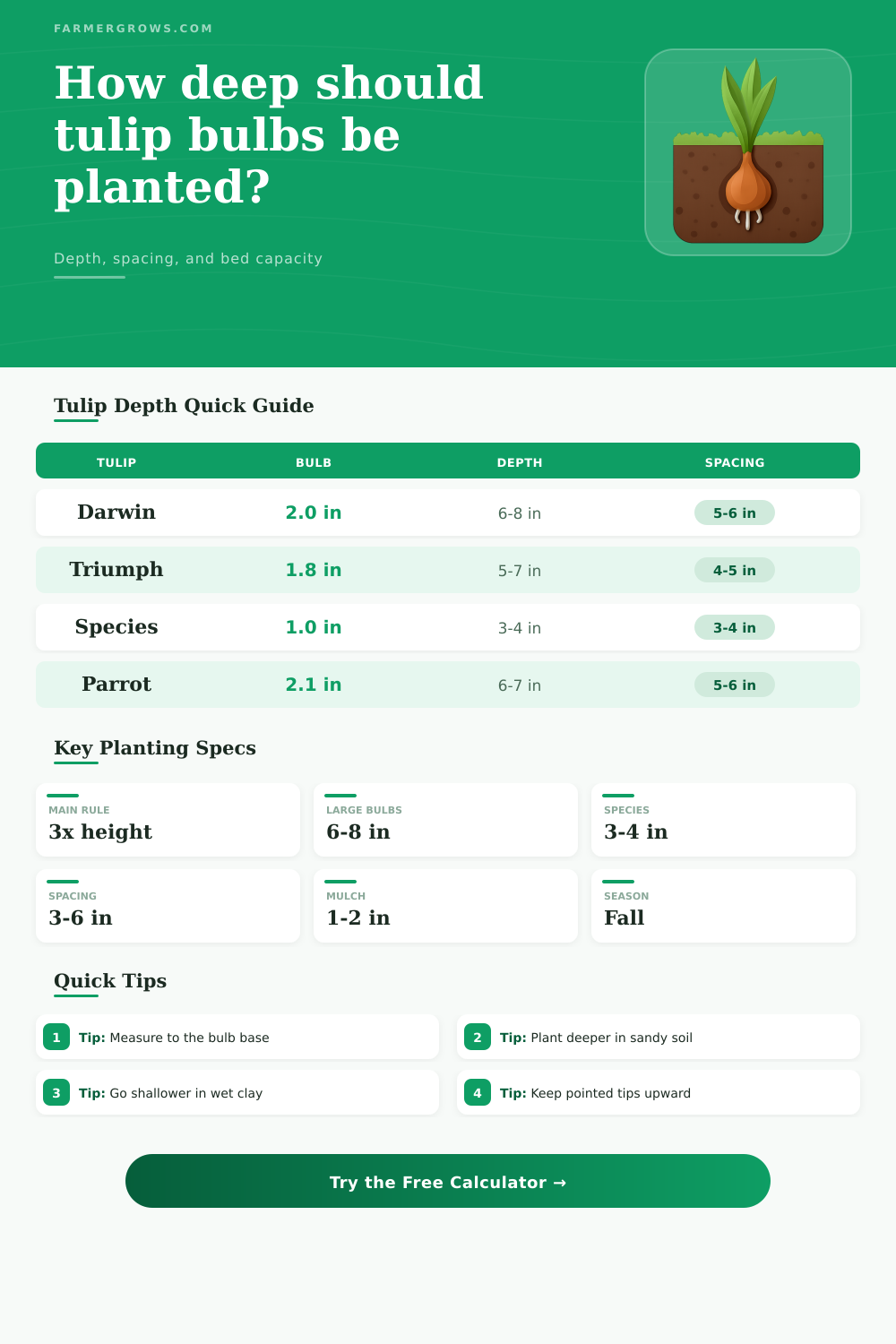
| Apeldoorn Darwin Hybrid | 2.0 in high / 5.1 cm | 6 to 8 in to bulb base | 5 to 6 in centers |
| Queen of Night Single Late | 1.9 in high / 4.8 cm | 6 to 7 in to bulb base | 5 to 6 in centers |
| Negrita Triumph | 1.8 in high / 4.6 cm | 5 to 7 in to bulb base | 4.5 to 5.5 in centers |
| Angelique Double Late | 1.8 in high / 4.6 cm | 5.5 to 7 in to bulb base | 5 to 6 in centers |
| Tulipa tarda Species | 1.0 in high / 2.5 cm | 3 to 4 in to bulb base | 3 to 4 in centers |
| Tulipa sylvestris Species | 1.1 in high / 2.8 cm | 3.5 to 4.5 in to bulb base | 4 to 5 in centers |
| Bulb height | 2.5x depth | 3x depth | 3.5x depth |
|---|---|---|---|
| 1.0 in / 2.5 cm | 2.5 in | 3.0 in | 3.5 in |
| 1.5 in / 3.8 cm | 3.8 in | 4.5 in | 5.3 in |
| 1.8 in / 4.6 cm | 4.5 in | 5.4 in | 6.3 in |
| 2.0 in / 5.1 cm | 5.0 in | 6.0 in | 7.0 in |
| 2.2 in / 5.6 cm | 5.5 in | 6.6 in | 7.7 in |
| Soil or site | Depth adjustment | Drainage note | Best tulip use |
|---|---|---|---|
| Loam or improved bed | No change | Balanced air and moisture | Most garden tulips |
| Sandy fast-draining soil | About 10% deeper | Depth buffers drying and cold swings | Darwin hybrids and perennializing |
| Heavy clay | About 10% shallower | Avoid deep wet cups around bulbs | Annual display beds |
| Container mix | About 15% shallower | Protect pots from freeze-thaw | Triumphs, doubles, and early tulips |
| Wet winter pocket | 1 in shallower or relocate | Raised planting is safer | Only short-term displays |
| Layout | Example area | Spacing | Likely count |
|---|---|---|---|
| Formal border strip | 48 sq ft | 5 in grid | 275 bulbs with buffer |
| Naturalized species patch | 24 sq ft | 3.5 in staggered | 320 small bulbs |
| Patio bowl | 5 sq ft | 3 in dense | 90 display bulbs |
| Perennial gap planting | 30 sq ft | 6 in loose | 85 bulbs with buffer |
Darwin hybrids
Large bulbs such as Apeldoorn usually suit 6 to 8 inch planting, especially where gardeners want stronger return bloom.
Triumph tulips
Medium display bulbs such as Negrita and Princess Irene fit dense borders and containers with moderate soil cover.
Species tulips
Small bulbs such as Tulipa tarda need shallower holes and tighter spacing for naturalized mats and sunny edges.
Wet clay sites
Tulips dislike wet winter pockets; use shallower planting, gritty backfill, or raised beds when drainage is marginal.
For instance, you don’t have to wonder if a bulb should go down four inches or six. Just enter the details about your bulb (what’s its size?) and those of your soil (is it coarse or fine-grained?), and the calculator tell you what depth to plant. The bulb need to remain cool as if still experiencing winter, but not so heavy that roots gets choked off. That’s why depth is important.
Now there are no separate rules to remember for each kind of flower, just one answer: Plug in your details, and this tool do the rest. Generally speaking: Plant bulbs 3 times their size deep from the bottom of their base (to protect the root system from premature thawing in late spring). If they is too deep, bulbs have trouble pushing up to get air through thick soil. If you plant them to shallow, temperature changes will fool the bulbs’ roots into waking up too early.
How to Plant Your Bulbs Correctly
Because soil types differ, the tool tweaks its default according to whether yours is sandy or not. Why? Sandy soil doesn’t retain much heat, but it does run off fast, so bulbs should of being planted a little deeper to protect them from temperature changes. Conversely, heavy clay holds moisture like a sponge… Which can lead to bulb rot prior to push. A gritty mulch layer or planting shallower help avoid anaerobic conditions.
Depth matter, but so does the spacing… Which affects how much air circulates among the foliage. With the garden getting humid with springtime rain, proper spacing help prevent fungal problems. Tulip species and Darwin hybrids is two popular types that will have their recommended spacings indicated on the reference table. Taller bulbs need more space horizontally, so they don’t end up with tangled stems.
Container planting has its own rules. Pots tend to freeze out quicker different than the ground and thaw sooner come spring. Adjust to match by planting slightly shallow, factoring in how the air surrounding the pot’s walls acts as insulation. It also simplifies bulb lifting in case any exhibit signs of distress from a damp winter.
How soon? Before the ground freezes solid, and keep in mind that colder zones might benefit from an extra inch of depth for insulation. Before the ground freezes solid, there is still time for roots to grow (though not in very cold zone). The calculator adjusts timing by taking into account your USDA hardiness zone, judging risk and suggesting tweaks. In a warmer zone, you’ll want to watch out for premature sprouting; in a colder one, an inch-deep additional layer of insulation might help.
Mulch does more than smother weeds and moderate soil temperatures, it poses its own challenges when it settles on the neck of the bulbs. Because it traps moisture, mulch promote rot. Remember to keep mulch off the tops of bulbs. Firm soil is good because it fills any gaps that would let the outer layer of bulb dry out, but it should be loose so the roots can grow downward.
Species tulips (the naturalizing ones) are really more like wildflowers; they want to be left alone and spread out as they please. Plant them in groups, not single bulb, and let them do their thing. The spacing inputs will allow you to imagine what a mass looks like vs. A row of them, and make an educated guess about how many bulbs to purchase. Fewer than the recommended number leaves gaps that look unfinished; more means you’re wasting money on overcrowding.
The tool also offers a buffer percentage for the fact that most bulbs come in bags with some dead or damaged ones… So your plan will be realistic to start. Working on tulips today pays off for months. By controlling what we can (depth, spacing), we take care of everything we can manage; then all we have to do is wait for time and weather. It’s a shift from not knowing to knowing; each bulb in its proper place for a reason, and no more guessing. It is simple math with real-world results.