Tulip Bulb Bloom Time Calculator
Estimate tulip bloom windows from chill weeks, tulip class, outdoor zone, planting depth, bulb size, forcing schedule, and pot cooling conditions.
Tulips need a cool rooting period before warm growth. This planner estimates timing for fall-planted beds, containers, and forced pots using class-specific chill targets and practical planting depth rules.
Tulip Bloom Estimate
The estimate combines class chill needs, bloom season, USDA zone, forcing mode, pot cooling, depth, spacing, and bulb count.
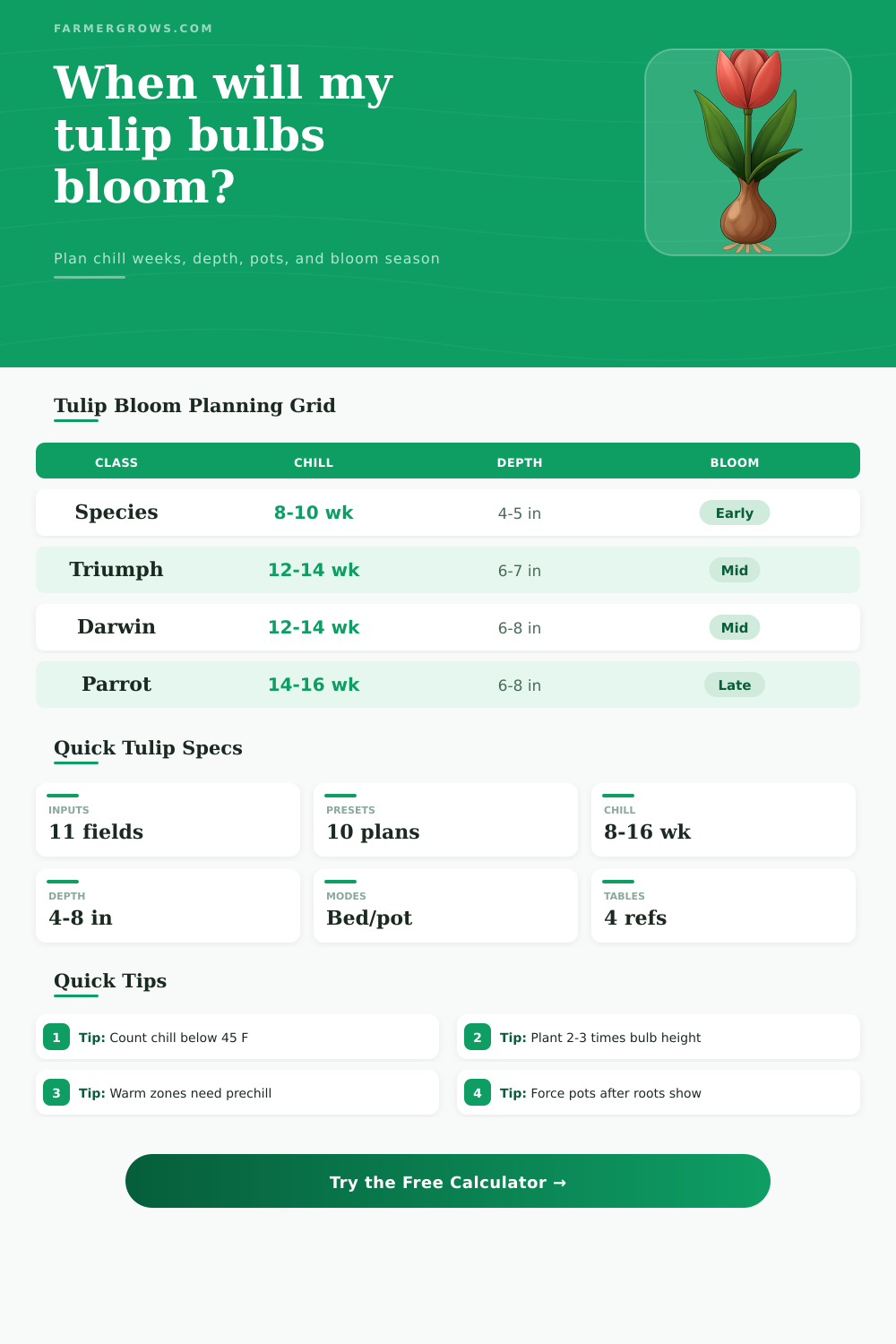
| Tulip group | Typical chill target | Base planting depth | Bloom season | Best use |
|---|---|---|---|---|
| Species or botanical | 8 to 10 weeks | 4 to 5 in | Early | Rock gardens, naturalizing, shallow beds |
| Kaufmanniana | 10 to 12 weeks | 5 to 6 in | Early | Very early color, short containers |
| Single early | 12 to 14 weeks | 6 to 7 in | Early | Forcing, front borders, compact pots |
| Triumph | 12 to 14 weeks | 6 to 7 in | Mid | Reliable beds, containers, cut stems |
| Darwin hybrid | 12 to 14 weeks | 6 to 8 in | Mid | Large flowers, perennial-style planting |
| Parrot, lily, fringed, late doubles | 14 to 16 weeks | 6 to 8 in | Late | Show beds, protected pots, late displays |
| USDA zone | Early bloom estimate | Mid bloom estimate | Late bloom estimate | Chill note |
|---|---|---|---|---|
| Zone 3 | Late April | Early May | Mid May | Long natural chill, plant before freeze |
| Zone 4 | Mid April | Late April | Early May | Strong natural chill in most falls |
| Zone 5 | Early April | Mid April | Late April to early May | Good outdoor tulip climate |
| Zone 6 | Late March to early April | Mid April | Late April | Plant after soil cools |
| Zone 7 | Mid to late March | Early April | Mid April | Chill can be marginal in warm winters |
| Zones 8 to 10 | February to March | March | March to early April | Use prechilled bulbs for reliable bloom |
| Forcing step | Temperature range | Typical duration | What to check | Calculator effect |
|---|---|---|---|---|
| Pot after planting | 35 to 45°F | 10 to 16 weeks | Moist mix, drainage, dark cool storage | Counts toward chill target |
| Root check | 35 to 45°F | At week 10+ | White roots at drain holes, shoots 1 to 2 in | Signals readiness to force |
| Cool bright forcing | 50 to 60°F | 3 to 4 weeks | Turn pots, keep evenly moist | Slower but sturdy stems |
| Warm room forcing | 62 to 68°F | 2 to 3 weeks | Watch for floppy stems and fast fading | Earlier but shorter bloom |
| Bulb size or planting style | Depth from bulb base | Spacing on center | Bulbs per sq ft | Planning note |
|---|---|---|---|---|
| Small species bulbs | 4 to 5 in | 3 to 4 in | 9 to 16 | Good for natural drifts and rock gardens |
| Standard landscape tulips | 6 to 7 in | 4 to 6 in | 4 to 9 | Balanced flower density and airflow |
| Large Darwin or late bulbs | 6 to 8 in | 5 to 7 in | 3 to 6 | Give large flowers room to open |
| Forced pot display | Bulb tips near mix surface | Nearly touching | Dense pot | Use drainage and cold root development |
| Warm zone annual display | 5 to 6 in | 4 to 5 in | 6 to 9 | Use prechilled bulbs and discard after bloom |
For outdoor beds: Plant after soil cools but before it freezes hard. In warm zones, buy prechilled bulbs or chill dry bulbs away from fruit.
For forced pots: Keep the pot cold and slightly moist until roots are visible, then move it to a cool bright room for sturdy stems.
If tulips won’t flower, they disappoint us in particular ways: We planted them in fall all hopeful that come March there’d be color, but instead there are just sad stems, or maybe no stems at all, and just some green leaves. If tulips don’t flower, it’s frustrating because we expect them to!
The good news is that it’s rarely our lack of gardening skill. Most often, its simply not understanding the concept of chill hours, which is where calculator comes into play. Once you tell it what variety of tulip (and your zone), it do the math for you. Turns out that a certain length of cool weather trigger their bloom.
Why Your Tulips Are Not Blooming
Bulbs get planted deep, why? The first reason is to prevent critters from eating them. Reason two: because deeper planting provide a cooler environment for bulb’s emerging roots, which are vulnerable to disruption by freeze/thaw cycles if they’re exposed higher up. In fact, the classic “rule” for planting depth is to bury bulbs twice as deep (or 2-3 times) than their own height. This keeps their roots in a relatively constant temperature zone and ensures that shoot has some stored-up energy once spring arrives to warm things up on top. Fine-tune that a bit based off whether you have sandy soil or clay (clay will be heavier then sand), but sticking roughly to that depth-to-height relationship will help you get uniform bloom in bed.
The second critical variable in bulb gardening is choosing the correct variety for your climate zone. For instance, Triumph tulips and Darwin hybrids is gorgeous. However, they require strict attention to a regimen of at least fourteen weeks of chill (below forty-five degrees). In warmer zones where the night-time temperatures don’t regularly dip down that low over time, those bulbs won’t be happy trying to flower here.
The species tulips and the Kaufmanniana sorts is more forgiving. They evolved in harsh conditions and require less total chill. They also tend to spread better then the exhibition hybrid kinds. This is another difference worth knowing as it spares you heartbreak (and dollars) before you buy any bulb.
TULIPS forced indoors need careful attention to timing: They have to be planted with patience, not just tossed into a container and expected to come alive by December. That’s because they develop their roots in cool, dark conditions while the shoots remain dormant; you want them to move right into the warm, bright world when white roots poke out of bottom of container (but not before or after), or else you’ll end up with nothing but a bunch of leaves and no buds. Use this handy chart as a starting point to figure out backward exactly when to plant for desired bloom day.
DO I chill my bulbs myself (and what about those of you who live in warm climates)? If you have a refrigerator that’s never used for food, you can chill them at home. For instance, fruit such as bananas and apples give off ethylene gas that damages the tulips’ flowers. Simply wrap the bulbs in damp moss (no touching!) in a plastic bag. To be safe, buy prechilled bulbs (it will cost more) from a reputable nursery; this is the option if your kitchen fridge holds leftovers. In an uncertain year, peace of mind should of come at a price.
Tulips are a great plant for growing (and then again), they’re not, unless you guide how they grow almost as much as you do the conditions of their growing place. Because each tulip is a biologic clock ticking away since it left the field in high summer, when it was cut from the ground and dried. If you time yourself to its inner clock, tulips reward you with vivid and firm flowers that seem to belong where they stand. The trick is getting the chill part right… And therefore the spring part too.
Follow these steps: