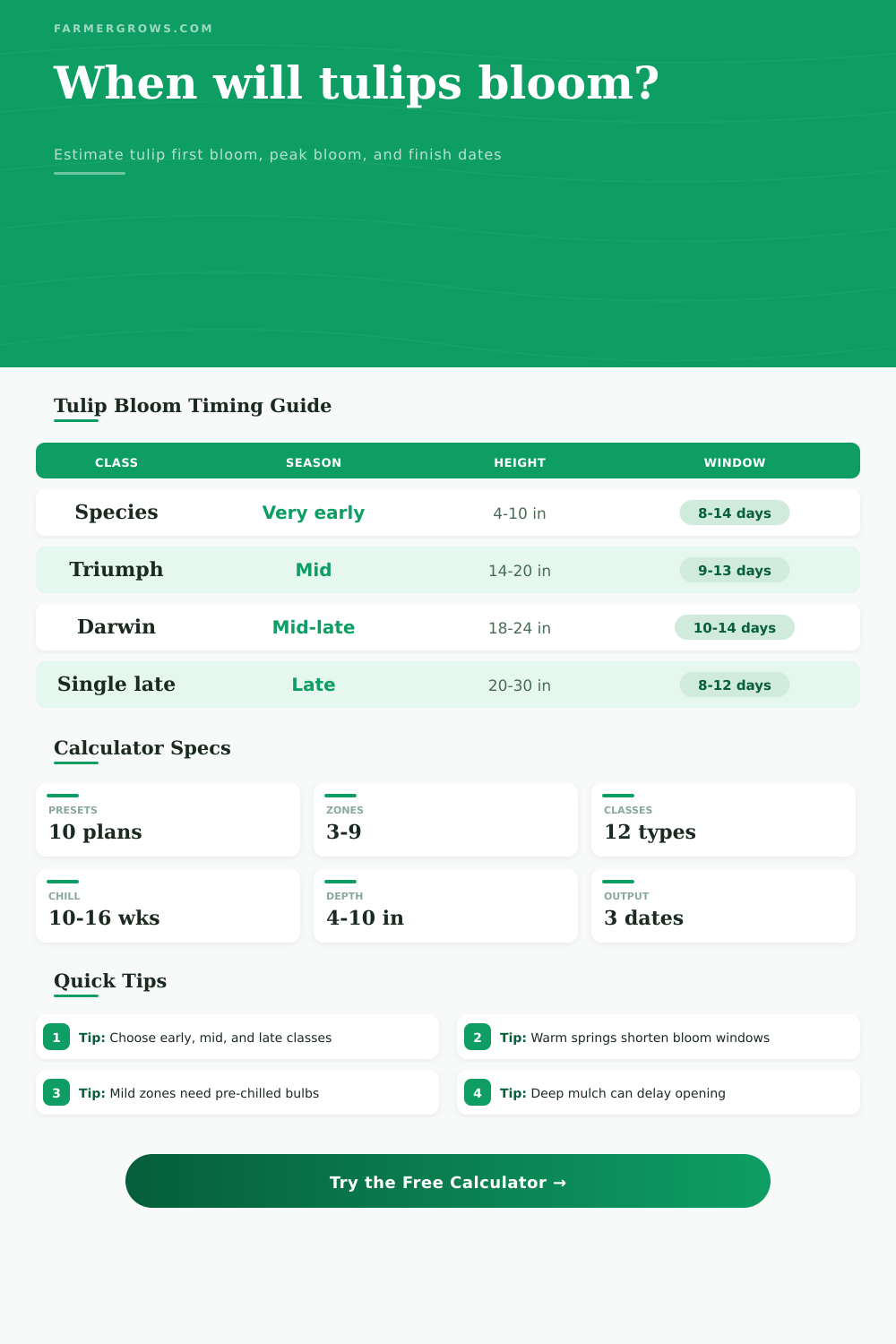
Tulip Bloom Time Calculator
Estimate when tulips will open, peak, and finish by USDA zone, tulip class, fall planting date, chill weeks, spring temperature pattern, exposure, depth, and bulb size.
Start with a common tulip planting situation, then tune the zone, class, chill, site exposure, and spring weather pattern for your garden.
Estimated Tulip Bloom Window
Your bloom estimate will appear after calculation.
Species, Kaufmanniana, Fosteriana, single early, and double early types open before the main mid-spring tulip show.
Triumph and Darwin hybrid tulips are the dependable middle of many beds and often bloom near classic peak spring.
Lily-flowered, fringed, parrot, viridiflora, and single late tulips stretch color toward late spring.
Hot, bright weather can move bloom earlier and shorten the open-flower period, especially in containers and warm walls.
| Tulip class | Season group | Calculator offset | Typical display use |
|---|---|---|---|
| Species and botanical tulips | Very early spring | 18 days earlier than Triumph | Rock gardens, lawn edges, naturalistic drifts |
| Kaufmanniana and Fosteriana | Early spring | 12 to 16 days earlier | Low beds, entrances, first spring color |
| Single early and double early | Early to mid spring | 8 to 10 days earlier | Patios, containers, short border fronts |
| Triumph tulips | Mid spring | Baseline timing | Mass bedding, cut stems, mixed bulb borders |
| Darwin hybrids | Mid to late spring | 4 days later | Tall beds, perennial-style displays, repeat color |
| Lily, fringed, viridiflora, parrot | Late spring | 8 to 16 days later | Late color, specialty shapes, bouquet stems |
| Single late tulips | Late spring | 18 days later | Last tulip wave, tall back-of-border bloom |
| USDA zone | Baseline Triumph peak | Bloom character | Planning note |
|---|---|---|---|
| Zone 3 | May 20 | Short, late spring flush | Snow cover and soil thaw control the start more than calendar date. |
| Zone 4 | May 10 | Cool spring, durable flowers | Early classes may start in late April during warm years. |
| Zone 5 | April 28 | Main-season tulip climate | Mixed classes can run from mid April into mid May. |
| Zone 6 | April 18 | Classic mid-April display | Warm springs can compress the show quickly. |
| Zone 7 | April 8 | Early, fast spring bloom | Late classes help keep color from ending too soon. |
| Zone 8 | March 24 | Early with chill risk | Pre-chilled bulbs give more reliable flowering. |
| Zone 9 | March 10 | Very early, often forced | Use refrigerator chilling and treat many tulips as annuals. |
| Chill situation | Useful target | Bloom effect | Risk if short |
|---|---|---|---|
| Species and early botanical types | 10 to 12 weeks | Can bloom with slightly less chill | Short stems or uneven opening |
| Most garden tulips | 12 to 14 weeks | Reliable bud development and stem length | Delayed or reduced flowering |
| Late specialty tulips | 14 to 16 weeks | Best for tall stems and full flowers | Weak stems or blind bulbs |
| Warm-zone pre-chilling | 12 to 14 weeks | Substitutes for cold winter soil | Patchy bloom in zones 8 and 9 |
| Site factor | Earlier or later | Typical adjustment | Why it matters |
|---|---|---|---|
| South-facing wall or sheltered courtyard | Earlier | 3 to 6 days earlier | Soil warms faster and buds move quicker. |
| North-facing bed or afternoon shade | Later | 4 to 8 days later | Cooler soil slows emergence and opening. |
| Heavy mulch or deep planting | Later | 3 to 8 days later | Extra insulation delays soil warming. |
| Containers or raised planters | Earlier but variable | 2 to 5 days earlier | Small soil volumes warm and cool more quickly. |
Plant by bloom class, not color alone. For a long tulip season, combine a very early type, a dependable mid-season Triumph or Darwin hybrid, and a late lily-flowered, parrot, viridiflora, or single late tulip.
Protect the post-bloom foliage. After flowers fade, leave leaves in bright light until they yellow naturally. That recovery period helps bulbs rebuild energy for the next spring.
Why don’t the tulips show up when you think they should? What happened? You planted the bulbs in October, but now your neighbor’s plants has already opened, and there’s nothing but vacant soil where yours ought to be.
The thing about tulips (which don’t adhere to a set calendar) is that they don’t care about your time-management system. No matter what day you plan for them to show up, they will go their own way. But when exactly will that happen? How can you tell? Enter the bloom time calculator. Simply plug in your bulb class (the tool walks you through it) and your zone, and voila! No more guessing or advanced mathematics. A solid date range, not a vague guess. Emerge.
How to Predict When Tulips Will Bloom
That’s because it isn’t really the calendar that matters as much as the temperature of the soil. Most tulip varieties requires about twelve to sixteen weeks of cold storage to break dormancy propery. In milder climates, they may never recieve enough chilling hours. You can enter such information into the calculator based off bulbs that were already stored cold. That’s why tulips don’t fare well when planted in February without any pre-chilling. The calculator include that experience in its timing.
Know which tulips to choose (and when). Early-hybrids and species tulips gets going fast, and are finished long before peak time. Later ones such as Parrots is slower to open; by mixing them up, you stretch out the display. On the Tulips page of the calculator, you’ll see that each type is listed by how many days it blooms earlier or later than average variety. This helps with succession planting, where one group fades away about the time another come into its own.
The other factor is that springtime weather is unpredictable. Tulip bulbs may respond to a sudden warm spell in March, when they emerge prematurely and stretch their stems. That’s bad news, because it shortens their bloom time, and also because stretched-out stems is weaker. On the other hand, cold spells can postpone the buds.
This factor compensates for exposure: Because sun-warmed soil heats up faster on a south-facing wall than it does on a north-facing one, tulips will bloom later on the north side. Soil temperature is also influenced by mulch; thick straw insulation slows soil warming.
Timing depends on the other factors, too: how deep you plant your bulbs. Cool temperatures are good; they prolong a bulb’s life, both by protecting it from frost heave (if planted shallow) and by keeping it cool longer before forcing itself up and out to bloom (if planted deeper). But if you plant them shallow, you get an earlier show…but run the risk of rotting the bulbs in soggy ground. To time things right, you has to weigh their timing against how long they last. The calculator takes this into account, with depth affecting the projected date. An eight-inch-deep bulb will act differently then one at four inches.
Tulips naturaly have brief periods of beauty; the flower opens and drops its petals shortly after. Not all come back, even if you hope they will, particularly in less-than-ideal climates. What happens next is the point: the foliage. Leave the leaves intact till they fade to yellow, so the bulb can store up strength for another season. Removing the leaves too early starve the bulb. Even though the tool tells you when to clean up, wait for the leaves to yellow and wither on their own.
The dates help you plan, and planning lessens disappointments. Are your chill hours enough? Will the exposure push things too early or late? It’s a project in the garden that have things you can measure. Yes, you’ll check the soil and watch the weather. But now you’ve got a map of how it all works. When the time is right, the flowers will bloom. And knowing the rough date makes waiting easier.