Tree Growth Rate Calculator
Estimate annual DBH gain, height, basal area growth, and maturity timing from repeat trunk measurements, tree species group, site quality, water, canopy pressure, soil, and age.
Measure diameter at breast height at the same point each time, usually 4.5 ft above ground on the uphill side. The calculator blends your measured DBH gain with species and site expectations so young trees, stressed trees, and open-grown trees are not treated the same.
Growth Estimate
Measured and expected growth will appear here.
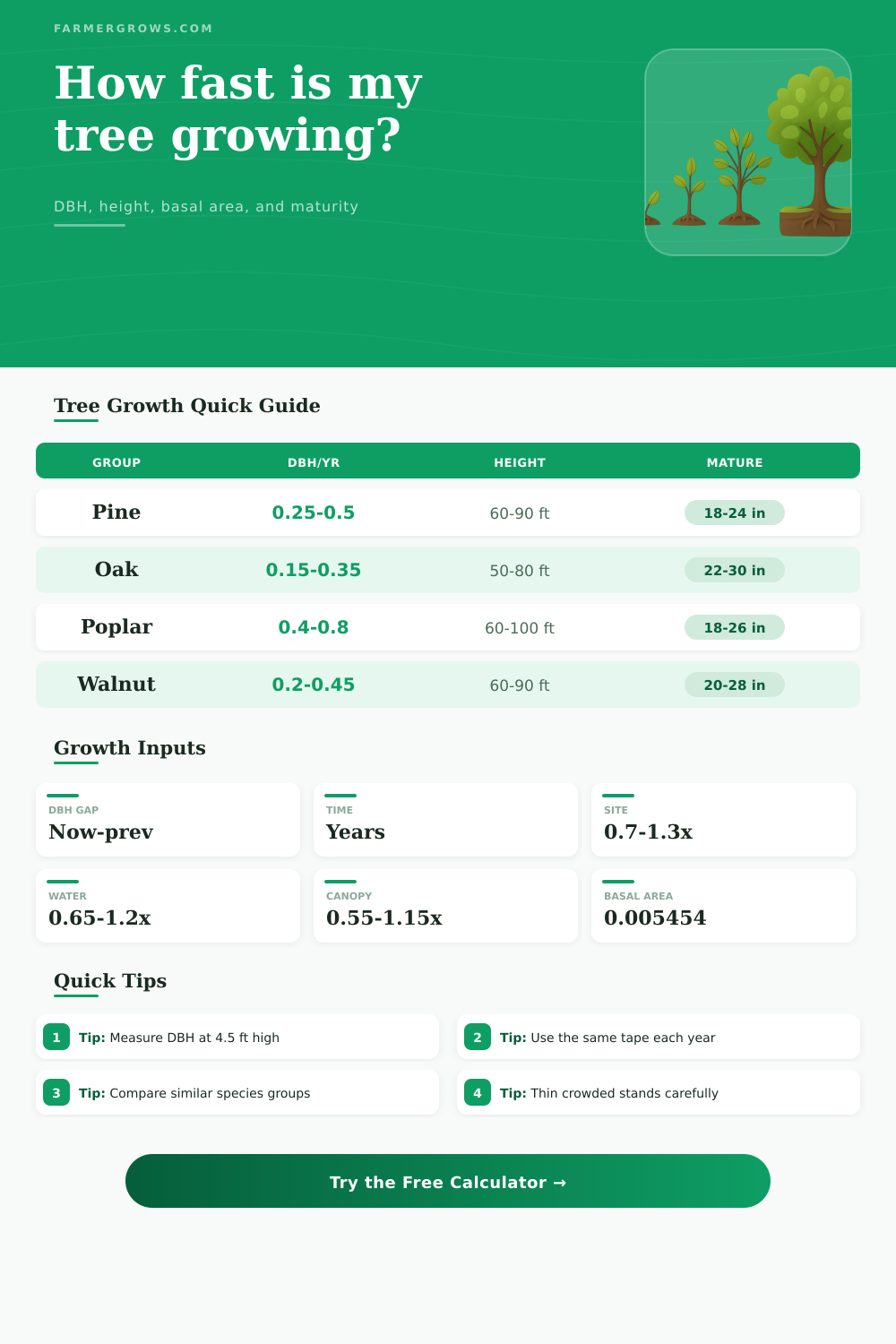
| Species growth rates | Typical DBH gain | Height pattern | Planning note |
|---|---|---|---|
| Oak and slow hardwoods | 0.15 to 0.35 in per year | Moderate height, strong diameter response after release | Long rotations reward crown management and patience |
| Maple, beech, birch | 0.12 to 0.32 in per year | Shade tolerant, steady height under canopy | Suppressed stems can resume growth after thinning |
| Pine plantation softwoods | 0.25 to 0.50 in per year | Fast height while young, then diameter fills in | Spacing and early competition control matter |
| Poplar, cottonwood, willow | 0.40 to 0.85 in per year | Rapid height and diameter on moist sites | Expect fast juvenile growth and shorter rotations |
| Walnut and quality hardwoods | 0.20 to 0.45 in per year | Moderate height, quality depends on clear stem | Use wide spacing only after pruning goals are met |
| Site classes | Growth factor | Field signs | Calculator use |
|---|---|---|---|
| Poor | 0.70x | Thin soil, exposed slope, drought stress, weak crowns | Use for rocky ridges, compacted urban soil, or shallow sites |
| Fair | 0.85x | Mixed stand vigor, some moisture or rooting limits | Good for average rough pasture edges and uneven woodlots |
| Average | 1.00x | Normal crown color, typical height for the species | Default when no major limitation is visible |
| Good | 1.15x | Deep rooting, strong leader growth, consistent moisture | Use for productive forest soils and managed shelterbelts |
| Excellent | 1.30x | Alluvial or fertile soil, vigorous crowns, high site index | Use when local trees clearly outperform regional averages |
| DBH-age ranges | Common DBH | Growth stage | Management note |
|---|---|---|---|
| 5 to 15 years | 1 to 6 in | Sapling to small pole | Diameter gain can be fast if weeds and shade are controlled |
| 15 to 35 years | 5 to 14 in | Pole to small sawtimber | Crown release often improves diameter growth |
| 35 to 70 years | 12 to 24 in | Sawtimber or mature orchard shade | Basal area gain may stay useful even as DBH slows |
| 70 to 120 years | 18 to 34 in | Mature to large legacy tree | Health, defects, and crown condition matter more than speed |
| 120 years or more | Variable | Old growth or senescent stage | Use projections cautiously; stability and habitat value dominate |
| Spacing effects | Typical condition | Growth effect | Field action |
|---|---|---|---|
| Open-grown | Wide crown, lawn, pasture, or orchard edge | More diameter, shorter clear stem, broader crown | Protect roots and keep mulch away from the trunk flare |
| Moderate competition | Crowns touch but still receive side light | Balanced height and diameter increment | Good default for many woodlots and shelterbelts |
| Crowded canopy | Narrow crowns, suppressed lower limbs | Diameter slows while height reaches for light | Consider crop-tree release or selective thinning |
| Suppressed understory | Small crown under taller trees | Very slow DBH, sometimes decades of stagnation | Do not project rapid growth without canopy release |
| Severe vines or brush | Stem wrapped, crown shaded, poor airflow | High stress and poor diameter response | Remove competing vegetation gradually and safely |
For repeat DBH checks: Mark the measurement height lightly, avoid measuring over swellings or wounds, and record the date so annual gain is based on actual elapsed years.
For woodlot decisions: Compare growth with crown position before thinning. A slow but healthy crop tree may respond well once nearby competitors are released.
Tree growth can be difficult to observe in some case, but tree growth often happens in ways that are not immediately visible. In some cases, a tree may have a healthy appearance, but it isnt adding much to the diameter of the trunk. Other trees may be adding more wood to the tree if they are growing in better soil.
The conditions of the environment in which the tree is growing will determine both how fast or slow the tree will grow. Foresters and those who owns land with trees use the measurement of diameter at breast height to measure the growth of trees. To measure the diameter at breast height of a tree, mark a spot on the tree four and a half feet up from the uphill side of the tree.
Measuring and Predicting Tree Growth
By comparing the measurement of diameter at breast height of the same tree taken over many years, you can calculate the growth rate of the tree. This measurement is used to determine how long the tree will take to reach a specific size, as well as to help understanding if that tree is competing with others in that area. Without the measurement of diameter at breast height, it is not possible to determine the growth of the tree with accurately.
The calculator finds the projection for the growth of a tree through the repeat measurements of that tree. The calculator will start with the actual change in the diameter of that tree and will blend that with the expected growth rate for the species of the tree. This blending of these two variables are necessary because the change in the diameter of the tree based on a wet year, for example, may be inaccurate.
Additionally, the species of the tree has its own expected growth rate. These factor that may affect the expected growth rate of a tree include the quality of the site where the tree is growing, the availability of water, the competition between other trees in the area, and the class of soil in which the tree is growing. For instance, if the site where the tree is growing is of poor quality with shallow or compacted soil, the growth rate will decrease.
If the soil is of good quality with deep layers and moisture availability, the growth rate will increase. Competition between trees can impact the growth rate of a tree. For instance, if the crown of a tree is relatively crowded with other trees, the tree will grow in height rather than diameter.
An open-grown tree will grow in diameter more fast but will have a wider crown and shorter clear trunk of its trees. A competition between trees can be set in the calculator to reflect the space in which the crown of the tree has. Age is another important factor in the growth of a tree.
Young trees will add to their diameter quickly. However, as they reach the middle age of the trees, and after they reach maturity, they will no longer add to the diameter of their trees at the same rate. An interesting fact is that, despite being of an old age, the trees may still be adding to their basal area.
Basal area is the square footage of the cross-section of the trunk of that tree. The total amount of basal area that is growing in a woodlot will help to determine the value of the trees in that woodlot. This calculator can show the basal area of each tree in the stand and the total basal area gain for that stand if the number of trees per acre are entered.
Height is another measurement that can be projected for the tree using this calculator. Trees of the same species will have similar rates of growth in height. However, species that naturally grow to tall heights will display a higher projection of height than those that are naturally short.
This projection of height will help to determine if the tree will reach a building of interest; however, as with all estimates from this calculator, this projection is only an estimate and not a guarantee. Factors that may influence the height of the tree include depth of soil, exposure to the wind, and any damage that the tree may have take. Many people who use this calculator may make the mistake of measuring the diameter of trees only once.
However, the growth rate of the trees will change over time. For instance, if the neighbor began to remove trees from their land, the shade that fell upon the individual’s tree may change. The amount of wet years that occurred in a decade may change the amount of growth rate of the tree.
Additionally, thinning the trees around the area where the crop tree is growing will increase the diameter of that crop tree. In these instances, individuals should use the calculator again to reflect the change in the stand of trees. Another mistake that may occur during the measurement of the diameter at breast height is if the diameter is measured over a wound in the tree or over a swelling.
In these instances, the diameter will appear to be a false measurement of the diameter at breast height of the tree. Additionally, if different tapes are used or if the diameter is not measured at the same height as other measurements, errors will be created in the calculation of the growth rate of that tree. It is important to record the date of each measurement of the diameter at breast height of the tree.
The calculator assumes that the years entered are correct, but inaccuracies in the date of the measurement will impact the accuracy of the calculations that are performed. Diameter growth and wood quality are not the same thing. If a tree is adding to its diameter quickly, it may be stressed, and the wood produced by that tree may have a lower strength.
If a tree is slowly increasing in diameter but utilizing even stems, the wood may have a higher quality. While this calculator does not determine the quality of the wood being produced by the tree, it will determine if the tree is adding any wood to the area at all. This information will help the individual to decide if they should prune the tree, release the tree from any constraints, or leave the tree alone.
Although many of the factors relate to trees of younger ages, there are differences in the needs of old trees compared with young trees. When old trees reach a certain diameter, the gain of that tree’s diameter becomes less important. It is the stability of these old trees and the habitat that they provide for other organisms that is important to consider when the age of a tree reaches maturity.
While the maturity projection can be helpful to those who wish to manage the trees, they should also be aware that the goal of an old tree may be different than that of a young tree. The value of calculating the growth rate and projecting the growth of trees can help individuals to make decisions about the trees in their care. Through calculating the growth of each tree, it is possible to determine which trees are responding to their environmental factors and which are not.
By comparing the rate at which the trees are growing to the benchmark for that species of tree and stand, it is possible to act. For instance, if the trees are growing at a much lower rate, it may be necessary to inspect its crowns and the competition between them, soil compaction, and soil moisture. If the trees are growing at a faster rate than the benchmark, it may be necessary to ensure that the two measurements of diameter were taken at the same height.
Through measuring and projecting the growth of the stand’s trees, it is possible to determine which trees are adding wood to the area and which have reached a growth plateau.