Rain Gauge Calculator
Turn a rain gauge depth or collected volume into rainfall depth, garden gallons, runoff-adjusted water, crop target balance, and practical irrigation equivalents.
Use one clean, level gauge placed away from roofs, trees, sprinklers, and splashback. This calculator estimates water received by the garden; soil moisture, wind, mulch, slope, and root depth still matter.
Rainfall and Garden Water Results
Results update after calculation.
| Rain depth | Millimeters | Garden meaning | Field note |
|---|---|---|---|
| 0.05 in | 1.3 mm | Trace wetting | Often evaporates quickly from bare soil. |
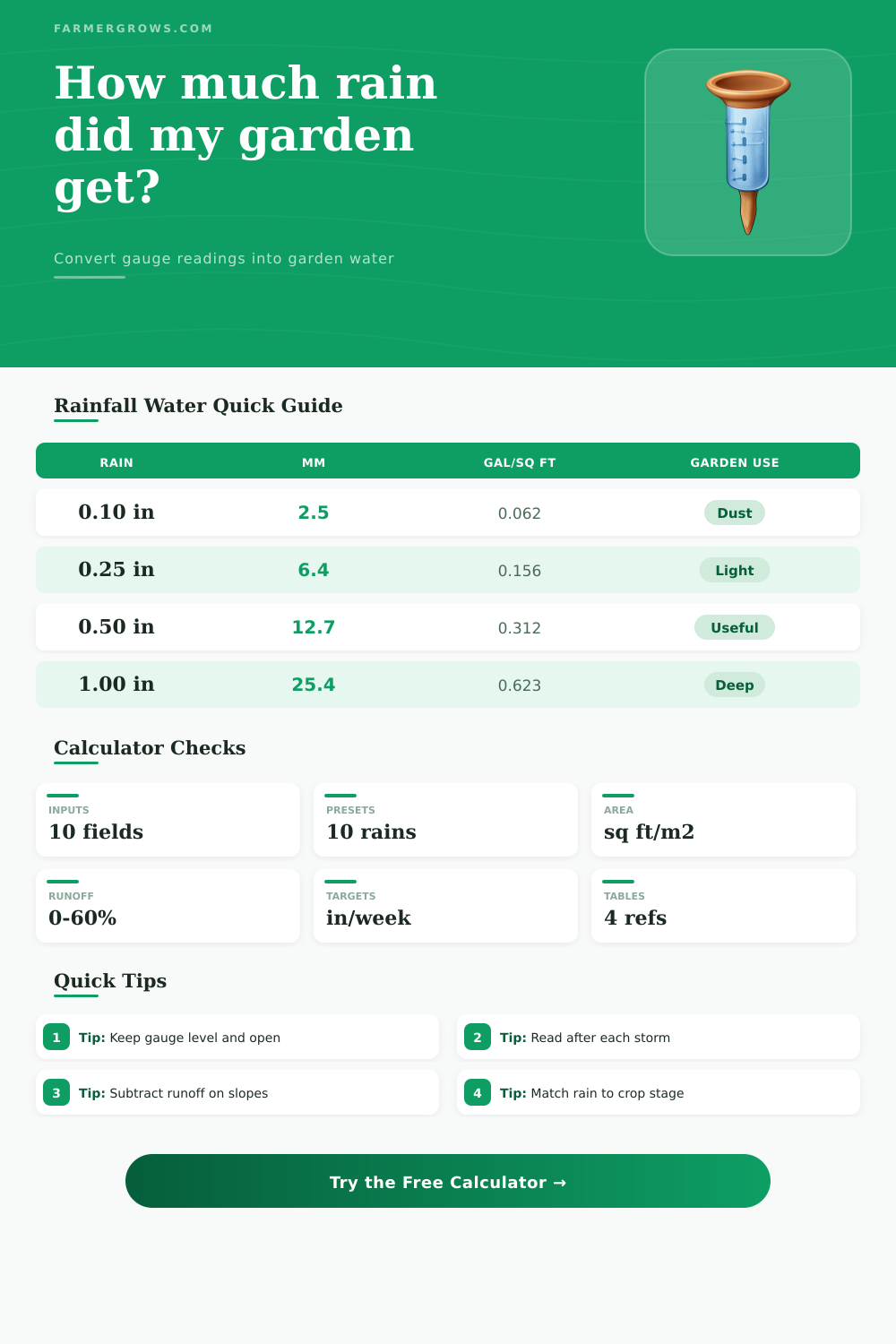
| 0.10 in | 2.5 mm | Dust-settling rain | Useful for seedlings only if soil was already moist. |
| 0.25 in | 6.4 mm | Light watering | May wet the top inch of loam or raised bed mix. |
| 0.50 in | 12.7 mm | Moderate rain | Often enough to delay irrigation for shallow-rooted crops. |
| 1.00 in | 25.4 mm | Deep garden rain | Common weekly target for many vegetables. |
| 2.00 in | 50.8 mm | Heavy storm | Check runoff, ponding, nutrient leaching, and erosion. |
| Rain depth | Gallons per sq ft | Gallons per 100 sq ft | Liters per sq meter |
|---|---|---|---|
| 0.10 in | 0.062 gal | 6.2 gal | 2.5 L |
| 0.25 in | 0.156 gal | 15.6 gal | 6.4 L |
| 0.50 in | 0.312 gal | 31.2 gal | 12.7 L |
| 0.75 in | 0.468 gal | 46.8 gal | 19.1 L |
| 1.00 in | 0.623 gal | 62.3 gal | 25.4 L |
| 1.50 in | 0.935 gal | 93.5 gal | 38.1 L |
| Crop or area | Typical target | High-demand stage | Rain gauge note |
|---|---|---|---|
| Leafy greens and herbs | 0.75 to 1.00 in/week | Hot weather, shallow roots | Small rains help, but soil can dry fast. |
| Tomatoes, peppers, eggplant | 1.00 to 1.50 in/week | Flowering and fruit sizing | Even moisture helps reduce stress swings. |
| Sweet corn and cucurbits | 1.25 to 2.00 in/week | Tasseling, silking, fruit fill | Track deficits after windy storms. |
| New lawn or seedbed | 0.75 to 1.25 in/week | Germination and establishment | Frequent shallow checks beat weekly totals. |
| Berries and young fruit trees | 1.00 to 2.00 in/week | Fruit swell and dry spells | Mulch can make a modest rain last longer. |
| Drought-tolerant herbs | 0.40 to 0.75 in/week | New transplants | Avoid treating every small gap as urgent. |
| Gauge opening diameter | Opening area | Volume for 0.10 in | Volume for 1.00 in |
|---|---|---|---|
| 2 in | 3.14 sq in | 0.17 fl oz / 5 ml | 1.74 fl oz / 52 ml |
| 3 in | 7.07 sq in | 0.39 fl oz / 12 ml | 3.92 fl oz / 116 ml |
| 4 in | 12.57 sq in | 0.70 fl oz / 21 ml | 6.96 fl oz / 206 ml |
| 5 in | 19.63 sq in | 1.09 fl oz / 32 ml | 10.88 fl oz / 322 ml |
| 6 in | 28.27 sq in | 1.57 fl oz / 46 ml | 15.66 fl oz / 463 ml |
| 8 in | 50.27 sq in | 2.79 fl oz / 82 ml | 27.85 fl oz / 824 ml |
Tip: Keep a second simple gauge in another part of the garden during storm season. Wind, trees, buildings, and slopes can make one reading look more precise than it really is.
Tip: Use the target gap as a planning number, then confirm by feeling soil at root depth. A mulched loam bed may hold a rain that bare sandy soil loses quickly.
A rain gauge doesn’t just give you a number; it tells you something much more useful. It shows how deep the rain was, but that doesn’t matter if the water never reach the roots. Did all of it run off down a hillside? Was total sufficient for the plants’ needs that week? A rain gauge will tell you this, but most gardeners don’t find out until after a large storm has passed and leaves them with dry beds two days later.
Those are the differences that the gauge doesn’t see, differences that make all the difference, like soil type (sandy beds drain quickly; loam holds moisture longer in the root zone). Slope and surface cover also matter; for example, a mulch-covered bed sheds fewer splashes different than exposed ground. Whether there is a gentle incline or a compacted path also matters, as these can send a surprising amount of water sideways before it soaks in. If it rains realy hard, clay take up moisture gradually and can even pond. So a single rainfall reading becomes multiple results based on where you put your gauge.
More Than Just Rain Numbers
The calculator comes in to play there. It factors in the raw depth and subtracts only the losses relevant to actual root-zone watering. Enter your target crops, garden area size, how much irrigation you have run, and an estimated runoff percentage. It then calculates total gallons and how much reaches roots based off your soil. It also indicate if it is still not enough for the plants’ needs that week. Tables on the page explains this relationship of the same numbers so you don’t have to run all the numbers yourself if you want to double-check a ballpark guess.
DON’T assume all your readings are created equal, even within the garden. A gauge exposed to the open sky will read far differently than one nestled beside a fence, where wind deflects the rain sideways. Foliage or a roof overhang makes dry pockets that a single gauge cannot shows. Put two gauges in separate location (and average the results) for a more accurate picture. And note: The duration of a downpour make a difference. Half an inch falling over four hours soaks in versus the same half-inch coming down in twenty minutes, when runoff rises quickly.
I also think people miss part of matching the week’s number not just to a single number each week, but to the crop stage. Shallow-rooted seedling like lots of light, moist inches-high water. More deeply rooted things, like corn in flower and fruiting tomatoes, will really grab when those are set. Some herbs can coast if there is tiny holes where shallower-rooted stuff would fail. The calculator will help with that by comparing what you got to the target you’ve dialed up. But the last check is always whether your fingers tell you the soil feels moist down deep, even though the inch on the surface was dry.
Maybe it’ll be okay? But where keeping track of rain helps most: It teaches you the pattern of your own garden’s response. Compare the number on the gauge with how each bed really responds over time, through a season, and gradually you come to know which storms make mealtimes longer between drinks. And which just wash away or dissapears. Which allows for the judicious use of water, not too little, not too much (and not too often), but enough.
The math is done by the calculator; it’s the act of observing what happens afterward when those numbers pop up on screen that transforms haphazard measurements into sound watering decisions. You should of used the calculator more often.