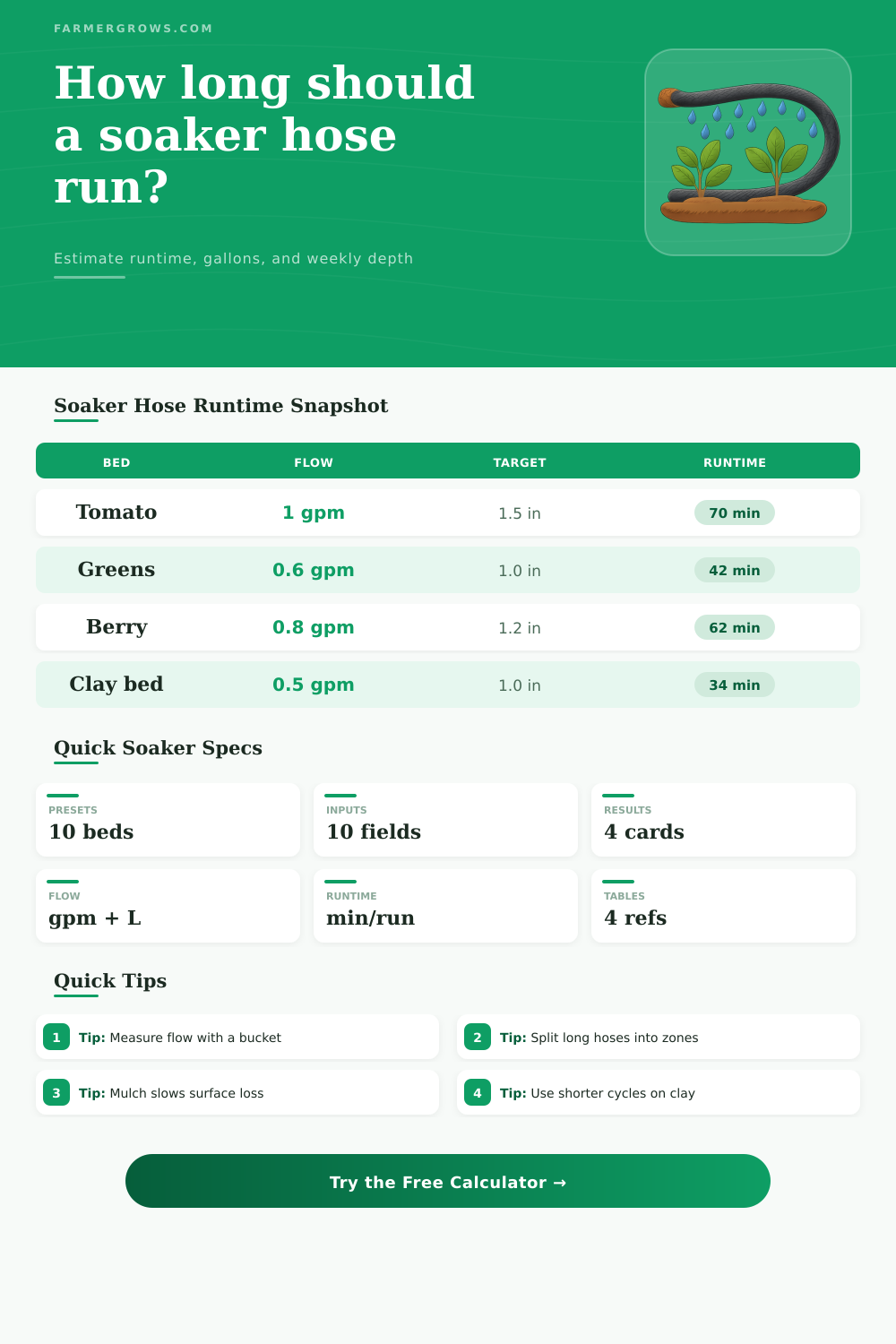
How Long to Run a Soaker Hose Calculator
Estimate soaker hose runtime per watering, weekly gallons, applied depth, and practical cycle length for vegetable beds, raised beds, berry rows, shrubs, and small crop blocks.
Pick a real garden setup to prefill hose length, flow, bed width, weekly water target, soil behavior, mulch, pressure, watering frequency, and weather. Then adjust the numbers to match your hose test.
Soaker Hose Runtime Results
Your watering schedule will appear here after the calculator runs.
Usually prefers fewer, longer runs that wet the full root zone without daily surface-only watering.
Lettuce, spinach, and baby greens often use shorter runs because feeder roots stay near the surface.
Strawberries and young berries benefit from steady moisture, mulch, and careful pressure regulation.
Woody plants often need longer, less frequent watering to pull moisture below the mulch layer.
| Measured flow | Gallons in 30 min | Best use | Pressure note |
|---|---|---|---|
| 0.25 gal/min | 7.5 gal | Containers, short herb strips, low-pressure systems | Long runtimes are normal; confirm the far end weeps evenly. |
| 0.50 gal/min | 15 gal | Raised beds, greens, narrow strips | Works well with regulated garden pressure and shorter zones. |
| 0.80 gal/min | 24 gal | Common 50 ft bed hose or two short loops | Check for puddling near the hose inlet before lengthening runtime. |
| 1.20 gal/min | 36 gal | Wide beds, multiple parallel hoses, sandy soil | High output may need splitting on clay or compacted soil. |
| Soil type | Typical intake behavior | Runtime approach | Cycle limit used |
|---|---|---|---|
| Sandy soil | Fast intake, lower storage, dries quickly | Run more often or increase weekly target in hot weather. | Up to 90 min before split check |
| Loam | Balanced intake and storage for most gardens | Use 1-3 deep waterings weekly for many vegetables. | Up to 75 min before split check |
| Silty soil | Moderate intake, can crust if bare | Mulch helps prevent surface sealing and uneven spread. | Up to 60 min before split check |
| Clay soil | Slow intake, high storage, puddles easily | Use shorter soak-and-pause cycles to avoid runoff. | Up to 35 min before split check |
| Raised bed mix | Usually fast draining with moderate storage | Watch edges; light mixes may dry faster than native soil. | Up to 70 min before split check |
| Compost-rich bed | Good storage when fully wetted | Longer intervals may work once the root zone is moist. | Up to 80 min before split check |
| Crop group | Planning target | Root-zone habit | Soaker schedule note |
|---|---|---|---|
| Leafy greens | 0.8-1.2 in/week | Shallow, steady moisture | Shorter, more frequent runs help prevent stress. |
| Tomatoes and peppers | 1.2-1.8 in/week | Medium to deep roots | Deep watering reduces blossom-end and wilting swings. |
| Root crops and onions | 0.9-1.4 in/week | Even moisture near root zone | Avoid long dry gaps during bulbing or sizing. |
| Berries | 1.0-1.5 in/week | Fibrous, near surface | Mulch plus steady drip-like soaking is useful. |
| Melons and squash | 1.3-2.0 in/week | Wide, vigorous roots | Water beyond the crown area as vines spread. |
| Shrubs and perennials | 0.7-1.3 in/week | Woody roots, wider spread | Longer slow soaks beat brief surface wetting. |
| Setup | Area watered | Flow and target | Estimated runtime |
|---|---|---|---|
| 4 ft by 12 ft tomato bed | 48 sq ft | 0.8 gal/min, 1.5 in/week, 2 events | About 28 min per watering |
| 3 ft by 8 ft greens bed | 24 sq ft | 0.5 gal/min, 1.0 in/week, 3 events | About 10 min per watering |
| 3 ft by 30 ft berry row | 90 sq ft | 0.75 gal/min, 1.2 in/week, 2 events | About 47 min per watering |
| 2 ft by 40 ft shrub strip | 80 sq ft | 0.6 gal/min, 1.0 in/week, 1 event | About 83 min per watering |
| 4 ft by 20 ft clay cabbage bed | 80 sq ft | 0.65 gal/min, 1.3 in/week, 2 events | About 42 min, split into cycles |
A soaker hose can change output a lot with pressure, hose age, slope, and valve position. Fill a bucket for 5 minutes, then divide gallons by minutes.
After the run, push a trowel into the bed. If only the surface is wet, lengthen runtime; if water puddles, split the run into soak-and-pause cycles.
Many gardeners find themselves either making puddles or not watering well; they’re under-watering. There’s an easy way to make sure that bed stay moist, without even using sprayers or sprinklers, like soaker hoses (a low-pressure option). How do I know when to turn it on, and for how long? It depends.
Many factors, like the plants you’re growing, the weather, and length of your hose, determine how many minutes you should of water. A tool exists to take away most of the guesswork by letting you enter your information: The first thing to consider is flow rate. They doesn’t put out consistent amounts of water across all settings, or even all way down. You can measure how much comes out in a minute or two by using bucket to get a usable number.
How to Water Your Garden Correctly
The calculator uses this number by multiplying it by your beds width and dividing it by your target inches per week. This gives you a runtime based off what your plants actualy need, rather than just an arbitrary schedule. You might think this is all straightforward, water when things are dry, stop when they’re not, but factors like soil type does matter (and you’d be surprised how easy it is to forget).
Sandy soils holds less water than others, so they needs more regular and shorter watering sessions. Clay soils take a while to absorbs water but then hold onto it for a long time. Because of this, a long watering session may result in runoff before the deeper roots ever gets enough water. The tool considers your soil type and adjusts the recommended runtimes to match. It even limits how many times per cycle it go through its process, allowing time for the water to soak in between rounds of shorter exposures.
Likewise, mulch and weather shifts matter. A bare surface will lose moisture at a higher rate on a hot day; or a windy one, and that’s exacerbated by a thick layer of organic cover, which both slows evaporation and retains more of the water it gets to deliver deeper into the soil. Those factors gets factored into the week’s target, with final minutes reflecting actual conditions (not textbook averages).
And finally: The numbers are understood based on what is growing there. Plants with shallow roots, such as greens, need regular surface watering; shrubs and tomatoes does better with deeper, less frequent watering to encourage them to grow deep roots. You can specify this in your crop selection. You tell it what kind of thing is planted there so it knows what root-zone habits to plan for instead of assuming all bed are alike.
On the page, there is also some reference tables that explain how various volumes of water affect different types of soil, and how measured flow converts to gallons in half an hour of run time. That’s good for knowing what adjustments you might want to make if you’re adding a pressure regulator, or considering splitting up a long hose into zones.
It makes it obvious, too, when something that seems like it should work out okay on paper doesn’t; so why isn’t the bed realy soaking up all that water? The calculator is a good beginning; what happens in practice will fine-tune result of that beginning. And you’ll know how much to adjust based on observation.
After your initial pass, check to see if ground an inch or two below feels moist; if it is moist, water for more minutes, but if it is dry, shorten the cycle. Those little tweaks, repeated over time, mean fewer wasted gallons and happier plants.