Container Soil Calculator
Estimate soil volume, drainage displacement, recipe parts, bag count, root-depth fit, and watered weight for deep patio pots, nursery tubs, barrels, and compact food containers.
Measure the inside dimensions where soil will sit. Tall containers often lose more usable mix to rim headspace, drainage layers, and settling than their outside size suggests.
Best when the inside diameter is consistent from bottom to rim, such as tubs, barrels, and many ceramic pots.
Uses top and bottom diameters, so tall black nursery containers are not overestimated by the rim width alone.
Good for storage-bin gardens, troughs with flat sides, and deep patio boxes that hold several compact crops.
Estimates elliptical footprint containers where length and width matter more than a single diameter.
Container soil estimate
Adjust the inputs to calculate deep container soil.
| Inside container | Usable depth | Approx soil | Typical use |
|---|---|---|---|
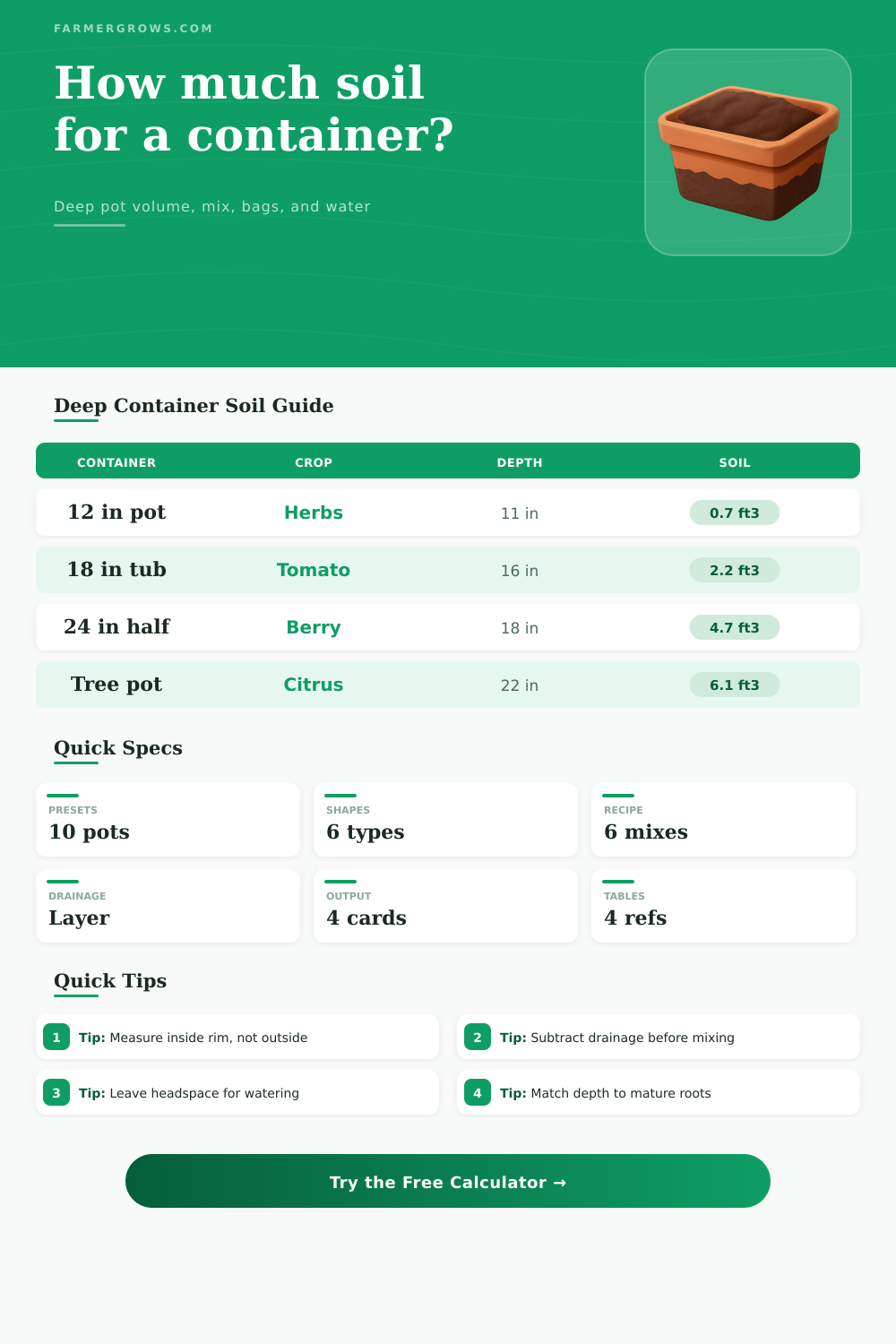
| 10 in round nursery pot | 9 to 10 in | 0.35 to 0.45 cu ft | Herbs, annuals, lettuce |
| 12 in deep round pot | 11 to 12 in | 0.65 to 0.85 cu ft | Herbs, greens, compact flowers |
| 18 in patio tub | 15 to 17 in | 1.9 to 2.4 cu ft | Tomato, pepper, blueberry |
| 24 in half barrel | 17 to 20 in | 4.4 to 5.5 cu ft | Berries, dwarf citrus, mixed herbs |
| 30 x 18 x 16 in tote | 14 to 15 in | 4.0 to 4.6 cu ft | Salad roots, greens, strawberries |
| Plant type | Minimum mix depth | Better depth | Container note |
|---|---|---|---|
| Herbs and shallow greens | 6 to 8 in | 10 to 12 in | Small pots work if watering is steady. |
| Leafy greens | 8 to 10 in | 12 in | Wide containers beat very narrow tall pots. |
| Peppers and eggplant | 12 in | 14 to 16 in | Deep tubs reduce summer dry-down. |
| Tomatoes | 14 to 16 in | 18 to 24 in | Use a heavy mix and sturdy container. |
| Carrots and root crops | 10 to 12 in | 14 to 18 in | Depth depends on variety length. |
| Citrus, olive, small tree | 18 in | 22 to 28 in | Long-term plants need drainage and weight. |
| Recipe | Base mix | Compost | Aeration and mineral |
|---|---|---|---|
| All-purpose container mix | 55% | 25% | 15% perlite plus 5% bark or mineral |
| Tomato and pepper blend | 50% | 30% | 15% perlite plus 5% mineral |
| Lightweight balcony mix | 60% | 15% | 20% perlite plus 5% bark |
| Fast-draining dry mix | 45% | 10% | 30% pumice plus 15% coarse sand |
| Berry and acid-lover mix | 50% | 20% | 20% pine bark plus 10% perlite |
| Long-term woody plant mix | 45% | 15% | 30% bark plus 10% mineral aggregate |
| Container situation | Starting water range | Check interval | Adjustment |
|---|---|---|---|
| Small herbs, 1 cu ft or less | 0.3 to 0.6 gal/week | Daily in heat | Water when top inch dries. |
| Peppers, 1 to 2 cu ft | 0.8 to 1.6 gal/week | Every 1 to 2 days | Increase during flowering and fruiting. |
| Tomatoes, 2 to 4 cu ft | 2 to 5 gal/week | Daily in hot wind | Mulch surface to smooth swings. |
| Berries and citrus, deep tubs | 1.5 to 4 gal/week | Every 2 to 3 days | Keep evenly moist, not saturated. |
| Self-watering container | Refill reservoir as needed | Reservoir check | Do not count reservoir as soil volume. |
Depth tip: For deep pots, judge usable root depth after subtracting drainage and rim headspace. A tall container filled only halfway behaves like a shallow pot.
Weight tip: Large watered containers get heavy fast. Confirm balcony, shelf, cart, and saucer capacity before filling multiple tubs in place.
When it comes to getting the volume of soil right in a container, it’s not just about how many cubic feet will fit into a pot. It’s also what can’t be seen, what that volume does to the soil once plants is planted (the headroom needed for watering; the space occupied by drainage material; the settling caused by rain). These things determine not only if there is enough room for roots, but also when you’ll need to run out and purchase one additional bag… Or three.
After you input your container’s dimensions and shape, the calculator do the math for you (subtracting the drainage layer automatically, taking into account the fill percentage you select). Then it includes its best guess about shopping overage and settling to give you a number that accounts for what you’ll actualy haul home. That’s important, since many pots are tall. But when you measure one by its rim alone, they might appear more roomy than they really is in terms of root-zone mix contained.
How to Calculate the Right Amount of Soil for Your Pots
The other thing: the tool breaks down the total into recipe parts, preventing any imbalance from use of approximate scoops that may wander over time. Little things count, too, like root depth. If there’s only an inch or two of soil left on top, shallow-rooters such as herbs can manages with eight or ten inches, but tomato plants and small trees needs closer to twenty to keep them happy and producing well for a full growing season. The calculator alerts you if the remaining depth after subtracting the drainage layer fall short. Then you won’t be surprised when your plants becomes puny. They will never reach their potential because they just could of catch up.
The watered weight is also displayed, which is important on decks or balconies where multiple heavy tubs could exceeds the surface’s weight limit. But there’s also more to texture: How much of a tomato mix contain compost? More will be heavier. This is good if planted in full sun, but not as good if you have to lift the pot. But how about a lightweight mix for my balcony that has lots of perlite? That’ll save on weight, but it’ll dry out sooner and perhaps require regular watering. The calculator keeps track of such variables, displaying not only each ingredient volume, but also an estimated weekly water range based off your plant type and exposure.
Most people gets this wrong when they first try. They either use too much soil, packing it all the way to the rim only to watch it sink below the water line, or they use too little, leaving enough room for the roots but creating a huge empty space above. This forces that choice out into the open before any mixing. It also avoids the trap many fall for of including the drainage layer as part of their growing medium, which shrink your effective root zone without anyone noticing.
Without having to do all that math, it provides instant answers for commonly sized containers (hence the reference tables up top of the page). Just compare what’s growing in those pots. For instance, what size tub makes sense for a row of herbs versus a tall pot like this? Or how about using a half barrel to grow some blueberries?
After that, it’s easy. Find a pot that will support weight of the wet contents. Double-check that your plants’ roots don’t exceed the recommended depth (use the root-depth chart for guidance). Purchase the number of bags the calculator recommends, and do not round down. Often that final additional bag is what makes the difference between getting by or not during the season.