Tractor Tire Diameter Calculator
Estimate nominal, loaded, and rolling diameter from tire size or measured outside diameter.
📌Preset tractor tire sizes
⚙Calculator inputs
📊Live diameter results
Nominal and loaded values update instantly as you change the inputs.
Detailed breakdown
📈Reference tables
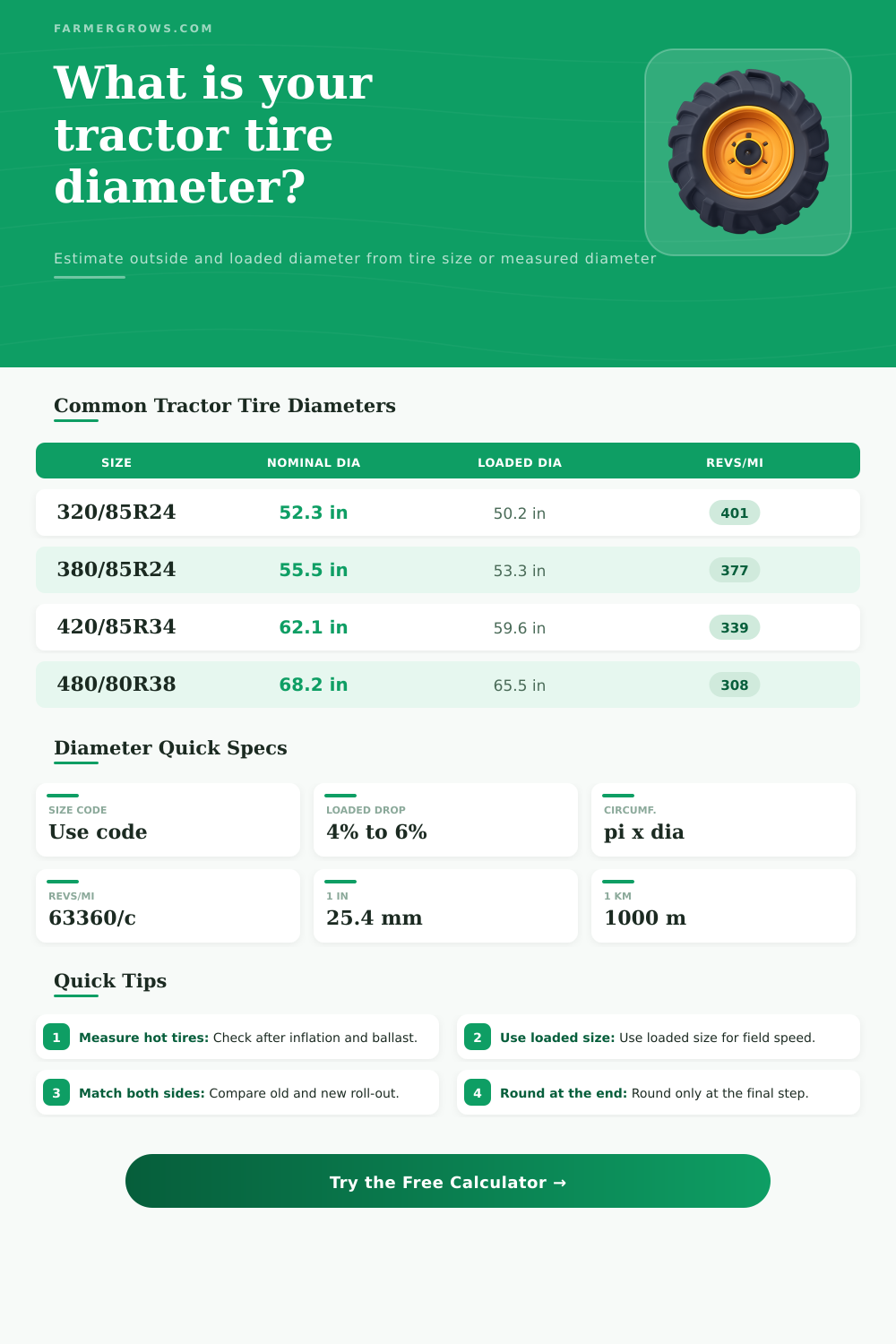
Common tractor tire sizes
| Size | Nominal diameter | Loaded diameter | Revs per mile |
|---|---|---|---|
| 320/85R24 | 52.3 in | 50.2 in | 401 |
| 380/85R24 | 55.5 in | 53.3 in | 377 |
| 420/85R34 | 62.1 in | 59.6 in | 339 |
| 480/80R38 | 68.2 in | 65.5 in | 308 |
| 520/85R42 | 76.8 in | 73.7 in | 274 |
| 540/65R28 | 55.6 in | 53.4 in | 377 |
| 600/70R30 | 63.1 in | 60.6 in | 332 |
| 710/70R42 | 81.1 in | 77.9 in | 259 |
Formula guide by input mode
| Mode | Inputs | Math | Best use |
|---|---|---|---|
| Metric size | Width, aspect, rim | D = rim + 2 x sidewall | Modern tire codes |
| Imperial size | Width, aspect, rim | D = rim + 2 x sidewall | Older tire codes |
| Direct measure | Measured OD | D = OD | Worn tires |
| Loaded check | D and deflection | D_loaded = D x (1 - deflection) | Field speed work |
Construction correction guide
| Type | Width shift | Deflection | Notes |
|---|---|---|---|
| Radial | 0.0% | 4.0% | Common field tire |
| Bias-ply | +0.8% | 6.0% | Stiffer sidewall |
| IF/VF | -0.5% | 3.0% | Flexes at low pressure |
| Flotation | +0.5% | 5.0% | Wide footprint shape |
Diameter to revolutions quick chart
| Diameter | Circumference | Revs per mile | Revs per km |
|---|---|---|---|
| 50 in | 157.1 in | 403 | 250 |
| 60 in | 188.5 in | 336 | 209 |
| 70 in | 219.9 in | 288 | 179 |
| 80 in | 251.3 in | 252 | 157 |
Tip 1
Check the loaded tire, not just the stamped size. Inflation, ballast, and field load all change the real rolling height, so the live value is what matters for speed and fit.
Tip 2
Compare a new tire to the old one before swapping. A small diameter mismatch can change travel speed, axle balance, and dual-tire match quality more than you expect.
This tractor tire diameter calculator converts tire size into outside diameter, loaded diameter, circumference, and revolutions per mile, helping you match replacements, speed, and field setup with confidence.
Tractor Tire Diameter is a Variable Measurement
The diameter of a tractors tires is a variable measurement since the tractor tire diameters changes when the tractor is under a load. A tractor tire’s diameter is not a fixed number. You must understand the diameter of a tractors tires correctly so that an incorrect diameter does not cause the tractor to make errors in the speed at which the tractor move and the movement of the tractors implement.
If tractor tires are not properly matched, the tractor will have errors in the calibration of the speed at which it perform tasks such as seeding or spraying the fields with fertilizers or pesticides. There is a difference between the nominal and loaded diameter of a tractor tire. The nominal diameter is the specification of the tire when it is not under any load and when the tractor tire manufacturer makes it.
Tractor Tire Diameter Changes With Load and Wear
This nominal diameter is calculated from the size of the tractor tire. The loaded diameter of a tractor tire is the actual diameter of the tractor tire when the tractor is under a load of ballast or hay. When the tractor tire is under a load, the tire may deflect.
The amount of deflection that radial tractor tires may experience is 4%. Because the loaded diameter is smaller than the nominal diameter of tractor tires, tractors will travel at a slower speed than the speed indicated on the tractors speedometer. The construction of tractor tires may impact both the loaded diameter of the tractor tire and the number of revolutions that the tractors tires may make in a mile.
Bias-ply tractor tires tend to have stiffer sidewalls then radial tractor tires. However, bias-ply tractor tires may deflect more than radial tires when under a load of ballast. Bias-ply tractor tires may deflect up to 6% under load.
The different loaded diameters that tractor tires may have will impact the number of revolutions that the tractor makes in a mile. The number of revolutions that a tractor makes in a mile will impact the spacing of a planter and the calibration of a sprayer setup on the tractor. Using tractor tires with an incorrect loaded diameter will lead to the rows of crops to be thinned or overcrowded by a specific percentage.
The diameter of tractor tires also changes with the wear of the tread. The tread of tractor tires may wear with use. New tractor tires will have a full height to there tread; however, tractor tires whose tread has worn down will have a reduced height of their tread.
The decrease of the height of the tread will lead to a decrease in the diameter of the tractor tire. A decrease in the diameter of tractor tires will increase the number of revolutions that the tractor may make in a mile. If tractor tires lose 5% of the height of their tread, a 62-inch tractor tire will lose nearly 3 inches of its diameter.
To account for this wear on tractor tires, it is important to measure the diameter of tractor tires when the tractor tires is hot. When tractor tires are hot, they have settled into their tires under load. When tractor tires are hot, they will display the correct loaded diameter of the tires.
The circumference of a tractor tire may be measured with a tape measure while the tractor is on flat ground. The circumference of a tractor tire divided by pi will show the diameter of that tractor tire. Tire types will exhibit different rates of deflection of tractor tires.
Flotation tires for tractor implement attachments may be wider in their dimensions than other tractor tires. These tires may deflect 5% of their diameter when under load to allow for even distribution of the tractors weight on soft ground. IF or VF high-flex tractor tires will deflect less than other tractor tires to allow for the tractor to run at lower air pressures in the tractors tires.
These changes to the diameter of the tractors tires will impact the height of the tractors axle and the three-point hitch that attaches to the tractor implement. When attaching implements to a tractor, it is essential to ensure that the diameter of the rear axles tires are the same size. If the dual tractor tires on a single axle have a different diameter, the inside tire will spin faster than the outside tire.
If one of the tractors tires spins faster than the other, the tire will prematurely wear down. Additionally, the tractor will pull to one side of the tractor when traveling. The size of the front tractor tires should also be considered in relation to the size of the rear tractor tires.
If the size of the rear tractor tires is increased, the speedometer of the tractor will read an incorrect speed of the tractor. The circumference of the tractor tires will have changed because of the increased size of the tires. The diameter of tractor tires changes due to several factors.
For example, the amount of ballast that a tractor has will change the diameter of the tractors tires. Tractor tires that are filled with fluid will sit lower on the ground than tractor tires that are only filled with air. The ground over which the tractor travels may impact the diameter of the tractors tire.
For example, rocky ground will cause less deflection of the tractor tires than muddy ground. The temperature of the tractor tires may change the diameter of the tractors tires. Cold rubber tires will be slightly smaller in diameter than warm tractor tires.
These factors that impact the diameter of tractor tires can be accounted for with the use of tire presets on the tractor or by measuring the diameter of the tractor tires directly. Some of the most common mistakes made by tractor operators include ignoring the drop in the loaded diameter of tractor tires when under load and assuming that all tractor tires of the same type have the same diameter. By ignoring the drop in loaded diameter, tractor implement operators may find themselves underspeeding their implements that may damage the belts on there tractor implement.
Another common mistake is to not check the loaded diameter of both sides of an axle. The axle on one side of the tractor may travel farther than the other side of the tractors axle over time which will lead to the frame of the tractor to get twisted. Additionally, the diameter of tractor tires may need to be adjusted with the construction of the tractor tires.
Both tires on an axle must match within one inch of each other in diameter. Field calibration of tractor implement setups should be performed from time to time to ensure that the implements are accurate in the measurements that they make. Tractor implements should be calibrated to the revolutions per mile that the tractor will make with its tires when loaded.
The implements should then be tested over a distance of 100 feet. These measurements should be taken again after 50 hours of use of the tractor. The loaded diameter of tractor tires will change over time as the tractor tires wear down.
Maintaining an understanding of the loaded diameter of tractor tires will allow for the tractor to run true during each pass it makes over the fields it manages.