🌱 Greenhouse Evaporative Cooling Calculator
Estimate greenhouse evaporative cooling airflow, pad area, fan count, and supply-air temperature from wet-bulb depression and heat load.
Pick a real greenhouse layout to seed the fields. Each preset loads dimensions, climate data, target temperature, pad media, fan delivery, pad efficiency, face velocity, and internal load.
Greenhouse Evaporative Cooling Output
Evaporative cooling summary will appear here.
| Pad media | Efficiency | Face velocity | Notes |
|---|---|---|---|
| Aspen fiber | 70-80% | 250-300 fpm | Low resistance |
| Cellulose 4 in | 80-85% | 275-325 fpm | Common choice |
| Cellulose 6 in | 85-90% | 225-300 fpm | More cooling |
| Synthetic pad | 70-80% | 300-375 fpm | Fast wetting |
| Wet-bulb dep. | 70% pad | 80% pad | 85% pad |
|---|---|---|---|
| 5 F dep. | 3.5 F | 4.0 F | 4.3 F |
| 10 F dep. | 7.0 F | 8.0 F | 8.5 F |
| 15 F dep. | 10.5 F | 12.0 F | 12.8 F |
| 20 F dep. | 14.0 F | 16.0 F | 17.0 F |
| Pad type | Flow rate | Reservoir | Note |
|---|---|---|---|
| Aspen | 0.33-0.50 gpm/ft | 0.5 gal/ft2 | Light load |
| Cellulose 4 | 0.50 gpm/ft | 0.8 gal/ft2 | Common rate |
| Cellulose 6 | 0.75-0.80 | 1.0 gal/ft2 | Deep pad |
| High-eff | 0.50-0.75 | 0.9 gal/ft2 | Vendor check |
| House | Floor area | Airflow | Pad area |
|---|---|---|---|
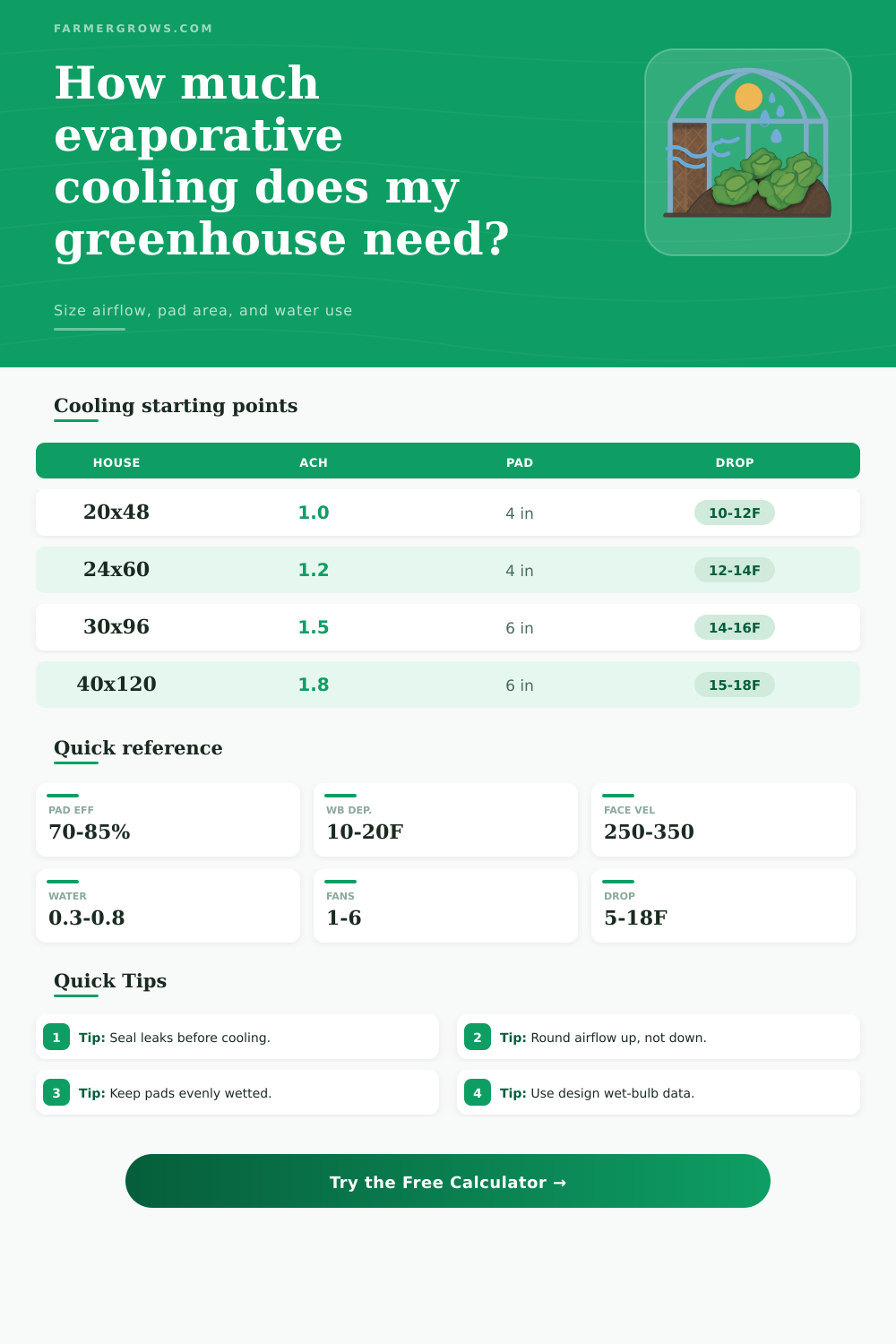
| 20 x 48 | 960 ft2 | 7-8 cfm/ft2 | 55-60 ft2 |
| 24 x 60 | 1440 ft2 | 8 cfm/ft2 | 80-85 ft2 |
| 30 x 96 | 2880 ft2 | 8-9 cfm/ft2 | 160-175 ft2 |
| 40 x 120 | 4800 ft2 | 8-10 cfm/ft2 | 270-345 ft2 |
Evaporative cooling are one method that can be used to lower the greenhouse temperatures. Evaporative cooling relies on the relationship between air velocity, water surface area, and humidity. Many greenhouse growers adds fans or cooling pads without a specific plan to the structures.
However, adding fans or cooling pads without a specific plan to the greenhouse often create inefficiently cooling within the greenhouse. Cooling pads are not a guessing game as the laws of physics govern the process. One of the main physics concepts that relates to evaporative cooling systems within greenhouses is the concept of wet-bulb temperature.
How Evaporative Cooling Works in a Greenhouse
The wet-bulb temperature represent the lowest temperature that the air can be cooled through the process of evaporation. A standard thermometer is used to measure the dry-bulb temperature, but the wet-bulb temperature represents the temperature that determines the cooling potential of the air. The difference between the dry-bulb temperature and the wet-bulb temperature is referred to as wet-bulb depression.
Air with a large depression will allow cooling pads to effectly move water into the air. However, air with a small depression will make it difficult for the cooling pads to move water into the air. Since it is impossible to change the humidity of the air outside of the greenhouse, the cooling pads must be sized according to the humidity level of the location where the greenhouse is established.
Another important decision that must be made in the installation of cooling pads is the choice of cooling media. The cooling media may be cellulose pads, which are commonly used due to the fact that they balance cooling power with airflow, or aspen fiber pads, which has lower resistance to airflow. Additionally, the thickness of the cooling media is another important decision.
A thicker cooling media will provide more surface area for evaporation to take place. Thicker pads will provide a larger drop in temperature of the air moving through the greenhouse structure, but will create more static pressure within the fans that move the air through the cooling media. Thus, if the fans does not have enough strength to push air through the thick pad of cooling media, the fans will move less air than if they were pushing air through a thinner pad.
Airflow is one of the measurements of the efficiency of the cooling pads. Airflow is measured in cubic feet per minute (CFM). The CFM for a cooling pad system can be calculated based off two different requirements.
One requirement is the number of air changes per hour that is required within the greenhouse. The other requirement is the amount of heat that must be removed from the greenhouse due to solar heat and heat released by the plants within the greenhouse. It is important to consider both requirements because focusing only on air changes per hour may make it easy for a grower to ignore the heat load of the greenhouse.
Both requirements must be considered when calculating the required CFM. The CFM of airflow will impact the face velocity of airflow through the cooling media. Face velocity is the speed at which air moves through the cooling media.
Air velocity can not be too fast or too slow. If the velocity is too fast, air will move too quickly past the cooling media so that it will not cool enough. If the velocity is too slow, the size of the cooling media will have to be increased to allow air to move through at a slower rate and allow it to cool.
Growers often use a calculator to determine the number of square feet of cooling media that will be required based on the CFM of airflow that is required in the greenhouse. Another error in the installation of evaporative cooling systems is that of bypass air. Bypass air is air that enters the greenhouse without passing through the cooling media.
Bypass air does not cool within the greenhouse structure, yet it still raises the internal temperature of the greenhouse. Therefore, ensuring that the greenhouse is sealed to prevent the entrance of bypass air is more effective than buying a fan that is too strong for the greenhouse structure. One of the necessary components of an evaporative cooling system is the management of water.
Water must be continuously supplied to the cooling media so that evaporation can occur. The recirculation rate of water to the cooling media must be sufficient to ensure that the cooling media is always saturated with water. If water is not supplied to the cooling media at an appropriate rate, dry streaks will form within the cooling media.
Additionally, the size of the water reservoir must be able to handle the evaporation of water from the cooling media, especially during periods of high heat within the greenhouse. If the water reservoir is too small to supply the amount of water that is needed for the cooling media to remain saturated, the water pump will not be able to supply enough water for effective cooling. Finally, the grower must monitor the supply air temperature to ensure that the cooling system is working correctly.
If the temperature of the air that is supplied to the greenhouse is higher than the target temperature that is to be established within the greenhouse, then the grower has reached the physical limit of evaporative cooling for that specific climate. If the physical limit of evaporative cooling is reached, the use of shade cloths to cover the greenhouse may be needed to reduce the amount of heat that enters the greenhouse. Thus, reducing the amount of heat that enters the greenhouse will make it easier to remove the heat that is already within the greenhouse.