Radish Seed Germination Time Calculator
Estimate when radish seedlings should break the soil, when to thin, how many plants to expect, and the earliest harvest check date from seedbed conditions.
This calculator is for radish seed emergence and early stand planning. It separates quick spring radishes, slower winter radishes, seed age, soil temperature, sowing depth, moisture, and row spacing so it does not behave like a general radish growth calculator.
📋Radish Germination Presets
🌱Variety, Season, and Soil Comparison
Cherry Belle, Sparkler, Easter Egg, and French Breakfast usually emerge quickly in cool, loose beds and reach usable roots sooner than winter types.
Spring and fall soil is naturally friendly. Hot midsummer soil can slow or patch emergence, while very cold soil stretches the sprout window.
Radish seeds are small enough that crusting clay, deep sowing, or dry topsoil can matter more than variety choice during the first week.
📏Seed and Bed Inputs
Radish Germination Estimate
Dates are planning windows for emergence, thinning, and first harvest check. Weather swings can move actual seedlings earlier or later.
🌡Radish Emergence Factor Grid
📚Reference Tables
| Average soil temperature | Likely radish emergence | Germination behavior | Bed adjustment |
|---|---|---|---|
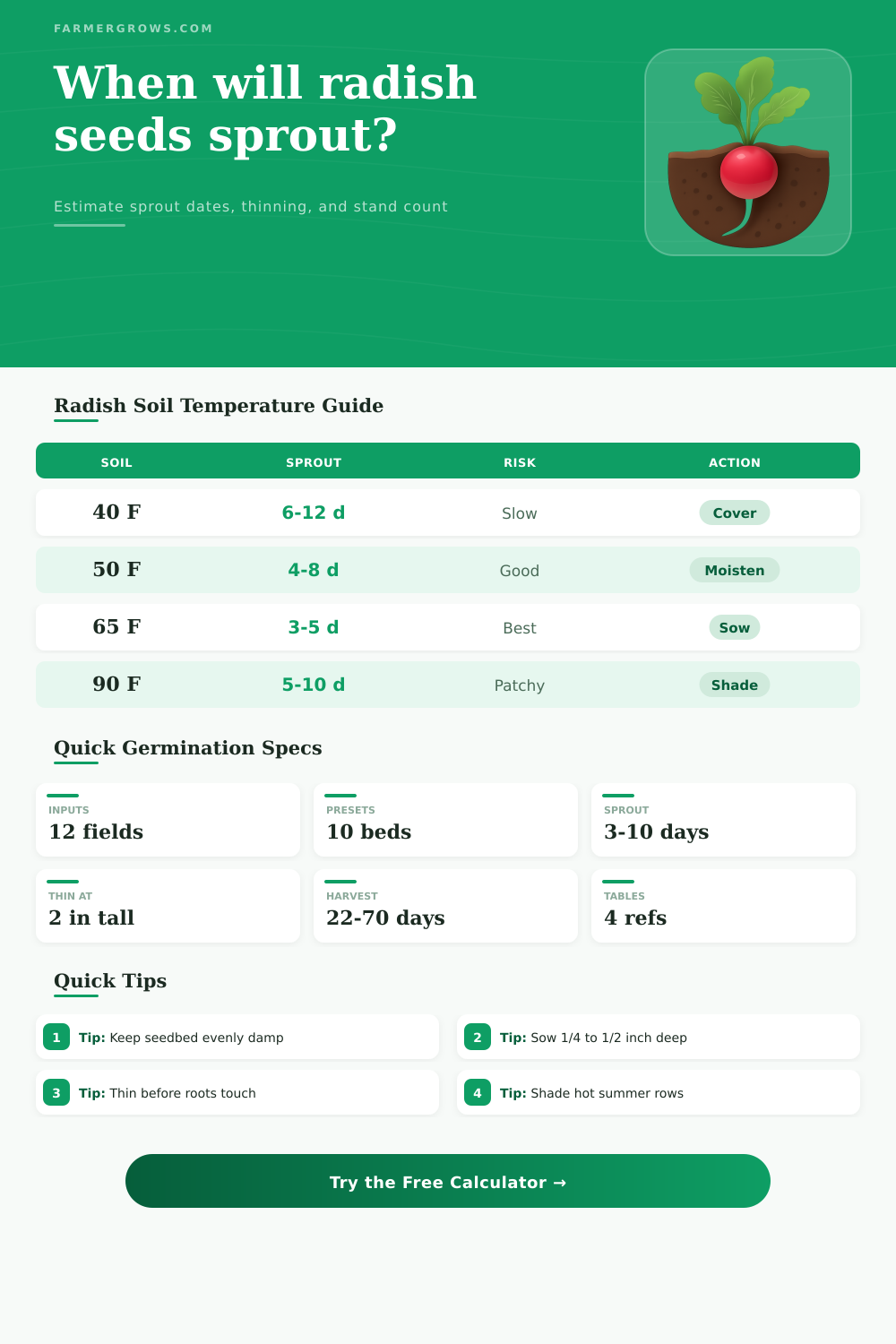
| 40 to 44 F | 6 to 12 days | Very slow, uneven if seed is old | Use row cover or wait for warmer soil |
| 45 to 49 F | 5 to 9 days | Acceptable for early spring sowings | Keep the surface moist and avoid crusting |
| 50 to 59 F | 4 to 7 days | Reliable cool-weather emergence | Good range for first outdoor successions |
| 60 to 75 F | 3 to 5 days | Fast, even emergence in loose soil | Ideal radish germination range |
| 76 to 85 F | 3 to 6 days | Fast but can dry quickly | Water lightly and shade if afternoons are hot |
| 86 to 95 F | 5 to 10 days | Patchy stands are more likely | Use shade cloth or shift sowing to fall |
| Radish type | Base sprout window | First harvest check | Seedling spacing note |
|---|---|---|---|
| Cherry Belle | 3 to 6 days | 22 to 28 days after sowing | Thin to 1.5 to 2 inches for round roots |
| French Breakfast | 3 to 7 days | 23 to 30 days after sowing | Thin to 2 inches for straight shoulders |
| Easter Egg blend | 3 to 7 days | 25 to 32 days after sowing | Thin mixed colors early so larger roots do not crowd |
| White Icicle | 4 to 8 days | 27 to 35 days after sowing | Thin to 2 to 3 inches for longer roots |
| Watermelon radish | 4 to 8 days | 50 to 60 days after sowing | Thin to 4 to 6 inches for full-size roots |
| Black Spanish winter | 4 to 9 days | 55 to 70 days after sowing | Thin to 4 to 6 inches and grow in cool weather |
| Seedbed condition | Sprout adjustment used | Stand adjustment used | Why it matters for radish seed |
|---|---|---|---|
| Fine loam | 0 days | No penalty | Loose particles help cotyledons lift cleanly |
| Compost-rich raised bed | -0.5 day | Small improvement | Warm, friable beds reduce surface resistance |
| Sandy soil | +0.5 day | Small penalty | Quick drying can stop shallow seeds |
| Heavy clay | +2 days | Moderate penalty | Cold, tight clay delays oxygen and emergence |
| Crusted after rain | +3 days | Large penalty | Radish seedlings may germinate but fail to break through |
| Sowing choice | Recommended range | Calculator effect | Field check |
|---|---|---|---|
| Depth | 1/4 to 1/2 inch | Outside the range adds delay and stand loss | Seed should be covered but not buried deep |
| Seed spacing | 1 inch for salad radishes | Controls total seed count before germination | Sow closer only if you plan to thin promptly |
| Final thinning | 2 inches, more for winter types | Sets target plants after thinning | Roots should not touch before sizing up |
| Moisture | Evenly moist, never saturated | Dry or wet conditions add delay and reduce stand | Check the top half-inch morning and evening |
| Seed age | Fresh to 2 years preferred | Older seed lowers adjusted germination | Pre-sprout a small sample if the packet is old |
💡Radish Germination Tips
For a faster sprout window: Water before sowing, press the row closed, and keep only the top layer damp. Radish seed can fail in dry crust even when the soil below is moist.
For a cleaner stand count: Thin soon after the first true leaves appear. Waiting too long lets crowded seedlings bend, stretch, and form small or misshapen roots.
Don’t expect radish to be a magic bean. It won’t sprout out of nowhere. There’s a real-world mechanical process at work that require forward thinking. To get radishes, you sow seed; then water it; then wait.
But there are variables: What happens if it doesn’t come up? When will it come up, exactly, given such-and-such soil temperature (because hotter is faster than seed metabolism)? A tool explain all this and turns it into timing so you know when to expect radishes and can be sure. And why the inputs? Because those are real-world limitations of what’s out there in dirt.
How a Radish Tool Helps You Grow Better
You plug in soil temperature, and that becomes your seed’s biological clock (meaning slower). Enzymes don’t work as fast when it is cold, such as around forty degrees F. The embryo wait a bit longer before it starts growing. Summertime soil that is too hot and too dry can also stop seeds from sprouting. So knowing what season your seeds will be planted in matters.
Does the tool take all this thermal reality into account? It does. It recalculates the probable time frame to match what kind of ground you’re planting in. Cool spring loamy soil versus mid-summer heat. That’s why April’s radishes comes up uniformly and June’s look spotty.
People often forget how important moisture is. Because radish seeds are tiny and near the surface, a hard rain can crust over them. Even if they have already sprouted below the surface, a hard crust will keep shoot from pushing up through it. You can look at the table for how soil texture affect this relationship; loose sand is less risky than heavy clay, which seals more. In either case, moist conditions that flip-flop from wet to dry cause decrease in stand counts. Keeping the top inch damp yields the cleanest stands. It’s not so much volume but consistency.
Another factor is seed age. Seeds that are fresh are more vigorous, able to plow their way through adversity with confidence. Old seeds (two or three years old) might still be viable, but not energetic enough to overcome a compacted surface. To help adjust for that loss of strength, the system reduce projected stand percentage to match. This allows you to adjust your expectations for emergence rate at thinning time. Better to go into it knowing that you’re going to have only 60 percent emerge (for instance), then discover holes later on.
Last of all, there is the practical result: the time to thin. Crowded radish plants yields tiny roots with no crunch or taste. By knowing the math of thinning, you know when seedlings are big enough for their true leaves and can handle a haircut without being killed. Too late, and what’s left will be tangled in each other’s roots; half the crop goes under the spade, and only the other half survives. This makes thinning an exact process instead of guesswork, giving every plant room to do its thing.
Once you understand this sort of mechanism, it make the whole business of gardening easy to understand. Instead of feeling like a victim of bad luck, you begin working with soil prep, watering routine and seed-sowing depth to suit the plants’ biological requirements. You should of planned ahead. After plugging in your own locale’s conditions, the calculator does all the tricky math for you. This frees up your time to assess soil texture before planting and to maintain steady moisture.
There are no shortcuts to growing radishes successfully. No amount of coaxing can make a seedling grow faster than its temperature permits. But you can provide an environment in which it’ll pop up fast. If you pay attention to sprouting times and follow the plan on thinning, your work will reward you with fresh roots… Not masses of tangled leaves. It is worth the wait to see those first flashes of red shoulders just as anticipated. You might recieve them naturaly.