🚜 Tractor Fuel Consumption Calculator
Estimate diesel usage by engine horsepower, hours of operation, and workload
| Engine HP | 25% Load (gal/hr) | 50% Load (gal/hr) | 75% Load (gal/hr) | 100% Load (gal/hr) |
|---|---|---|---|---|
| 40 HP | 0.4 | 0.8 | 1.2 | 1.6 |
| 60 HP | 0.6 | 1.2 | 1.8 | 2.4 |
| 80 HP | 0.8 | 1.6 | 2.4 | 3.2 |
| 100 HP | 1.0 | 2.0 | 3.0 | 4.0 |
| 120 HP | 1.2 | 2.4 | 3.6 | 4.8 |
| 150 HP | 1.5 | 3.0 | 4.5 | 6.0 |
| 200 HP | 2.0 | 4.0 | 6.0 | 8.0 |
| 250 HP | 2.5 | 5.0 | 7.5 | 10.0 |
| Fuel Type | Energy Density | Relative Consumption | CO2 (kg/L) | Notes |
|---|---|---|---|---|
| Diesel | 35.8 MJ/L | 1.00x (baseline) | 2.68 | Most efficient for tractors |
| Biodiesel B20 | 34.5 MJ/L | 1.04x more volume | 2.15 | Slightly lower energy |
| Petrol / Gasoline | 32.0 MJ/L | 1.12x more volume | 2.31 | Less efficient, older tractors |
| LPG / Propane | 25.3 MJ/L | 1.42x more volume | 1.63 | Requires conversion kit |
| Task | Typical Load % | HP Needed | Gal/hr (est.) | L/hr (est.) |
|---|---|---|---|---|
| Road Transport | 25–40% | 40–80 | 0.5–1.5 | 1.9–5.7 |
| Mowing / Slashing | 45–55% | 40–80 | 0.8–2.0 | 3.0–7.6 |
| Spraying | 40–55% | 60–100 | 1.0–2.5 | 3.8–9.5 |
| Baling (Round) | 65–80% | 80–150 | 2.0–5.0 | 7.6–18.9 |
| Field Cultivation | 70–80% | 100–200 | 2.5–7.0 | 9.5–26.5 |
| Moldboard Plowing | 85–100% | 120–250 | 3.5–10.0 | 13.2–37.9 |
| Subsoiling | 90–100% | 150–300 | 4.5–12.0 | 17.0–45.4 |
| Loader / Bucket | 60–80% | 60–120 | 1.5–4.5 | 5.7–17.0 |
Fuel planning are an important part of any farm operation. Fuel planning is necessary to keep the cost of fuel for the farm as low as possible and to ensure that the tractors isnt idling due to a lack of fuel. Because different task require different rates of fuel consumption from the tractors, planning for the tasks that will occur on the farm will help ensure that you purchase fuel in an amount that will meet the demands of those tasks.
Tractors dont consume fuel at a constant rate during their operations. Instead, the load of the tractors engine determines the amount of fuel that is consumed by a tractor. The load of the engine is calculated as the percentage of the maximum power of the tractor that is being utilized to perform a specific task.
How to Plan Fuel for Farm Tractors
For instance, tasks like hauling equipment on a road require the tractor to utilize a lower load of its engine than tasks that require the tractor to perform heavy tasks like deep plowing. Thus, a tractor will consume more fuel while plowing fields than it would while hauling equipment on a road. Fuel can be estimated for a tract by using a form of baseline calculation of the tractors fuel consumption.
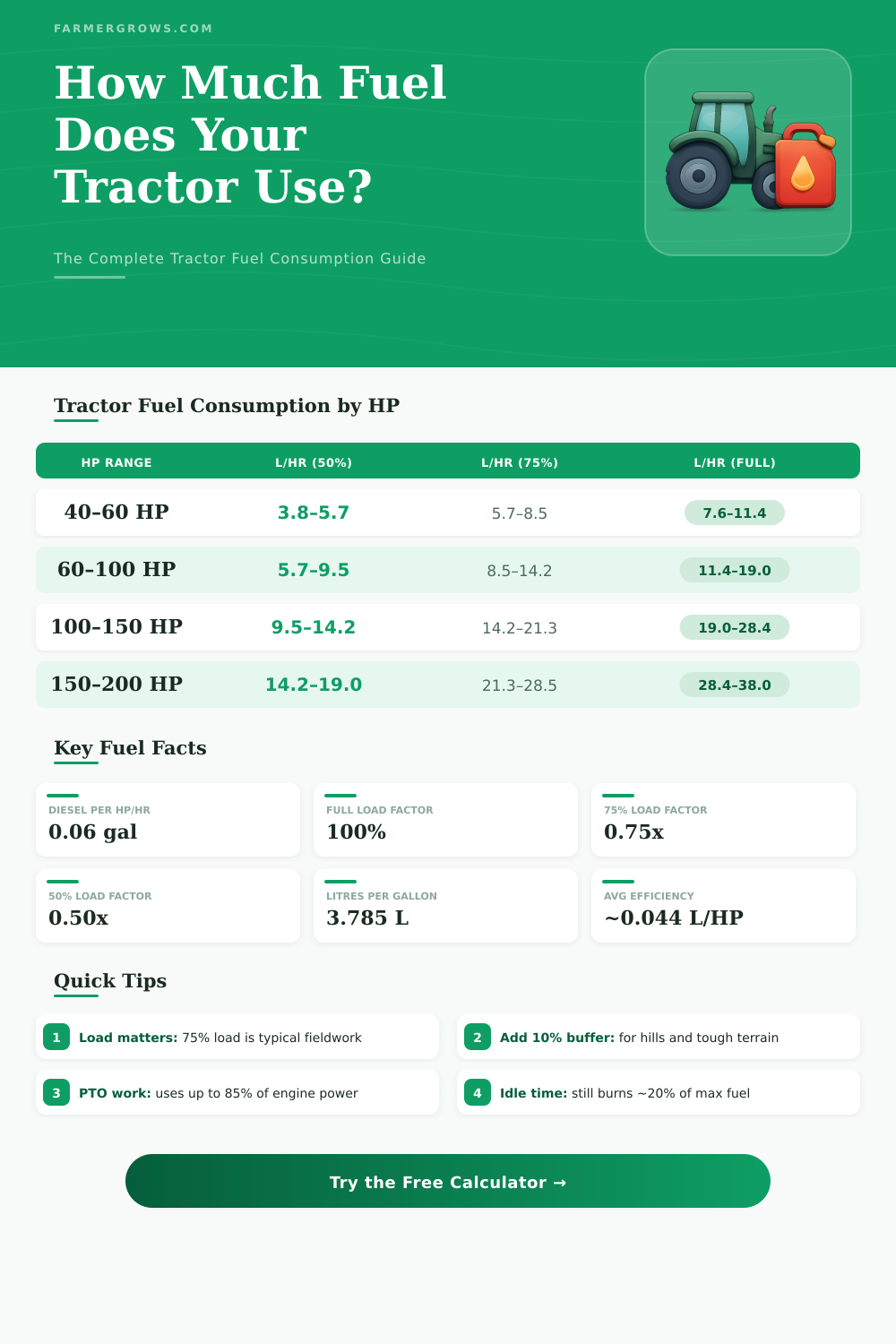
For instance, you can multiply the horsepower of the tractor by the number of hours that the tractor will run. The baseline for fuel consumption for tractors is typically between 0.04 and 0.06 gallons of diesel fuel per horsepower of the tractor per hour of running. However, various variable will impact the actual consumption of fuel by a tractor while in operation.
The type of tasks that the tractor performs will impact fuel consumption. For instance, tasks that utilize the power take-off (PTO) of the tractor will require more fuel than tasks that do not use those PTOs. Additionally, the terrain upon which the tractor performs its tasks will have an impact upon the fuel consumption of the tractor; tractors that must travel on hills will consume more fuel than tractors that travel on flat field.
Thus, it is recommended that a buffer fuel be added to the calculation of the fuel consumption that is performed by the tractor. For instance, 5% of fuel can be provided for flat fields, but 15% to 20% of fuel can be provided if the terrain is hilly or dusty. The type of fuel that is used for the tractor will also impact the amount of fuel that is required for the tractor to perform its tasks.
For instance, farmers typically use diesel fuel for tractors due to the high energy density of diesel fuel. Energy density refers to the amount of work that is provided per liter of fuel that is burned. Thus, diesel fuel provides more work per liter than fuels like gasoline or LPG.
Fuel like biodiesel may require more fuel to be provide to the tractor than fuel like diesel due to the slightly lower energy density of biodiesel. Gasoline fuel for a tractor will result in less fuel efficiency for the tractor due to the lower density of gasoline fuel relative to diesel fuel. Finally, idling of the tractor will result in the waste of some of the fuel that is contained within the tractor; an idling tractor will consume approximately 20% of the maximum fuel rate for the tractors engine.
Thus, idling for long periods will waste fuel. The maintenance of the tractor and the operation of the tractor may impact fuel consumption. For instance, if the tractors tires are underinflated, the tires will create more friction (drag) while in operation and burn more fuel to overcome that drag.
If the soil that is being plowed is wet, it will create more resistance to the movement of the tractor and the engine will consume more fuel to implement the tractor to the fields. Additionally, the air filter for the tractor should be clean and maintained because dirty air filters will prevent the engine from efficiently combusting the fuel; if the air filter is dirty, the tractor will waste between 5% and 15% of its fuel. Finally, the oil that is provided to a tractor should be fresh in order to minimize friction between the components of the tractors engine.
Mathematical examples help to calculate fuel needs for a tractor. For instance, if a tractor contains 100 HP and is to run for 8 hours at a 75% load for its engine, the tractor will require approximately 24 gallons of diesel fuel. If 10% of that fuel is provided as a buffer for fuel needs of the tractor, the tractor will require 26.4 gallons of fuel to perform its tasks without running out of fuel.
Thus, using 26.4 gallons of fuel is a way to ensure that the tractor does not run out of fuel. Additionally, an owner can use reference charts to calculate fuel needs based off the horsepower of the tractor. For instance, smaller tractors that contain between 40 and 60 HP will require less fuel per hour than larger tractors that contain between 150 and 200 HP.
Thus, by keeping track of the number of hours that the tractor runs, the different loads of those tractors, and the amount of fuel that is filled into the tractor, an owner can create more accurate fuel plans for the farm. You should of accounted for extra fuel. It is actualy a lot of work to plan this out but it helps.