Cubic Yard of Topsoil Weight Calculator
Estimate how many pounds and tons your ordered topsoil may weigh after moisture, texture, screening, settlement, overage, truck loads, and wheelbarrow trips are included.
Pick a realistic bulk topsoil order, then adjust the yardage, density, moisture, soil texture, screened status, settling allowance, load count, and spread depth.
Topsoil Weight Estimate
Results use the entered cubic yards, then adjust weight for texture, screening, moisture, settlement, and selected overage.
Light mineral soil with faster drainage. It is often easier to shovel but may dry out sooner after spreading.
Balanced sand, silt, clay, and organic matter. This is the middle reference for most garden deliveries.
Dense fine particles and retained water push weight up. Wet clay can exceed light trailer or pickup limits.
Organic-rich mixes are lighter by volume but settle more as fine material filters into the bed.
Screening removes stones, roots, and clods, so volume spreads evenly and finished beds settle more predictably.
Clods, rocks, and uneven moisture make the pile heavier and less consistent from one bucket to the next.
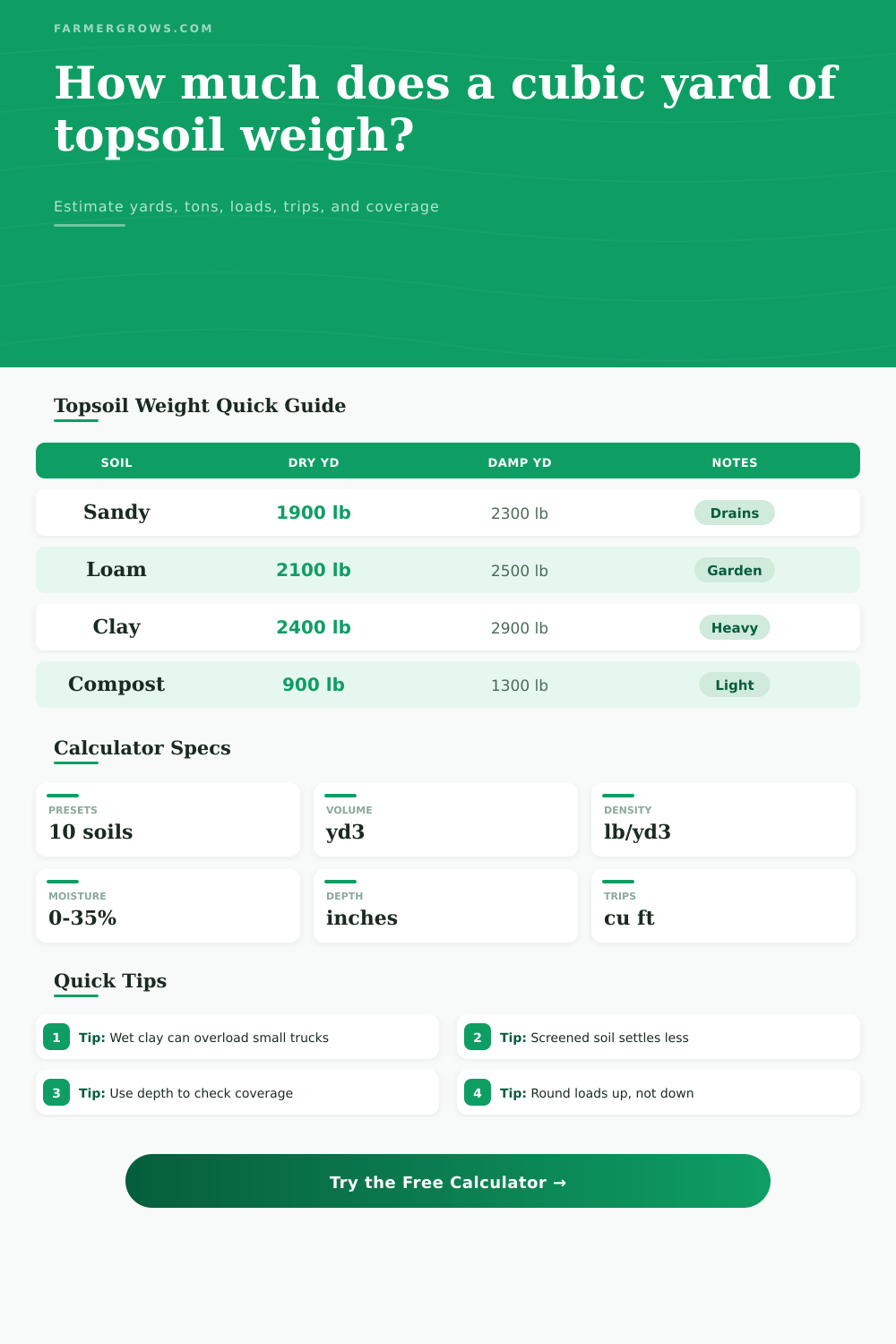
| Topsoil texture | Dry planning weight | Damp planning weight | Wet planning weight | Use case |
|---|---|---|---|---|
| Sandy screened topsoil | 1,800 to 2,050 lb/yd³ | 2,000 to 2,300 lb/yd³ | 2,250 to 2,600 lb/yd³ | Lawn dressing, leveling, fast-draining beds |
| Loam garden topsoil | 1,950 to 2,250 lb/yd³ | 2,200 to 2,600 lb/yd³ | 2,450 to 2,850 lb/yd³ | Raised beds, lawns, general planting |
| Clay-heavy topsoil | 2,250 to 2,600 lb/yd³ | 2,550 to 3,000 lb/yd³ | 2,900 to 3,400 lb/yd³ | Grading, fill, moisture-retentive sites |
| Compost-rich blend | 800 to 1,150 lb/yd³ | 1,050 to 1,600 lb/yd³ | 1,350 to 1,950 lb/yd³ | Garden mixes and organic amendments |
| Finished depth | Sq ft per cubic yard | Sq m per cubic meter | Typical use |
|---|---|---|---|
| 1 inch | 324 sq ft | 12.0 m² at 7.6 cm | Lawn topdress and light leveling |
| 2 inches | 162 sq ft | 6.0 m² at 7.6 cm | Thin bed refresh or turf repair |
| 3 inches | 108 sq ft | 4.0 m² at 7.6 cm | Common raised bed or garden top-up |
| 4 inches | 81 sq ft | 3.0 m² at 10.2 cm | New planting beds with moderate depth |
| 6 inches | 54 sq ft | 2.0 m² at 15.2 cm | Deep bed fill or poor-soil correction |
| Handling method | Volume reference | Per cubic yard | Weight note | Best planning use |
|---|---|---|---|---|
| 6 cu ft wheelbarrow | 6 cubic feet | 4.5 trips per yd³ | Often 450 to 650 lb/trip when full | Short paths with firm footing |
| 4 cu ft wheelbarrow | 4 cubic feet | 6.75 trips per yd³ | Lower strain per trip | Narrow gates and soft lawns |
| Small pickup bed | 0.5 to 1 yd³ | Check payload first | Wet soil can exceed rating quickly | Small DIY hauls only |
| Dump truck delivery | 5 to 12 yd³ | Split by site access | Confirm driveway and axle limits | Bulk beds, grading, larger lawns |
| Project | Typical volume | Depth check | Weight range | Planning note |
|---|---|---|---|---|
| 4 x 8 raised bed top-up | 0.30 yd³ | 3 inches | 600 to 850 lb | Usually moved by wheelbarrow or tubs |
| Small lawn low-spot repair | 1.0 yd³ | 1 inch over 324 sq ft | 1,900 to 2,800 lb | Keep piles off weak turf when wet |
| New 10 x 20 garden bed | 1.85 yd³ | 3 inches | 3,700 to 5,300 lb | Add overage for edges and settling |
| Market garden bed refresh | 6.0 yd³ | 2 inches over 972 sq ft | 12,000 to 16,800 lb | Split delivery near the work area |
Check the truck before the soil. One wet cubic yard of clay-heavy topsoil can weigh more than 1.5 tons, so use payload ratings rather than bed volume alone.
Separate ordered volume from finished volume. Loose topsoil settles after watering and foot traffic, so the settlement field helps convert pile volume into finished bed depth.
When most gardeners order topsoil, they do so by volume; after all, that’s how soil-supply companies sell it. “I need four cubic yards for my new bed,” you say, and voila: Truck arrives with a dump full of dirt.
Volume does not account for weight. Weight is what actualy causes your driveway’s load limit to be exceeded or your wheelbarrows’ axles to snap. A cubic yard of dry sand bears no resemblance whatsoever to a cubic yard of wet clay… But each will take up exactly the same amount of space in back of a dump truck.
Why Soil Weight Matters
It is a small difference, but it becomes a big one if you are out there in mud struggling to shift two thousand pounds. There’s no need for you to do all this work; the calculator does it for you (above), taking into account not just the soil type, but also its moisture content.
The latter is one factor that greatly changes the weight of whatever it is you’re carrying. For instance: People think topsoil is always roughly equal in weight. It isn’t: Water has a lot of heft. A cubic yard of wet loamy soil could easily be close to two thousand pounds. But that same volume can weigh much more if it absorbs enough rain to become soaked. That can increase up near three thousand pounds or even more.
And there’s your error; people think ahead for when it will be dry, then go out in a downpour…and find themselves wrestling with a bale weighing half again what they had figured on, and too much for their back to support.
Another key aspect is soil type. Lighter soils (like sand) drain rapidly and can absorbs easier to spread around. But they’re also not very good for retaining nutrients, making the substance easier to throw around but less useful once it’s in place. On the other hand, denser clay soils holds water like a sponge, are heavier when wet, and become a sticky nightmare. If you have to deal with this sort of fill, respect the weight involved.
You can tell the tool what kind of soil texture you’re working with, and it’ll adjust the baseline density accordingly… Before even factoring in the moisture. That way, you won’t underestimate how much work is necessary to get the stuff out.
With the weight estimation in hand, it’s time to get down to some serious planning. How are you going to transport this dirt? One cubic yard is about four and a half trips in a traditional wheelbarrow. Each wheelbarrow can carry approximately 6 cubic feet.
If you’re ordering more than a few cubic yards, do the math, the number of trips will add up quickly. The calculator breaks down the overall load into easily digestible trips. This prevents the embarrassing realization that you need thirty trips to move even a small order. Before signing the delivery ticket, it makes you face the actual physical task at hand.
Another silent killer of garden projects is settlement. Once you walk on and water the loose topsoil, it settles into place, compacting. Order up just enough to cover an area at three inches thick? You’ll probably find yourself with two inches within a week.
The settlement allowance feature in the calculator can help, because it suggests buying slightly more volume (a buffer) than you believe you require. Better to have a bit too much soil than see your handsome new beds crack open and subside. That’s what the buffer is for, the air pockets in the loose fill that vanish under pressure.
Then there’s the added variable of getting it delivered via a truck. A loaded dump truck is going to weigh a lot and most residential driveways is rated for limited amounts of weight. Are you splitting up a big order into several smaller deliveries? Knowing how much each load will weigh allows you to prevent putting stress on the truck’s suspension or ripping up your driveway.
Knowing how much each load weighs is key for planning logistics. Sure, the bed may hold all that volume, but does it weigh too much to get it home without breaking something?
Compost-rich blends are lighter than mineral soils, meaning they are less dense by volume, but they will also settle more as the compost breaks down and blends into underlying soil. So potentially you’ll want to start deeper in order to get that desired end result.
That’s what the density comparisons in the tool illustrate. It helps guide you toward purchasing a compost mix that is denser different than looser, depending on how compacted your soil is now.
In the end, soil is no ordinary dirt. Topsoil has particular volume and weight characteristics that should of been considered. Save yourself money, time, and your back by planning based off actual weight instead of mere bulk appearance.
The tool lets you figure out how many loads it will take and how heavy each one will be before the truck even arrives. You’ll know if you have enough or too little to complete the task. This ensures you are not left short.
That’s what separates an occasional project from a lifetime of work.