Tomato Seeds Per Hole Calculator
Estimate how many tomato seeds to sow in each cell, plug, hill, or planting hole using seed lot germination, tray size, target seedlings, reserve plants, and thinning tolerance.
Tomatoes are often started indoors with one or two seeds per cell, but older heirloom lots, cool media, or high reliability goals can change that count. This calculator finds the smallest practical seeds per hole and translates it into total seed, tray, packet, and thinning estimates.
Tomato Seed Starting Plan
Your tomato seed plan will appear here.
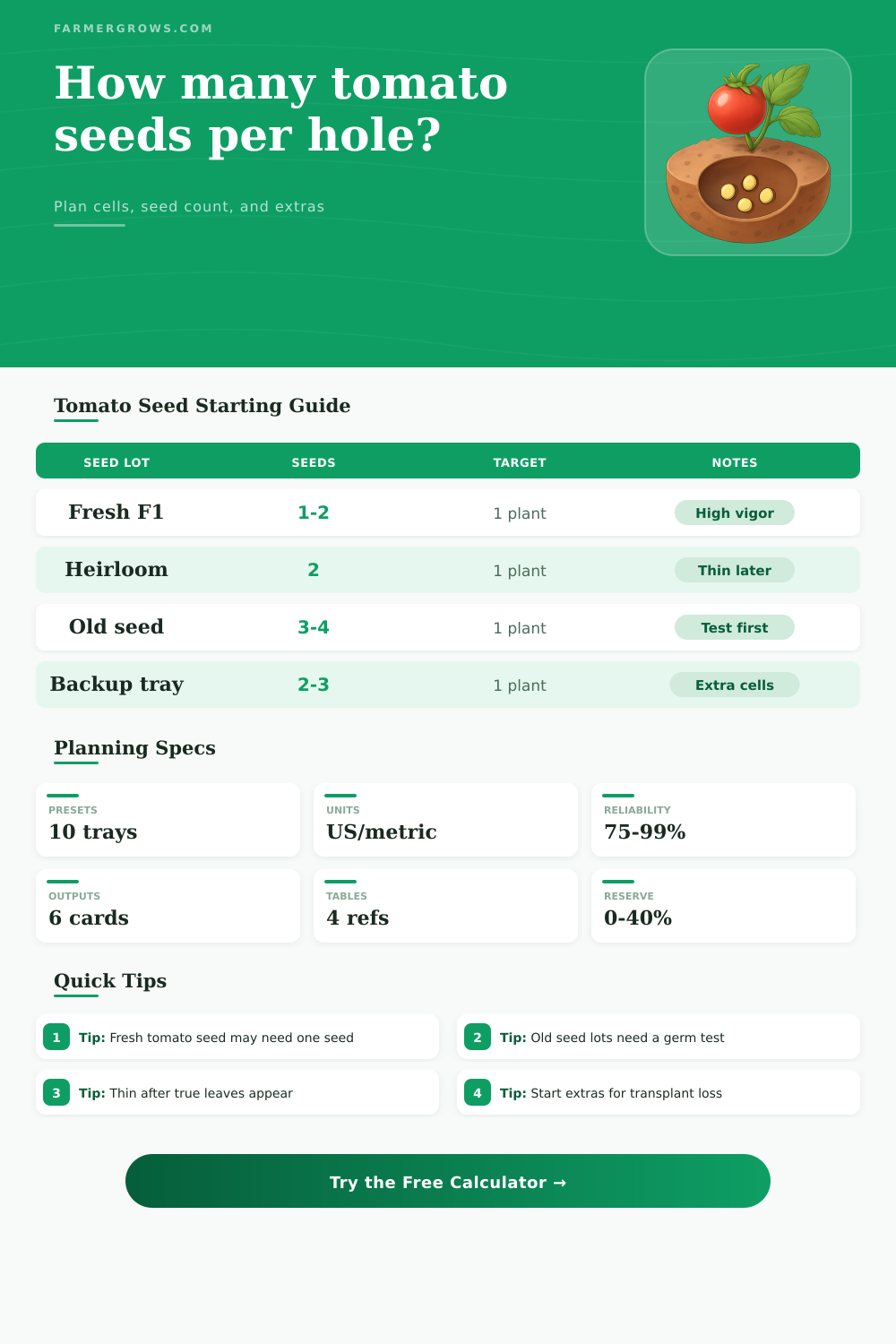
| Tomato seed situation | Typical seeds per cell | Best target | Thin or transplant extras |
|---|---|---|---|
| New hybrid packet, warm mat | 1 to 2 seeds | 1 seedling | Thin only doubles |
| Fresh heirloom seed | 2 seeds | 1 seedling | Snip weaker plant |
| Saved seed over 4 years old | 2 to 4 seeds | 1 seedling | Prick out extras if valuable |
| Rare variety with few seeds | 1 seed plus test | 1 seedling | Use germination test first |
| Warm direct-sown holes | 3 to 5 seeds | 1 to 2 plants | Thin after true leaves |
| Live emergence per seed | 1 seed succeeds | 2 seeds succeeds | 3 seeds succeeds | 4 seeds succeeds |
|---|---|---|---|---|
| 95% | 95.0% | 99.8% | 99.99% | 99.99%+ |
| 85% | 85.0% | 97.8% | 99.7% | 99.9% |
| 75% | 75.0% | 93.8% | 98.4% | 99.6% |
| 65% | 65.0% | 87.8% | 95.7% | 98.5% |
| 50% | 50.0% | 75.0% | 87.5% | 93.8% |
| Starting plan | Cells or holes | Seeds per hole | Total seed | Best use |
|---|---|---|---|---|
| One 72-cell tray | 72 | 1 | 72 | Fresh high-vigor packets |
| One 72-cell tray | 72 | 2 | 144 | Normal tomato backup |
| Half 50-cell tray | 25 | 2 | 50 | Small home garden |
| Market flat | 200 | 2 | 400 | Farm transplant batch |
| Outdoor row holes | 20 | 4 | 80 | Warm direct sowing |
| Condition | Effect on emergence | Calculator adjustment | Practical reading |
|---|---|---|---|
| Warm media, even moisture | High and uniform | Use 90% to 95% | One or two seeds may be enough. |
| Cool media below ideal range | Slower, patchier | Reduce emergence by 5% to 15% | Use two seeds or warm the tray. |
| Old saved seed | Lower live seed count | Use germ test result | Do not guess with rare varieties. |
| Outdoor direct sowing | Weather and pests matter | Use 50% to 75% | Thin after the strongest plants show. |
| Dense multi-seed cells | More thinning work | Watch expected extras | Prick out valuable seedlings early. |
Use a germination test for old tomato seed. Ten seeds on a damp towel can give a better live-emergence estimate than guessing from seed age alone.
Thin at the right stage. When true leaves form, snip weak extras at soil level or prick out valuable seedlings before roots tangle heavily.
It’s all in the probabilities: When sowing multiple seeds per cell (hoping to get at least one germination), you think of them as interchangeable units, until those roots tangle, or you have an empty spot among your precious heirlooms. Starting off smooth vs. Being messy has less to do with technique then with probability. It’s kind of a gamble: water and dirt.
The math are done for you by the calculator above, but knowing why those numbers matter will change what you sow. Each tomato variety have its own story. A fresh packet of hybrid seeds is full of vigor. Because they were selected to be consistent, they sprout fast and in unison. If your soil is still warm, you may even get away with sowing a single seed in each cell.
Why You Should Use This Tool
Not so heirlooms, which are older seeds. Whether because of improper storage over time or simply their age, they may not germinate as well. In this case, it isn’t wise to sow just a single seed. You could easily find yourself with empty spots when you need a plant.
And that’s where the tool prompts: How fast do you think these will germinate? And what about emergence? The “best case” estimate on the packet was a laboratory situation. It is not your unheated garage or basement shelf. Emergence declines if your heat mat fail to hold temperatures consistent. The calculator accounts for that; it reduces expected success as a percent, allowing you to adjust downward. As you reduce the likely percent success, the tool adds more seeds per hole to cover the downside of going empty.
It takes the guesswork out of thinning, while still accounting for cost of sowing empty holes. Thinning is nobody’s favorite chore. Sow an excess of seeds and hope one emerges. And here you have three scuffling seedlings in a two-inch cell. Conventional wisdom say to trim down below the surface so that the winner won’t have its roots disturbed. Or better yet, prick them all out (adding labor) and replant each in its own pot (avoiding losses). Because the calculator assumes that you’re doing some kind of picking and thinning from the start, it calculates number of extras you’ll be facing based off your sowing density. Want more than 95 percent success? Expect to do more thinning. Want to trim back on time? Go bare spots.
Another thing that everyone forgets about: Reserve Seedlings. You know the feeling when you order seeds and plan on having 50 plants but have only started 48? Something happens. Either a plant dies (damping off) or gets knocked around too much or whatever, and some seedling don’t make it to transplant day. Enter the reserve percentage into this tool. At first, adding an extra ten or even twenty percent of starts seems like overdoing it. It seems wasteful. Then you go to transplant day and lose three plant. And then you see what those “extra” plants mean, the difference between a patchy row and a fully-grown row.
Getting the depth wrong matters more than you might expect. If you plant seeds deeper than the best depth, they’ll burn up all of their stored energy on the way to the sun. If too-shallow, then they dry out. A quarter inch (give or take) is the usual guidance, like with tomatoes, and that’s the depth no matter how you’re growing them: in direct sow in the warm ground, or in trays under plastic. By recommending greater numbers per planting hole, the calculator takes into account factors such as irregular rainfall and slugs that is part of direct sowing.
That’s laid out clearly in the table of references on the page; the higher the number of seeds, the greater your success rate. One seed = an eighty-five percent chance at having a plant (if it germinates). Two seeds increases that rate to almost ninety-eight percent. The leap isn’t linear. It’s exponential. That’s the leverage point.
When you add another seed, you’re not just increasing your number of seeds. You’re insuring yourself against failure. Begin early with warm soil and some new seed. Keep it simple. Adjust the inputs if conditions aren’t ideal; don’t hope for luck. Aim to have just one strong survivor per cell in a tray; not a single empty spot. This isn’t about sowing more, but sowing smarter.
You will know precisely what did and didn’t work when those first true leaves emerge. Till then, follow the odds, and let the odds guide your hand.