Tomato Seed Viability Calculator
Estimate how many tomato seeds to sow from seed age, storage temperature, storage humidity, packet condition, germination test results, target transplants, sowing buffer, and tomato variety type.
📋Tomato seed lot presets
Start from a realistic tomato seed lot, then adjust the packet, storage, germination test, and transplant target for your tray plan.
🍅Seed packet inputs
Use the test fields if you have run a paper towel or tray germination test. If not, leave the test count at zero and the calculator will use tomato seed age and storage conditions.
Tomato seed viability result
Calculated from tomato seed age, storage, packet condition, test results, and transplant target.
Detailed sowing breakdown
📊Viability signals
These cards translate the calculation into practical decisions for tray planning, packet triage, and whether to run a larger tomato germination test.
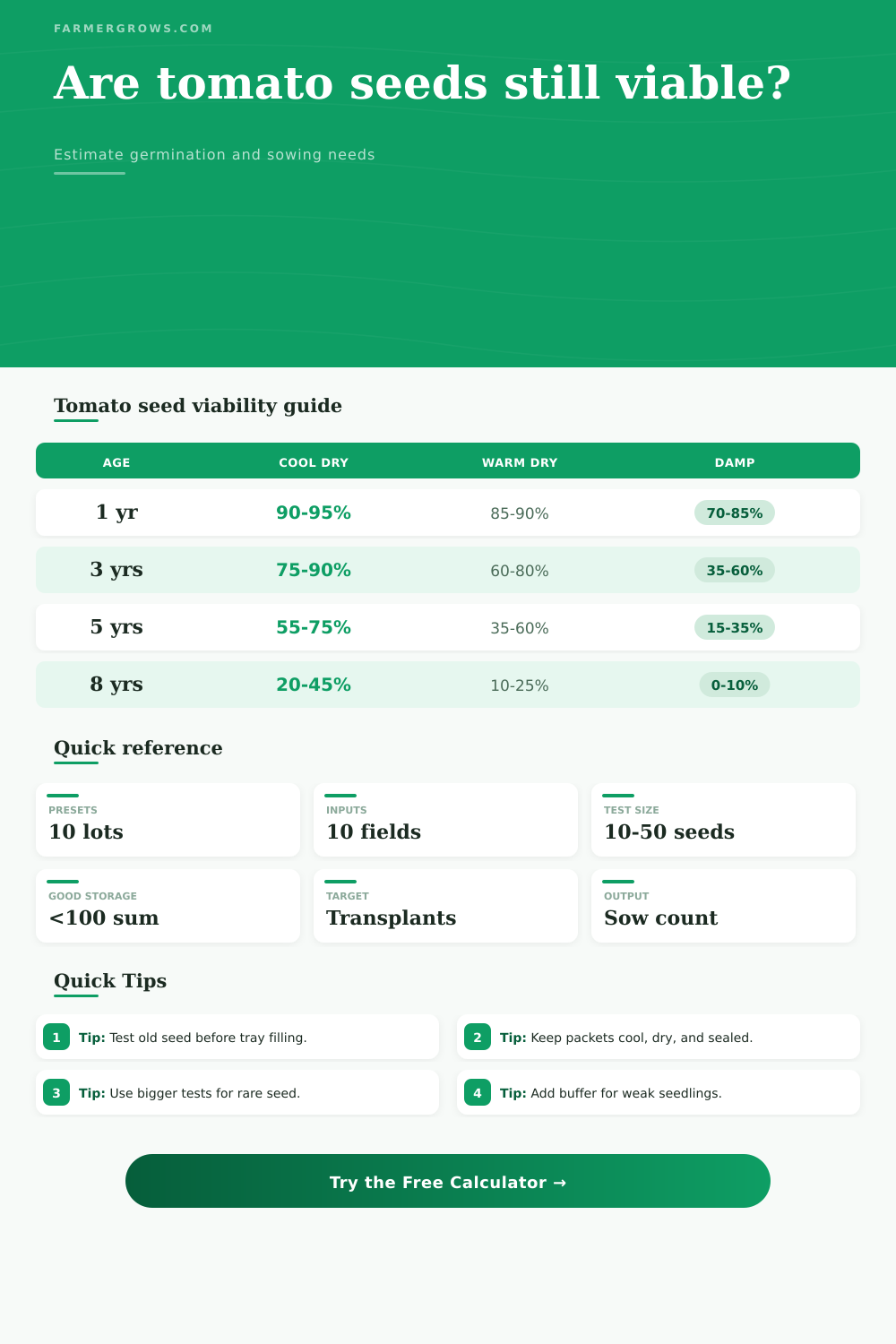
| Seed age | Cool dry | Room dry | Warm or damp |
|---|---|---|---|
| Fresh to 1 year | 90% to 96% | 85% to 92% | 70% to 85% |
| 2 to 3 years | 78% to 90% | 62% to 82% | 35% to 65% |
| 4 to 5 years | 55% to 78% | 35% to 62% | 15% to 38% |
| 6 to 8 years | 25% to 55% | 12% to 35% | 0% to 18% |
| 9+ years | 5% to 25% | 0% to 12% | 0% to 5% |
| Storage | Example | Temp + RH | Seed risk |
|---|---|---|---|
| Excellent | Sealed jar, cool room | Under 90 | Low |
| Good | Dry packet, closet | 90 to 110 | Moderate |
| Fair | Room packet, opened | 111 to 130 | Noticeable |
| Poor | Garage or shed | 131 to 155 | High |
| Very poor | Damp or hot packet | Over 155 | Severe |
| Test count | Best use | Confidence | Action |
|---|---|---|---|
| 0 seeds | No test | Estimate only | Use age and storage |
| 10 seeds | Home packet | Rough | Add buffer |
| 20 seeds | Small grower | Useful | Plan trays |
| 50 seeds | Market lot | Strong | Trust test |
| 100 seeds | Seed saving | High | Compare lots |
| Goal | Target | At 85% | At 55% |
|---|---|---|---|
| Home garden | 12 plants | 16 seeds | 25 seeds |
| Family plot | 24 plants | 32 seeds | 49 seeds |
| CSA row | 72 plants | 94 seeds | 147 seeds |
| Market bed | 150 plants | 195 seeds | 306 seeds |
| Greenhouse set | 500 plants | 648 seeds | 1011 seeds |
🌱Tomato seed lot reference
Use these reference cards to compare common tomato seed types. Rare saved seed often deserves a bigger buffer because every surviving seedling matters.
Tomato seed usually sprouts fastest around 75°F to 85°F. Count only normal seedlings with roots and shoots when entering the sprouted number.
A simple rule for vegetable seed storage is to keep temperature in °F plus relative humidity below 100 whenever possible.
Calculator estimates are for tomato seed planning and tray sizing. Disease, seed treatment, potting mix, watering, and seed-starting temperature can change actual emergence.
In late february, you discover a packet of Brandywine seeds in your garage. They are three-year-old seeds. The envelope’s looking faded; there’s no telling whether those specks is dust or viable embryos. Should you open it and take a chance? Maybe toss a handful into the soil and see what happens? Or maybe wait?
Most gardeners approach seed with a mix of trial and error and superstition. They’re afraid to fail, so they sow way too much. Their seedling bench resembles a forest rather then a farm. But here’s the truth: There is no magic numbers when it comes to tomato seed viability. It has nothing to do with voodoo, but everything to do with how moisture, heat and time slow life inside the packet.
How to Check If Old Tomato Seeds Will Grow
When you guess at how long the seeds have been in storage (and therefore how much longer they might last), the calculator do the math for you. You won’t have to make wild guesses about whether it is worth it to plant them. Besides seed age, some of the key variables are how they’ve been stored over all that time. Is their home a cool, dry basement that acts like a vault? Or is it a damp shed or a boiling hot attic that is more like an oven?
Viability drops along with temperature and relative humidity; the tool will ask for both. Based off your guessed-at storage condition, plus the seed age, it calculate a baseline germination rate. And this is before you lift a single seedling tray. Plug those numbers into the calculator if you’ve run a germination test for 20 seeds on a moistened paper towel. That’s real world data, and it speaks for itself: You know what shape your batch is in.
Don’t assume that the packet date is a truer indicator of viability different than what your eyeballs can tell you (it isn’t). A germination test will reveal who’s alive today. The calculator weigh that actual test result a lot against the prediction based off age. Why? Because that percentage will be sharper then the guess, providing a clearer picture of how many of those babies is most likely to fare. Then it goes back from there to calculate how many healthy plants you’ll get.
June: You’d like to have a row of, say, forty-eight strong tomato plants by this month so you can enjoy them in your summer meal rotation. But who gets exactly forty-eight seeds to sow, and expects perfect conditions with zero losses? Nobody! Some seeds fail to sprout; others may die from damping off; you’ll accidently lose a few at planting time.
The tool allows you to enter the percentage of expected loss as a buffer. With fresh hybrid seeds, a reserve of just ten percent is typically sufficient, but for heirlooms or seed that’s been stored in less-than-ideal conditions, go higher on your reserve. Better to have a few more seedlings to share with friends than an open space in the middle of your garden row where there ought to be a plant.
If the storage wasn’t perfect, viability declines significantly beyond five years (see the chart on the page). Even then, fresh hybrids are forgiving and tend to sprout despite rough treatment. Fresh hybrid seeds is vigorous and forgiving. Heirlooms, by contrast, are more delicate and require more loving care. To account for this, the calculator default with a cautious buffer for older genetics, which it factors in depending on what kind of variety you choose.
Because remember: You’re not just looking for a sprout; you want a sturdy transplant that’s up to surviving in the field. Seedlings that were weak to start with is often losers later on. So the math nudges you toward sowing more at first to guarantee some good ones will survive.
The beauty of the hobby includes seed saving, but there’s no use being dishonest about storing them. If you’re in a high-humidity area, stash your upcoming seeds in sealed containers that include some sort of desiccant packet. Label with the harvest year. Then when it’s time to reach into those trays come springtime and fill them up, do so by the numbers, not by fear.
Don’t overpopulate your greenhouse bench; don’t spend what would of been a few bucks on a new pack. Maybe those Brandywines are fine. Maybe not. There’s only one way to find out: Read the data before you drop that first seed into its new home.