Tomato Ripening Time Calculator
Estimate when tomatoes will reach first color, full color, and table-ripe eating stage from variety type, fruit stage, average temperature, sunlight, ethylene exposure, vine or indoor ripening, frost deadline, and cluster load.
📋Tomato ripening presets
Choose a starting point for common garden situations, from cherry tomatoes coloring on the vine to mature green slicers being picked ahead of frost.
🍅Fruit stage and variety
A tomato that has reached mature green can ripen off the vine. Immature hard green fruit may color slowly or fail to develop full flavor.
☀Temperature, sunlight, and load
Tomato color development slows in cool weather, can stall in extreme heat, and is delayed when a plant carries too many fruit at once.
Ripening estimate
Enter fruit stage and conditions to estimate tomato ripening time.
Calculation breakdown
📊Ripening batch metrics
📘Tomato ripening reference
| Stage | What it means | Typical finish |
|---|---|---|
| Immature green | Hard, small, no gel seed cavity | Often unreliable |
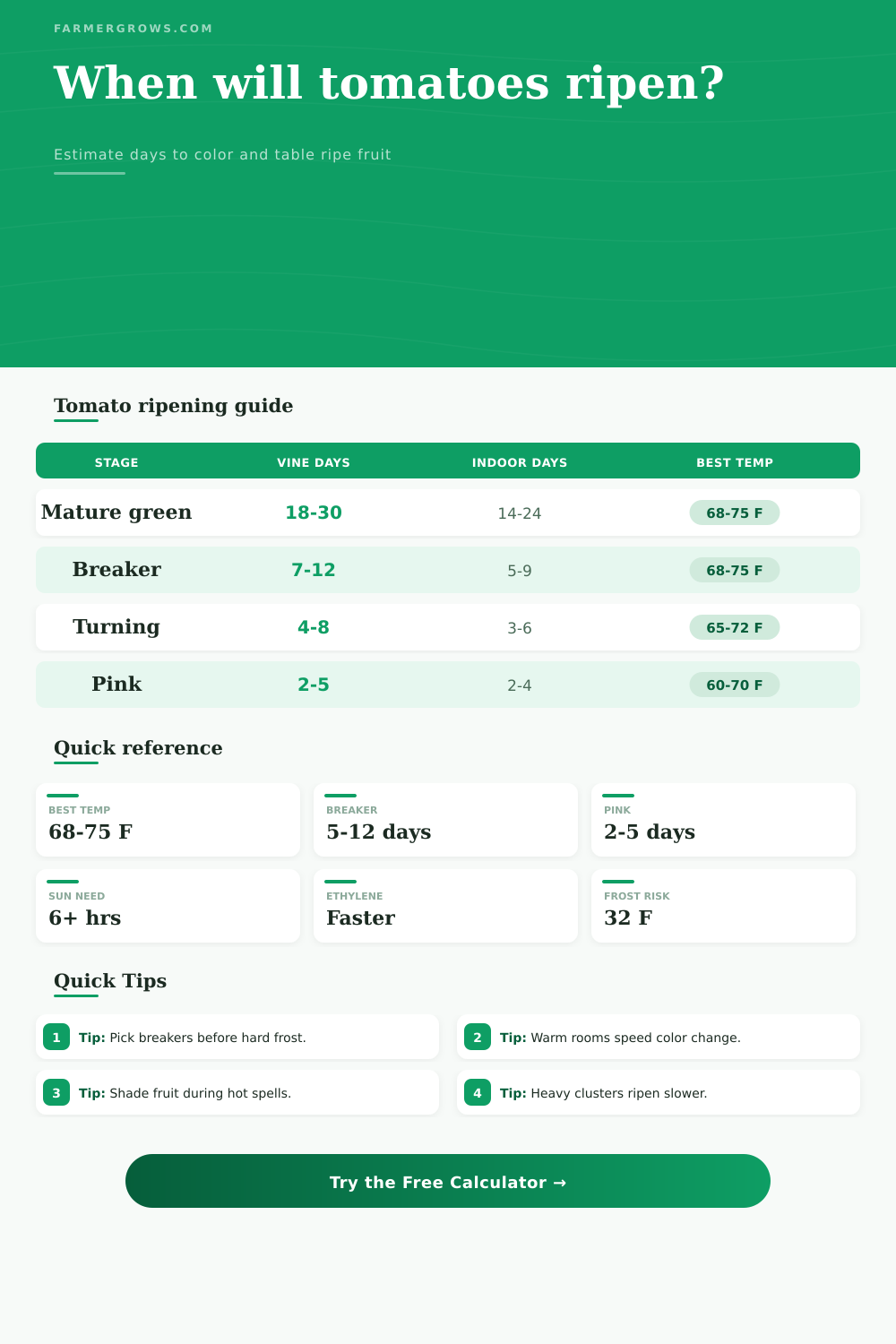
| Mature green | Full size, glossy, pale star may show | 14-30 days |
| Breaker | First pink, red, orange, or yellow blush | 5-12 days |
| Turning | 10-30% color across the fruit | 3-8 days |
| Pink | 30-60% color, still firm | 2-5 days |
| Nearly ripe | Full color but firm shoulders | 1-3 days |
| Average temp | Effect | Best action |
|---|---|---|
| Below 55°F | Very slow color | Pick breakers |
| 55-64°F | Slow but steady | Use indoor tray |
| 65-75°F | Best ripening | Hold steady |
| 76-84°F | Fast, watch softness | Check daily |
| 85-92°F | Pigment can slow | Add shade |
| Above 92°F | Color may stall | Pick turning fruit |
| Type | Relative speed | Notes |
|---|---|---|
| Cherry or grape | Fast | Small fruit colors quickly |
| Standard slicer | Normal | Good baseline for timing |
| Roma or paste | Normal | Often colors evenly indoors |
| Beefsteak | Slow | Large shoulders finish last |
| Large heirloom | Slow | Uneven color is common |
| Greenhouse truss | Normal-slow | Cluster load matters |
| Method | Speed | Use when |
|---|---|---|
| Vine | Best flavor | Weather is safe |
| Bright room | Moderate | Picked fruit needs color |
| Counter tray | Steady | Daily sorting is easy |
| Paper bag | Faster | Breaker fruit needs push |
| Banana or apple | Fastest | Use for mature green fruit |
| Cool room | Slow | Stretch harvest over time |
Tomatoes picked at breaker stage usually finish indoors with good color, especially when kept at mild room temperature away from direct hot sun.
If the frost window is shorter than the ripening window, pick mature green and breaker fruit before cold damage ruins texture.
A paper bag, box, banana, apple, or ripe tomato can speed color change, but inspect fruit often for soft spots or mold.
Temperatures above about 85°F can slow red pigment formation, so shade or indoor holding may improve late-summer color.
Calculator estimates are planning ranges. Actual ripening varies by cultivar, maturity, plant stress, weather swings, and fruit damage.
That frost warning on your phone triggers panic: Your tomatoes are still green. All those possible salads will become frozen mush, right? Panicking never speeds up tomatoes’ path to ripeness; more likely then it causes bad decisions; squandering the good ones. How do I save my late-season crop? Hint: It’s not by sitting there hoping every single berry will finally color up on the vine. Because it can’t if temperature are plunging.
First, you must know which stage each tomato is in. Is it capable of finishing its journey from there? All you have to do is enter your specific set of circumstances into the calculator, which does all calculations for you. No more relying on fuzzy online tips that assume your microclimate is like everyone else’s. (The calculator prompts you to input your fruit first, since that’s the most important factor.)
How to Save Your Tomatoes Before Frost
If you pick an immature fruit, like a hard green tomato, it won’t yet be changed internally to begin developing sugars and flavor. You’ll get a fruit that’s hard and tasteless. Perhaps it will finaly go soft, but not ripe. On the other hand, if you pick at a fully mature green fruit. Meaning it’s glossy and full-sized, that fruit has already gone through what’s necessary inside to develop flavor and sugar. It’s time for that one to leave the vine. Pick it now and it will hurry up and turn color (if stored appropriately indoors).
The rate of color change is complicated by temperature. Contrary to popular belief among most growers, that hotter must be better. In fact, tomato pigment synthesis slow if days become excessively hot or if the nights are too warm. You’re in the prime window for ripening if average daytime temperatures is around sixty-five to seventy-five degrees Fahrenheit. Enzymatic processes require warmth to operate; cool nights slows things down. And that’s one reason why bringing fruit indoors during a cold snap is helpful: not only does it protect against frost, but it also keeps them in the right thermal environment where biochemistry can do its thing.
Then there’s that other thing: ethylene gas. This is something most casual gardeners don’t think about, but if you’ve had tomatoes go from green to red overnight on your kitchen counter, it was probabley because of ethylene gas. That’s a natural plant hormone that signals the plant to ripen. As tomatoes develop, they makes their own ethylene. To speed up the process after picking, put them in a paper bag with a couple apples or bananas (they give off lots of ethylene, too). In fact, you can amplify this effect by placing picked fruit in a paper bag with a ripe banana or apple, which releases high levels of ethylene into the enclosed space. Think of it as a chemical switch: “Stop holding on,” it says to the tomato, “and change yourself inside so you’ll be ready to eat.”
See how various approaches stack up in the reference table. A plant has limited energy resources. That is why cluster load is important. It is not as much about how many people know how to prune a tomato plant, but rather how they treat the plant at the end of the season with all those fruits hanging on. The plant spreads out its sugar supply by having dozens of tomatoes developing instead of concentrating it into a handful. No matter what the weather, it will take longer for the colors to change when the plant is spread out like that. Preventing the bottleneck comes from pruning the vines earlier in the summer.
If you have lots of fruit developing and are nearing harvest time, pick off the bigger ones (at the stage called breakers) first. Letting the plant concentrate its last energy reserves on the smaller ones will give them a better chance. This would of stop anything from slowing down the plant. It is also nice to think about how ripe you want your fruit to be. If it will go straight into the fresh-eating bowl, wait a bit longer until they’re really soft and all sugary. If tomatoes are going for processing (sauce, etc.), they might still be picked a little firm but be just fine. When saving seeds, try to pick fruit that is fully ripe. That means that the seeds inside have had plenty of time to reach maturity in the gel sac. Too long? They gets vulnerable to pests and to rot. The chart shows you visually when it’s time.
When does it end? What is the frost date here where you live? How close are we to that day? You’ll know what to do. The trick to successful late-season harvest is all about timing and setting expectations, about the fact that no matter what, you’re never going to make nature speed up forever. But you can work with it, within its own biological limits, by learning that any fruit in the breaker stage will do just fine finishing off indoors where it’s safe (and free of birds). It eliminates the fear factor from the last few weeks, and transforms an otherwise stressful deadline into a tolerable exercise in sorting. This means you make sure that all your hard work this summer isn’t wasted with a disappointing finale, but rather a reliable stream of homegrown goodness throughout fall.