Tomato Plants Per Raised Bed Calculator
Estimate tomato plant capacity from raised-bed length, width, row count, growth habit, trellis style, companion crop clearance, aisle access, fill depth, and seasonal yield assumptions.
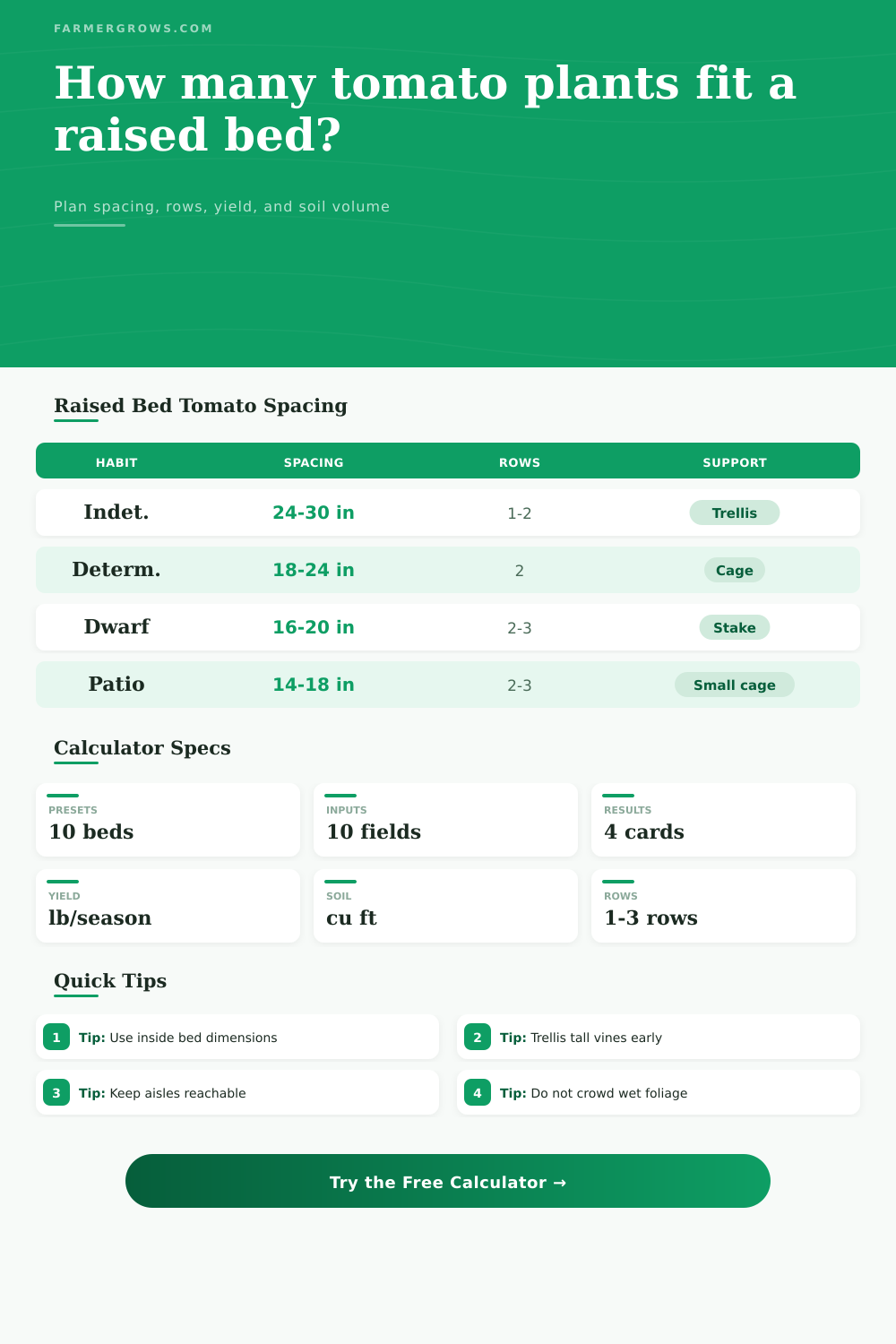
Use inside bed dimensions. Tomato spacing changes quickly with plant habit and support style: a pruned indeterminate on a string trellis can fit tighter along the row than an unpruned cage tomato.
1Raised bed tomato presets
2Bed dimensions and tomato inputs
Raised bed tomato plan
Spacing estimate updates as you change the bed and tomato settings.
3Tomato habit comparison grid
Best for string, stake, arch, or cattle panel support. Pruning allows tighter raised-bed spacing and easier harvest lanes.
Good for paste and sauce tomatoes. Heavy fruit set often benefits from cages or Florida weave support.
Shorter plants with sturdy stems. Useful where bed height and trellis height are limited.
Lower total yield per plant, but tight spacing can work in shallow or narrow raised beds.
4Reference cards and tables
| Support style | Spacing effect | Best raised bed use | Watch point |
|---|---|---|---|
| String trellis | Tightest spacing | Single or double row beds | Needs regular pruning and tying |
| Florida weave | Moderate spacing | Determinate rows | Works best with even plant height |
| Round cages | Widest spacing | Wide 4 ft beds and edge access | Cages can block companion crops |
| Arch panel | Moderate-tight spacing | Cherry tomatoes and vining types | Keep path side clear for harvest |
| Bed width | Likely row count | Good layout | Clearance note |
|---|---|---|---|
| 18-24 in | 1 row | Patio, dwarf, or single trellis | Harvest from one or both sides |
| 30-36 in | 1-2 rows | One tomato row plus basil strip | Two rows only with tight support |
| 42-48 in | 2 rows | Classic raised bed tomato layout | Keep center reachable |
| 60 in plus | 2-3 rows | Market-style block with paths | Internal access may be needed |
| Soil depth | 4 x 8 bed volume | Root-room fit | Tomato note |
|---|---|---|---|
| 8 in | 21.3 cu ft | Tight | Best for dwarf or compact tomatoes |
| 10 in | 26.7 cu ft | Fair | Use steady watering and mulch |
| 12 in | 32.0 cu ft | Good | Common raised-bed tomato depth |
| 16 in | 42.7 cu ft | Strong | More buffer for big vines |
| Bed example | Habit | Support | Typical plants |
|---|---|---|---|
| 2 x 6 narrow bed | Dwarf or patio | Small cage | 4 to 6 |
| 3 x 8 trellis bed | Indeterminate | String trellis | 4 to 5 |
| 4 x 8 caged bed | Determinate | Cage or weave | 6 to 8 |
| 4 x 12 arch bed | Cherry indet. | Arch panel | 8 to 10 |
5Raised bed tomato tips
A bed can mathematically fit more tomato stems than you will enjoy harvesting. Leave enough aisle and edge room to reach fruit without breaking stems.
String trellises assume regular tying and pruning. If you prefer low-maintenance plants, use the cage or light-pruning setting and accept wider spacing.
It’s panic buying. You buy ten tomato plants on a sunny Saturday with a bag of soil under your arm, standing in the garden center aisle believing that the more plants you buy, the bigger the salad. The math looks good, until it comes time to wrestle all those root balls into a four-by-eight raised bed. A lot of times, what results is a steamy jungle where no one gets any air. Most of us fall for this at home, counting heads rather than square footage. Yield doesn’t equal density.
It’s spatial arithmetic, and the online calculator (above) does that work for you. Just plug in size of your inside beds, choose which trellis you prefer and what growth habit chosen varieties have: indeterminate or determinate. Then add the aisle width and include any companion crops. Why? Because tomato plants grows out as they go up.
How to Plant Tomatoes
Indeterminates just keep on going if allowed to (until frost kills them). Determinates set their final size at maturity, but they can run wide with a heavy load of fruit. Depending on the habits of your two varieties, this can mean 10 inches per plant more space is needed. The second thing people overlook is the support structure. Big mistake. Are they trained onto one stake or string? It is much different than training them on a round cage. Cages take so much space! They block light and hold moisture next to foliage.
String trellises takes up less space because the vines grow vertically instead of taking up much width sideways. The calculator takes that into account. Observe what happens with your plant number recommendations when you swap out “string” versus “cage” from input field. Generally speaking, it increases, as now you’ll have fewer vining plants sprawled here and there, but many more trained into a single plane.
Another factor is how deep the soil is. Tomato roots like space; they’re extensive and thirsty. During a heat wave, stressed plants gets blossom end rot if their roots don’t have enough moisture. There is also competition for nutrients in a shallow bed. An eight-inch-deep bed means tomato roots must fight over limited resources. You may wish to restrict yourself to dwarf or patio varieties if that’s all you can provide. These plants has shallower root systems and less biomass to support than indeterminate types. With a deeper bed, indeterminates have room to stretch out and be happy (and not always thirsty!).
The depth of the bed calculation also allows you to calculate how much soil mix you’ll realy need to purchase. That way no one has to run back and forth to hardware store when it dawns on you that you miscalculated how many cubic feet of material you’d need to fill the area. Spacing decisions also hinge on pruning plans.
Planting closer together works if you will be trimming suckers periodically; you are eliminating some of your own foliage that might crowd the next plant. Plant farther apart if you don’t intend to do any pruning (which means you’ll have less yield per square foot; but easier life). This is the variable you change on the calculator. How many hands-on hours are you willing to give after planting? The closer you go, the more hands-on it will get. Planting farther apart is easy, but you won’t get as full a yield per square foot.
Don’t forget about companion plants. Tomatoes look great alongside basil, for instance; but basil must have some air and some light. Clearing an herb (or flower) row on one side reduces the space available to tomatoes; that means fewer rows, in turn. The calculator ignores any space not used by tomatoes when figuring your total area. Remember: Don’t plant companions right among the tomatoes’ leaves; they’ll create a damp area that is perfect for blight. Clear the edges.
You want to be able to get your hand in there to pick without snapping off branches or bruising the fruit. Depending upon the variety’s health and the climate, these are very different yield estimates. On the calculator, you’ll enter a per-plant target that gets converted into a season total. Consider this your “ceiling”, don’t expect it to be what you get; real world factors such as pests, heavy rain, or late spring frost will bring those yields down. Better to err on the side of fewer plants than a disappointing crop.
Plan ahead to save yourself grief later on: Plan your bed before you dig. You are trying to create an environment where each plant has room to grow. They need room to stretch their roots, catch some sun, and get a breath of air. Do not pack them as densely as possible. Productively packed.
When you stand back and check the overall plan, does it seem too crowded? Or is it organized? Because that’s what will produce food sustainably: balance. Begin with math, but rely on visual judgment when planting.