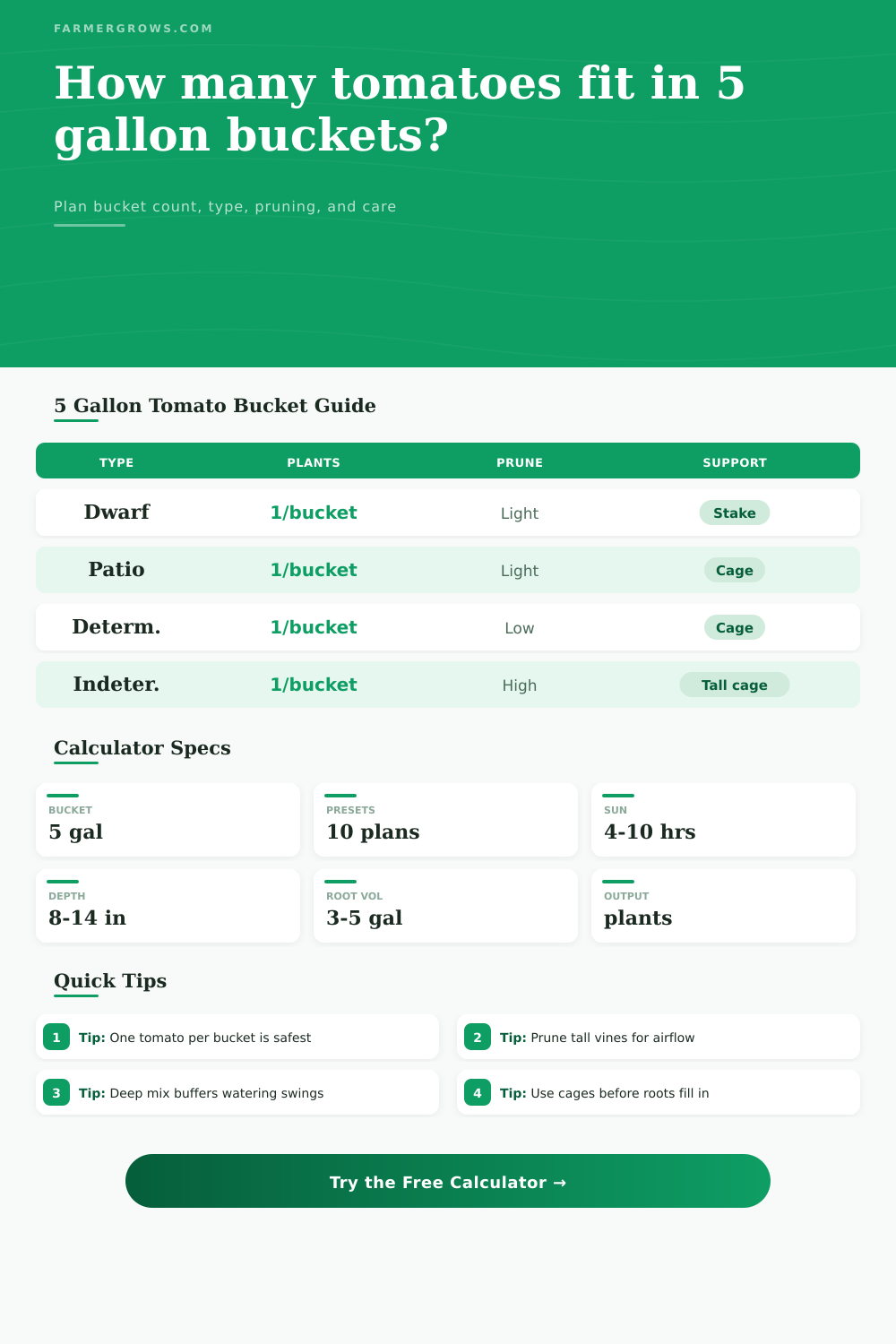
Tomato Plants Per 5 Gallon Bucket Calculator
Estimate how many tomato plants belong in 5 gallon buckets using bucket count, tomato type, pruning style, cage support, potting mix depth, root volume, sun, watering, fertilizer, and airflow.
Choose a common 5 gallon tomato setup, then adjust the bucket count, vine type, root volume, watering rhythm, and disease airflow for your exact patio or garden row.
Your 5 Gallon Tomato Bucket Plan
Results update after calculation.
One plant per 5 gallon bucket is comfortable. A short stake or compact cage usually supports the canopy.
One plant per bucket works well with steady feeding, a cage, and consistent watering through fruit swell.
One plant is possible when pruned and trellised. Letting it sprawl raises watering and disease pressure.
Use one plant only, prune hard, support early, and consider a larger container for better root buffering.
| Tomato type | 5 gallon plant count | Root demand | Best bucket use |
|---|---|---|---|
| Dwarf or micro patio | 1 plant per bucket | Low to moderate | Balcony crops, short cages, limited sun trials |
| Compact cherry or grape | 1 plant per bucket | Moderate | High fruit count where daily watering is easy |
| Determinate slicer | 1 plant per bucket | Moderate to high | Patio slicers, Roma types, sauce batches |
| Paste tomato | 1 plant per bucket | Moderate | Short season container harvests with cage support |
| Indeterminate slicer | 1 plant per bucket | High | Use only with pruning, tall cage, and strong sun |
| Large beefsteak or heirloom | 1 plant per bucket, no doubles | Very high | Accept lower yield or move up to 10 gallons |
| Pruning style | Canopy load | Support match | Bucket note |
|---|---|---|---|
| No pruning | High | Wide cage | Works best for dwarf and determinate plants, not tall vines |
| Light pruning | Medium | Short cage or stake | Remove low leaves to reduce splash disease |
| Moderate pruning | Controlled | Tall cage | Good balance for cherries and indeterminate slicers |
| Single leader | Low width, high height | Trellis or string | Useful when buckets are close but sun is strong |
| Condition | Bucket response | Calculator effect | Watch point |
|---|---|---|---|
| Every 2 to 3 days | Dry swings likely | Lowers care multiplier | Blossom end rot risk rises during fruit swell |
| Once daily | Good baseline | Neutral to positive | Check afternoon wilt in hot wind |
| Twice daily in heat | Strong peak support | Positive for large vines | Avoid constantly soggy mix |
| Drip or wicking | Most stable | Highest water score | Keep fertilizer diluted and even |
| Very strong fertilizer | Salt stress possible | Adds risk penalty | Flush mix if leaf edges burn |
| Setup | Bucket gap | Plants per 10 buckets | Airflow note |
|---|---|---|---|
| Dwarf patio row | 12 to 18 inches | 10 plants | Canopies stay compact if watered evenly |
| Determinate cage row | 18 to 24 inches | 10 plants | Better fruit drying after rain |
| Pruned indeterminate row | 24 to 30 inches | 10 plants | Tall support and pruning matter more than bucket count |
| Humid wall or fence line | 30 inches or more | 8 to 10 plants | Reserve space beats crowding in disease weather |
| Usable root volume | Depth signal | Best tomato type | Planning note |
|---|---|---|---|
| 3.0 to 3.5 gallons | Underfilled bucket | Dwarf only | Do not double plant; water swings fast |
| 3.6 to 4.2 gallons | Moderate fill | Patio and determinate | Use mulch and steady water |
| 4.3 to 5.0 gallons | Full bucket | Most single plants | Good baseline for one tomato plant |
| More than 5 gallons | Extended reservoir | Large vines | Still count as one plant per bucket |
Fit tip: Treat one tomato per 5 gallon bucket as the ceiling, then improve yield with pruning, support, and root volume instead of adding a second plant.
Airflow tip: In humid spots, fewer well-spaced buckets often beat a packed row because leaves dry faster and disease pressure drops.
Everyone knows that a single tomato plant go in every five gallon bucket. It is a nice, easy guideline that most times holds true. But as all gardeners know, there’s more to growing tomatoes in containers than that mantra.
Perhaps you have room for a big, meaty heirloom on your ample patio? Or perhaps you’re living on a tiny balcony, where something like a dwarf variety will be happier. Regardless of what container you use, the needs of the plant vary.
How to Use the Tomato Calculator
The calculator will help you find a balance between two: container limitations and tomato desires.
The first variable is root volume. After subtracting water, air pockets, and root space from a five gallon bucket, how many gallons do you have left of USEABLE soil? Enter your mix type and soil depth in the tool and it will calculates to adjust for that.
Why does this matter? Shallow soils dry out quickly; deep soils retains moisture better. That’s why an indeterminate cherry tomato, with its thirstiness, benefits from deeper soil as well. Too little effective depth (say, just three gallons) mean more frequent watering. Can you get away with your watering schedule or are you shortchanging the plant? Math time.
The next topics is support and pruning. Some growers plants big varieties into a plastic bucket, and expect their tomatoes to stay small. It won’t happen.
The calculator include two other factors: the type of cage you use and your pruning style. If you decide on a big beefsteak tomato but don’t provide any support or do any pruning, guess what? The computer output will probably tell you it’ll be a tough year.
Why? Because without pruning, there’s simply too much foliage, and no air circulation; diseases takes hold. It’s biology, folks.
When you select a tall cage and prune with the single leader approach, you’re altering the plant’s form. You sacrifice some width for more height. That’s good because it allows for better airflow and helps prevent fungal issues like mold. This help make for a healthier crop.
Airflow and sunlight are critical factors. Even with proper soil and cage, crowded buckets won’t thrive in the shade. How much sun? Is it windy or sheltered from those breezes? The tool require this information. Aim for six hours of direct sun, which should yields decent fruit. Less means growing not-food (ornamentals), but at least something.
How to manage humidity? Use this reference table. Crowded, humid conditions requires larger spacing between buckets. Why? Because wet leaves mean wet fruits, which means blight invitation. Space isn’t for looks; it’s to save your crop.
The next layer is fertilizer. Frequent watering deplete containers quickly. The calculator takes that into account. Overfeeding (heavy application in a small space) burns out roots; underfeeding starve them. Consistent input is best. Not sporadic big amounts.
So what it gives you is a readied rating of how well all those factors line up. If yours scores low, don’t despair (it’s not a lack of gardening skill), but simply that your environment or goals does not match what the plant needs.
Planning is beautiful, especially with this kind of structure, because it eliminates guessing from the start. No more throwing seed around and hoping something grows. A system is designed. The same logic apply whether it’s salad-sized tomatoes or one big canner-full.
Manage the water, support the weight, match the plant to the space. Then follow through on routine maintenance, and those variables becomes their own routine. Your bucket becomes something you know well, your patio a garden to rely off.