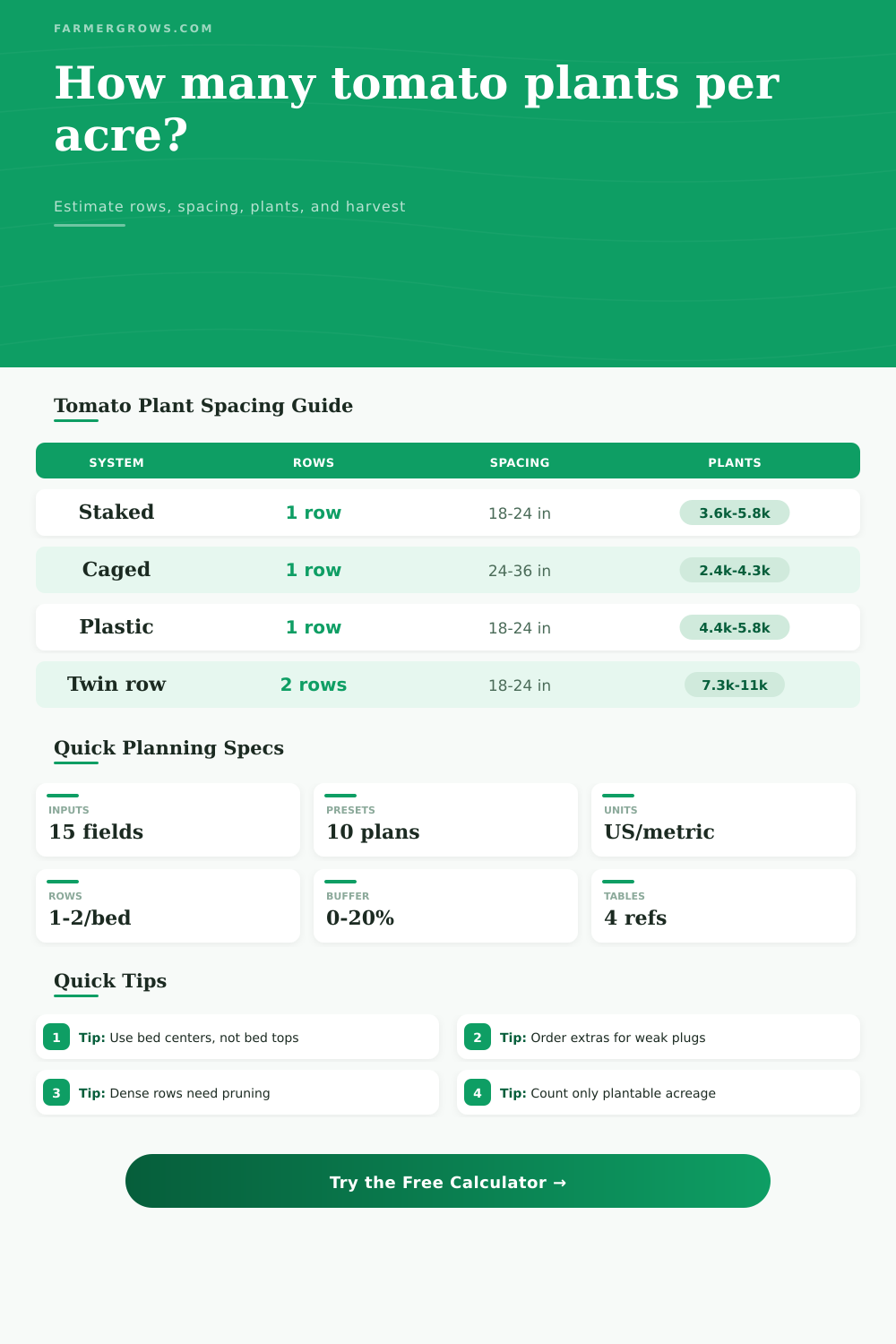
Tomato Plants Per Acre Calculator
Estimate tomato plant population, bed and row length, transplant order size, gross and net acre density, and harvest range for staked, caged, plasticulture, processing, and high tunnel layouts.
Use bed-center spacing from one row or bed center to the next. The usable planted area factor removes headlands, turn rows, irrigation headers, roadways, and unplanted edges before the calculator sizes the tomato stand.
Moderate in-row spacing supports tying, airflow, harvest access, and larger fruit size.
Plants need more room because canopy volume is carried by cage, basket weave, or lower pruning.
Bed center controls population because the planted bed, wheel track, drip line, and aisle share the acre.
Population is often planned around equipment width, determinate habit, and one-pass harvest timing.
Tomato Plant Population Results
Calculated from usable planted area, row center spacing, in-row spacing, and rows per bed.
| Tomato system | Bed or row centers | In-row spacing | Rows per bed | Typical use |
|---|---|---|---|---|
| Staked fresh market | 48 to 72 in | 18 to 24 in | 1 | Pruned plants, hand harvest, strong airflow |
| Caged determinate | 60 to 72 in | 24 to 36 in | 1 | Wider canopy and easier picking lanes |
| Plasticulture single row | 54 to 72 in | 18 to 24 in | 1 | Drip bed with mulch, stakes, or weave |
| Twin-row bed | 60 to 72 in | 18 to 24 in | 2 | High population where canopy care is intensive |
| Processing tomato | 60 to 66 in | 12 to 20 in | 1 | Determinate types and equipment-based spacing |
| High tunnel trellis | 36 to 54 in | 18 to 24 in | 1 to 2 | Managed pruning with vertical support |
| Spacing pattern | Plants per acre | Plants per hectare | Row feet per acre | Density cue |
|---|---|---|---|---|
| 72 in x 36 in, 1 row | 2,420 | 5,980 | 7,260 ft | Very wide for cages or heirlooms |
| 60 in x 24 in, 1 row | 4,356 | 10,764 | 8,712 ft | Common fresh market baseline |
| 54 in x 20 in, 1 row | 5,808 | 14,352 | 9,680 ft | Moderately dense staked planting |
| 48 in x 18 in, 1 row | 7,260 | 17,940 | 10,890 ft | Dense field or tunnel management |
| 60 in x 18 in, 2 rows | 11,616 | 28,704 | 17,424 ft | Very intensive twin-row layout |
| Field scale | Gross sq ft | At 80% planted | At 4,356/ac | At 5,808/ac |
|---|---|---|---|---|
| 0.10 acre | 4,356 | 3,485 sq ft | 348 plants | 465 plants |
| 0.25 acre | 10,890 | 8,712 sq ft | 871 plants | 1,162 plants |
| 0.50 acre | 21,780 | 17,424 sq ft | 1,742 plants | 2,323 plants |
| 1.00 acre | 43,560 | 34,848 sq ft | 3,485 plants | 4,646 plants |
| 2.00 acres | 87,120 | 69,696 sq ft | 6,970 plants | 9,293 plants |
| Planning factor | Conservative | Typical | Strong | How to use it |
|---|---|---|---|---|
| Usable planted area | 70% | 85% | 94% | Lower for wide headlands, service lanes, and water rows |
| Transplant establishment | 85% | 94% | 98% | Lower for hot planting, weak plugs, or rough handling |
| Order buffer | 5% | 10% | 20% | Add extras for gaps, replacements, and poor starts |
| Row-end loss | 2% | 5% | 12% | Accounts for row breaks, valves, and odd field edges |
| Cull allowance | 5% | 12% | 25% | Use higher values for cracking, sunscald, disease, or rough harvests |
For bedded fields: Enter the bed center distance, not just the plastic top width. The aisle and wheel track are part of the acre and reduce total rows.
For transplant orders: The order estimate divides by expected establishment before adding buffer, so it covers both weak starts and planned replacements.
In spring, the transplant truck backs into field and the real work starts. You’ve got the soil; you’ve got the plants. Big harvest time, right? It is not actualy like that.
Look at what’s between rows. Spacing isn’t just about getting stuff to fit. It is about airflow, it is about light management. And yes, it is about your own sanity. Many people don’t admit how important getting the number of plants right can be.
Why Plant Spacing Matters
Having too few plant wastes land and fertilizer. Too many plants, and you’ve created a humid tunnel of nowhere for disease to thrive. When air doesn’t move, fruit quality suffers.
Use the calculator above. It does the math for you after you plug in your row widths so you don’t have to do all the conversions and coefficient guessing.
Growers is most likely to make a mistake in their plant count or ordering because they focus on the row length. “I can fit x amount of plants into one-hundred feet.” And then they say, “So I’ll have y amount of plants per row,” and they adds up those rows.
What about the acre? Forty-three thousand, five-hundred sixty square feet. But not every inch of an acre is plantable. There are headlands so tractor can turn around. There are spaces for irrigation headers. There needs to be room for walking without stepping on any plants.
The tool considers these factors with its usable planted area. Wide aisles drives that number down. These are little things, but they matter. If you lose 10 percent of your usable planting area, you would of ordered hundreds fewer plants. And wasting money on over-ordering is no good. Under-ordering results in gaps in your fields which reduces your yield.
“It depends on your system. If it’s a staked fresh market tomato, there must be some air circulation around each plant. Eighteen to twenty-four inches is what you’re looking for. That way, you can pick the fruit and tie up the vines easly. With caged plants, they becomes bushier and take up more vertical space. Twenty-four to thirty-six inches apart is what you’ll want. An efficient plastic mulch system is like that, too. Population control is in center of the bed. An acre contains 1 planted bed + wheel track + drip line + aisle. The table on page spells it out. It’s not purely geometric; it’s also how you’ll work with the crop.”
What about a twin row bed? You double up the density. Two rows right next to each other. Sounds good for yield, but canopy management gets real hot and heavy. And pruning is tougher. And if the twin rows are too narrow, airflow can be compromised.
The calculator will show you the overall length of plants in rows. So you’ll know if the twin row should get heavy pruning, based off how high the stand intensity score comes out. The denser the twin, the more it need help. There is a reason for this.
There is one more variable: transplant survival. You figure all the transplants are going to make it. They don’t. Some are lost to weather, some succumb to transplant shock. The tool allows you to enter your estimated establishment rate. As a hedge, add in a few more: maybe ten or twenty percent. Plug up any weak ones.
How do you know your plug quality? That’s where knowing your grower comes into play. Go easy on the tough stuff; go heavy on the tender things. Better safe than sorry.
All comes back to the harvest estimate. The calculator calculates yield range. It includes the percentage of damaged fruit that must be thrown away. It provides you with a realistic picture of what you’ll have to harvest. You know how much time you’ll need to spend. You’re planning your work, a planting plan becomes a business plan.
What? No, filling every single square inch isn’t the point. Filling the right square inches is the point. You begin with inches and end up with fruit. Inches are the measure of the space in between.