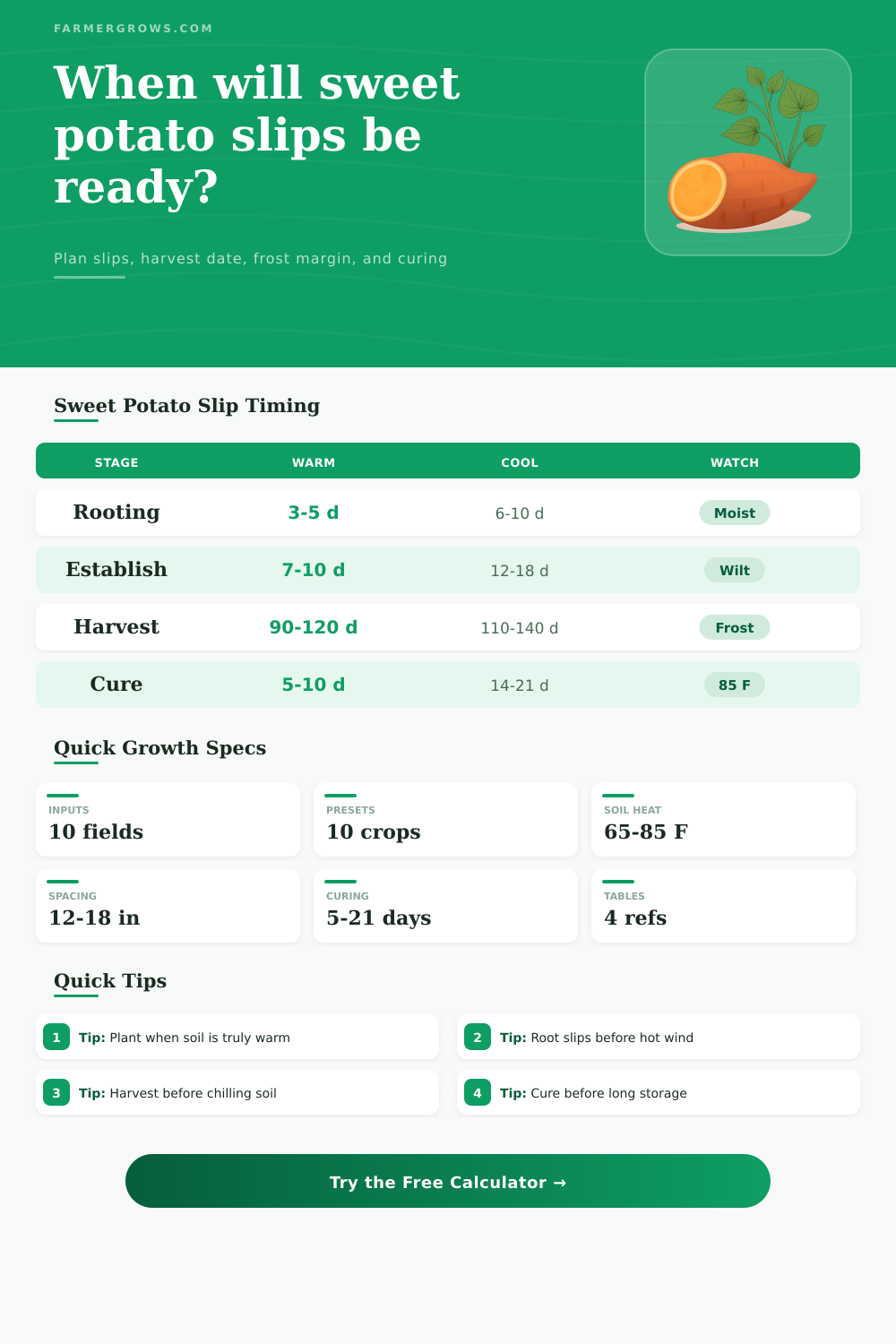
Sweet Potato From Slips Growth Time Calculator
Estimate when rooted or fresh-cut sweet potato slips will establish, size roots, beat frost, and finish curing based on transplant date, soil warmth, spacing, and variety maturity.
Use field conditions for the week after transplanting. Sweet potatoes count warm growing time from slips, so cool soil, weak roots, crowded spacing, and an early frost date can all move the practical harvest window.
Sweet Potato Slip Growth Results
Dates are planning estimates. Dig a few test roots before the full harvest if frost is close or vines stayed slow after transplanting.
| Variety | Typical maturity from slips | Growth habit | Planning note |
|---|---|---|---|
| Georgia Jet | About 90 days | Vigorous, fast sizing | Useful where the warm season is short |
| Centennial | About 90 days | Productive orange roots | Often chosen for dependable early digging |
| Vardaman | About 100 days | Bushier vines | Helpful for tighter beds or smaller gardens |
| Beauregard | About 105 days | Widely grown orange roots | Give extra time in cool spring soil |
| Covington | About 105 days | Uniform orange roots | Common market type with steady maturity |
| Jewel | About 120 days | Longer-season vines | Needs a generous frost-free window |
| Slip condition | Rooting allowance | Transplant care | Calculator effect |
|---|---|---|---|
| Well-rooted slips | 0 to 2 days | Keep moist but not waterlogged | Fastest establishment setting |
| Lightly rooted slips | 3 to 5 days | Firm soil around roots, shade if wilting | Adds a small delay before strong vines |
| Fresh-cut slips | 5 to 8 days | Water daily until roots grab | Adds rooting time to the growth count |
| Wilted shipped slips | 7 to 12 days | Recover in damp media before or after planting | Adds a recovery delay for slow starts |
| Soil temperature at transplant | Slip response | Timing adjustment | Field note |
|---|---|---|---|
| Below 60 F | High stress | Add 14 days or more | Wait if possible; chilling slows roots |
| 60 to 64 F | Slow rooting | Add about 9 days | Use covers or black mulch in cool areas |
| 65 to 69 F | Acceptable start | Add about 4 days | Good with steady moisture and sun |
| 70 to 84 F | Strong start | No delay | Preferred planting range for slips |
| 85 F plus | Fast but thirsty | Add 2 stress days | Protect from hot wind until rooted |
| Spacing plan | Plants per 100 ft row | Bed area per slip | Growth-time note |
|---|---|---|---|
| 12 in x 36 in | 100 slips | 3.0 sq ft | Higher count, watch for small roots |
| 15 in x 36 in | 80 slips | 3.8 sq ft | Balanced for many home gardens |
| 18 in x 40 in | 67 slips | 5.0 sq ft | More root sizing room |
| 24 in x 42 in | 50 slips | 7.0 sq ft | Wide spacing for big vines or poor soil |
Before transplanting: Do not rush slips into cold beds. A later planting into 70 F soil can catch up to an early planting that sat chilled and barely rooted.
Before digging: Sweet potato skins bruise easily at harvest. Plan the curing space before the harvest date so roots move quickly into warmth and humidity.
Three weeks until frost, and those sweet potato vines are still green? Panic sets in. Many gardeners feel this way, especially those who see the calendar as more of a guide than a rule and assume that planting slips in cool ground can absorbs, even though it is just a way to buy extra time. That’s where the calculator comes in: thinking of time as a precious commodity instead of a bottomless one. You can plan backward from your deadline; your actual deadline, to prevent yourself from going down this blind alley again.
Soil temperature at transplant time are actually the single most important factor in this tool. Why? Because everyone thinks it’s safe to plant as soon as it no longer feels cold to us out here in the air. It never occurs to most folk that their actual crop can only grow in soil temperatures above seventy degrees F. Anything below sixty-five will slow down to a crawl and have a much greater chance of rotting. The tool uses this fact to calculate how long you will have to wait before harvesting. You might be planting early in cool soil. Expect to wait even longer, often dangerously close to your first frost date, as the calculator shows you. This forces you to think through a choice: get the slips in now, but they may not grow large enough roots to store until next year.
Why Soil Temperature Matters Most
Don’t assume it’s only about soil warmth; also consider slip condition. Is it rooted well? Does it have two inches of good white roots? Or does it need time to recover from being cut and sent? A wilted shipment or a fresh-cut stem will require healing time before any energy goes down into the roots. That’s why you may find two neighbors who planted side by side on the same date: one was up and growing in vines in a week’s time, while the other hasn’t even taken yet because the slips haven’t rooted into their new home. The chart on the page makes that clear, adding days if there were setbacks in getting them rooted. That isn’t penalizing them arbitrarily, but reflecting biology: Under stressful conditions, a plant can’t grow shoots and develop roots efficienty at the same time. It will go with whichever is more necessary to its survival, rather than expansion.
I want to draw particular attention to how important spacing is. Most home gardeners do not pay enough attention to this aspect of growing things in their gardens. It may look like smart gardening to crowd your slips, trying to get maximum yield on every square foot, but crowded vines makes tubers smaller (they don’t have enough room), and take longer to harvest, too. Because the vines all get tangled up. Each slip needs ample room so its vines can spread out and not choke the ones next to it. This results in more airflow and root space. And that means straight-up better roots that dig up cleaner and bigger. Changing those spacing inputs isn’t just tinkering with geometry, it’s tinkering with the quality of what ends up in your final harvest.
But then there’s the final step: Curing. Depending on when you start, that could mean curing your haul all the way through February; or watching it rot by December. Proper curing requires high humidity and specific temperatures for about ten to fourteen days after digging. The calendar includes the post-dig timeframe. This means it doesn’t just tell you when to dig; it also lets you know when the tubers can move into long-term storage. This shows you when it is no longer worth digging later in the season, as many gardeners do without enough time to cure them before winter arrives.
Growing sweet potatoes, in short, is a race against thermodynamics: Energy comes from the sun; soil holds that energy. Respecting those physical limits is planning ahead, and would of more sane than wishing to make nature bend to your calendar. Start with warm dirt, give the roots time to breathe, and then let nature take its course.