
Sweet potato gardening gets you down when the vines grows fast but you only harvest a handful of usable tubers from your effort. Did you really put it in on time? Did you water regular? Yet despite all that there you are digging around, feeling like you’re in empty soil.
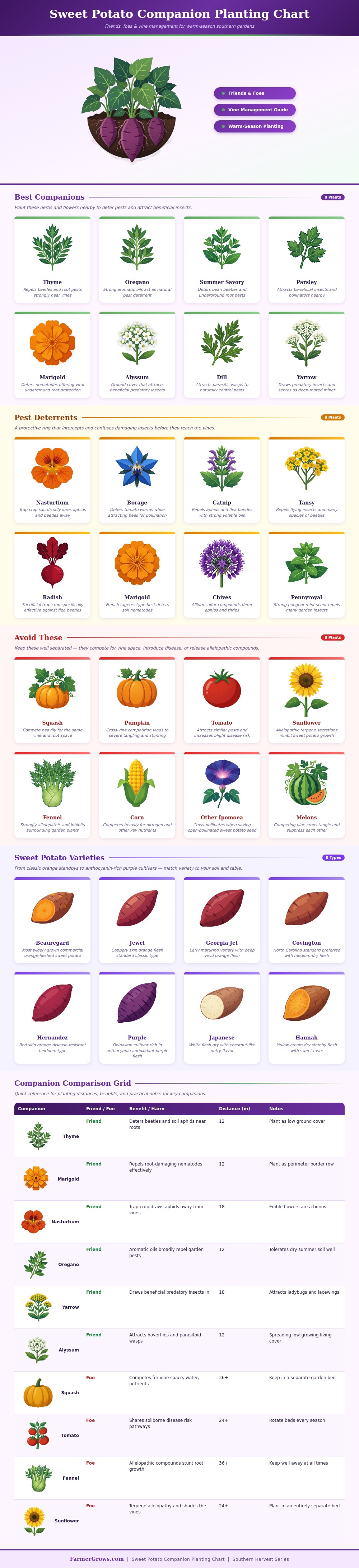
Usually the problem is not the sweet potato itself, but what else was growing beside it. What else did you invite into garden with that sweet potato? Sweet potatoes don’t like to share their space with certain other plants whose aggressive vines and ravenous roots takes over. Growing a group of plant that work well together produces better results. This visual guide, Sweet Potato Friends and Foes, breaks down who is good for company and who is not.
Who Grows Well with Sweet Potatoes
The tactic here is less about looks then it is about resource management and chemical warfare. As in, “Ooh, I need a plant to make my garden smell great.” That’s one level of protection, but you’re also using plants to help stop root pests like beetles. It’s all about a living pest control system.
Marigolds is especially important. Nematodes are microscopic critters in the soil that cause havoc with otherwise-healthy roots and they hate marigolds. Planting marigolds around perimeter makes for a buffer zone.
Nasturtiums serve as trap crops. Beetles and aphids love them and don’t touch the sweet potatoes (a trick that spares your precious crop, but costs you a few nasturtium leaves). No need to spray any chemcials. Sweet!
Ditto dill and alyssum lures in beneficial insects that prey on pests. Think of these guys as bodyguards for the vines.
Don’t grow sweet potatoes alongside squash and pumpkins which like to tangle vines (no one wins), or tomatoes, which are on the same disease pathway. For the good of the soil, rotate these crop.
Another less obvious danger is fennel and sunflowers, which release substances that stops neighboring plants from growing. Sunflowers cast a long shadow as well. Full sun are needed for sweet potatoes to get their energy converted to starch-filled tubers.
There’s a strategic component here too: Which variety? For traditional orange-fleshed goodness, you can’t go wrong with either Beaureguard or Jewel. If you’re in a cooler climate, try the early maturing variety Georgia Jet. The beautiful purple-fleshed Okinawan sweet potatoes is not only good to look at but are also packed with antioxidants. For savory uses, such as when it’s texture that counts over the sweet taste, go for dry varieties like Hannah or Japanese (which is realy quite starchy). Match your cooking habits, not necessarily your garden real estate.
Gardeners think in terms off ecosystems, of plants as companions who help each other thrive, as well as who don’t; it’s not about hard-and-fast rules but about knowing how to make plants play nice together. Once you grasp the web of crop relationships, the garden should of stopped feeling like work and starts feeling like a managed community. Some plants grows well alongside sweet potatoes and help them spread, while others do not. Plan accordingly and reap the reward: the harvest.