Sunflower Seed Germination Time Calculator
Estimate sunflower emergence, thinning date, first bud timing, and bloom start from soil temperature, sowing depth, seed age, row spacing, zone, and bird protection.
Sunflowers usually germinate best after the soil is genuinely warm. Use this estimator for field planning, container sowing, cut-flower successions, oilseed rows, or a quick birdseed viability trial.
Large heads, deep roots, slower canopy fill, and a longer wait from sowing to bloom.
Shorter plants with faster bud timing, useful where pot volume and spacing are tight.
Uniform florist stems often bloom quickly when successions are sown into warm beds.
Field types germinate evenly when soil moisture is steady and seed is not too deep.
Sunflower Germination Timeline
Dates use your sowing date, estimated emergence speed, class maturity, and stress adjustments from depth, moisture, spacing, seed age, and zone.
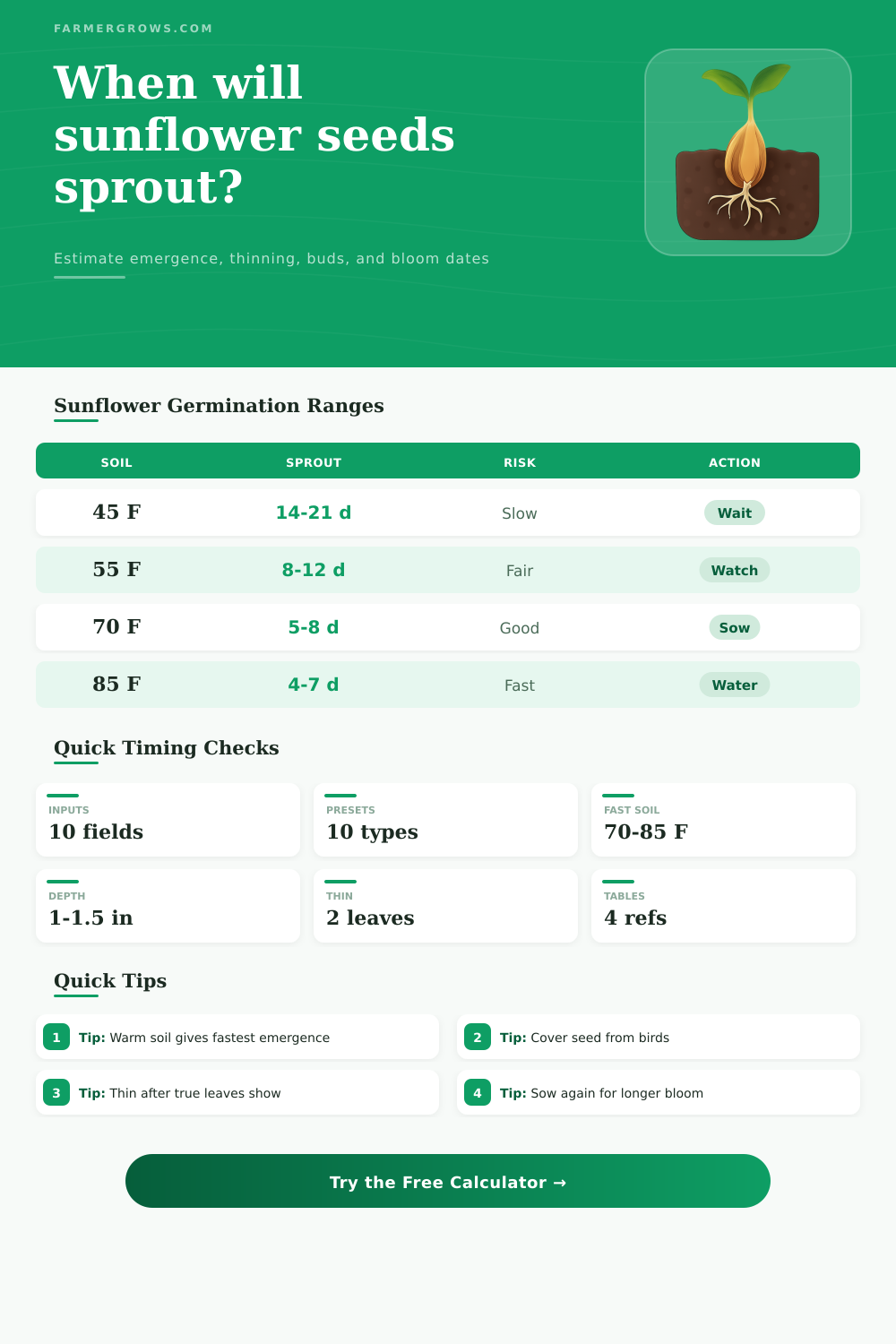
| Soil temperature | Expected emergence | Stand risk | Planting note |
|---|---|---|---|
| Below 45°F | Often stalls or rots | High | Wait for warmer soil unless testing a few seeds only. |
| 45 to 49°F | 14 to 21 days | High to moderate | Cool beds delay sprouting and expose seed to birds longer. |
| 50 to 59°F | 8 to 16 days | Moderate | Usable for early sowing if drainage and seed quality are good. |
| 60 to 74°F | 5 to 10 days | Low | Strong garden range for most sunflower types. |
| 75 to 85°F | 4 to 7 days | Low | Fast emergence if the surface stays evenly moist. |
| Above 90°F | 6 to 10 days | Moderate | Heat and dry crusting can slow or reduce stand. |
| Seed depth | Best use | Emergence effect | Field note |
|---|---|---|---|
| 0.5 inch | Heavy clay or small pots | Fast but exposed | Use firm contact and bird cover because seed is easy to find. |
| 0.75 to 1 inch | Cool spring beds | Near ideal | Good compromise when soil is moist but not hot. |
| 1 to 1.5 inches | Most gardens | Ideal | Best balance of moisture, anchoring, and quick emergence. |
| 1.75 to 2 inches | Dry sandy soil | Slight delay | Can reach moisture, but weak or old seed may struggle. |
| Over 2 inches | Rare emergency depth | Slow and uneven | Use only for very dry soil and strong fresh seed. |
| Sunflower class | Common spacing | Bud estimate | Bloom estimate |
|---|---|---|---|
| Mammoth / giant | 18 to 30 inches | 50 to 65 days | 75 to 95 days |
| Dwarf / container | 6 to 12 inches | 35 to 45 days | 50 to 65 days |
| Pollenless cut flower | 6 to 12 inches | 38 to 50 days | 55 to 70 days |
| Oilseed / row crop | 8 to 16 inches | 42 to 55 days | 60 to 75 days |
| Birdseed mixed trial | 8 to 18 inches | 45 to 60 days | 65 to 85 days |
| Spacing / bloom plan | Plant response | Bloom timing | Use case |
|---|---|---|---|
| 6 inch cut rows | Thinner stems | May bloom 2 to 4 days later | Pollenless bouquets and single-stem cuts. |
| 12 inch garden rows | Balanced stems | Normal timing | Most dwarf, cut, and medium garden types. |
| 18 inch field rows | Broad leaves | Normal to slightly earlier | Oilseed, wildlife rows, and medium heads. |
| 24 to 30 inch giants | Larger heads | Often longer season | Mammoth displays and edible seed heads. |
| 7 to 14 day succession | Staggered stems | Rolling bloom waves | Cut flower harvest and pollinator beds. |
For faster emergence: Sow after soil reaches at least 55°F, then keep the seed zone evenly moist until the hook breaks the surface.
For a cleaner stand: Cover direct-sown rows with netting or lightweight row cover, then remove it once seedlings are up and sturdy.
If sunflower seeds fail to germinate, and you’re left with a mess of mushy kernels after six weeks, it can be heartbreaking for a gardener. Why? Gardeners plants by date instead of soil temperature. Most times it’s not that there was anything wrong with those seeds; it was simply too cold for them where they lay.
Moisture helps, and warmth causes them to pop open. If they don’t get warm enough, they will stay stuck in time and become even more likely to be eaten by squirrels or grow fungus.
Tips for Growing Healthy Sunflowers
Soil information goes into this calculator. It then calculates a timeline for when things will emerge, when to thin, and when to bloom. The variables such as how deep you planted seeds, or what age your seed is, are factored in so that the timing is reasonable. You do not need a science degree to use it, though the more you understand about those input factors, the better.
The most important variable is soil temperature. Unlike cool-season plants like spinach and peas, sunflowers needs warmth. Below forty-five degrees, it will be even slower getting going (and also out of ground longer, where birds can get at them). If the soil’s fifty-five or warmer when they go in, that makes a big difference. Warmer means more biological action, helping seed put down roots before someone else does.
The tool takes heat into account, which alters the effects of sowing date: In a cool northern zone, the planting date says one thing; in a cozy microclimate, something else.
Growing habits are related to depth of planting as well. Some gardeners believe in planting sunflower seeds really deep to protect them from elements. However, any deeper than an inch and a half requires the seedling to use up precious energy pushing up through soil. It hampers plant’s growth, delaying it in getting its true leaves up and running. About an inch deep will do it; the cotyledons push right on up, strong and swift.
As soon as green hooks emerge, start thinning. Though it’s tempting to leave everything intact, the more crowded they get, the fewer resources there is for each one. This crowding will stunt their growth. By thinning, you’re allowing each plant room to grow its own deep root system instead of fighting over moisture on surface. When done once true leaves have emerged, it jump-starts other plants to form sturdy stems.
If you prefer a continuous bloom (instead of just one big harvest), succession planting is a way. If you stagger your sowings with a couple of weeks difference, you have rolling waves of flowers rather than a big bloom all at once. That keeps pollinators busy through the summer. The calculator will do that math for you and show you what overlapping in time multiple plantings might mean.
One more thing is protection from birds, which are usually the last barrier. Netting or lightweight row covers can gives seedlings a crucial buffer during their most vulnerabel phase. Wait till seedlings have toughened up before removing the protection, otherwise, you’ll create shade problems without losing too many plants. It pays off with flowers growing evenly.
When it comes to growing sunflowers, go with nature, not against her. Your timing matches when you align what the plants want to do with how they want it done. If that means waiting for soil temperature to be correct, then let it be so. That’s the way to get off on the right foot: When the seeds are ready to go, they will tell you if they have what they need.