Sunflower Plants Per Acre Calculator
Estimate sunflower plant population from row spacing, in-row spacing, planted acreage, stand survival, headlands, seed count, and planter skips before seed goes in the box.
Use final stand targets for your hybrid, moisture profile, and market class. The calculator converts metric spacing internally, then reports live seed needs, expected emerged stand, seed weight, and planter row-foot checks.
★ Planting presets
⚙ Common sunflower systems
Typical dryland field population where head size and oil yield must stay balanced.
Lower stands help preserve larger seed size and stronger head fill.
Higher water and fertility support a thicker stand without starving heads.
Dense blocks make smaller stems; spacing varies heavily by stem target.
📏 Field and spacing inputs
Sunflower stand estimate
Your calculated plant population and seed order will appear here.
Calculation breakdown
🌻 Seed and stand quick cards
📊 Plants per acre by spacing
| Row spacing | Plant spacing | Plants per acre | Field use |
|---|---|---|---|
| 20 in | 12 in | 26,136 | Narrow oilseed or irrigated fields |
| 22 in | 11 in | 25,920 | Narrow planter with high resource target |
| 30 in | 8 in | 26,136 | High stand or smaller-head oilseed |
| 30 in | 9.5 in | 22,006 | Common oilseed sunflower setup |
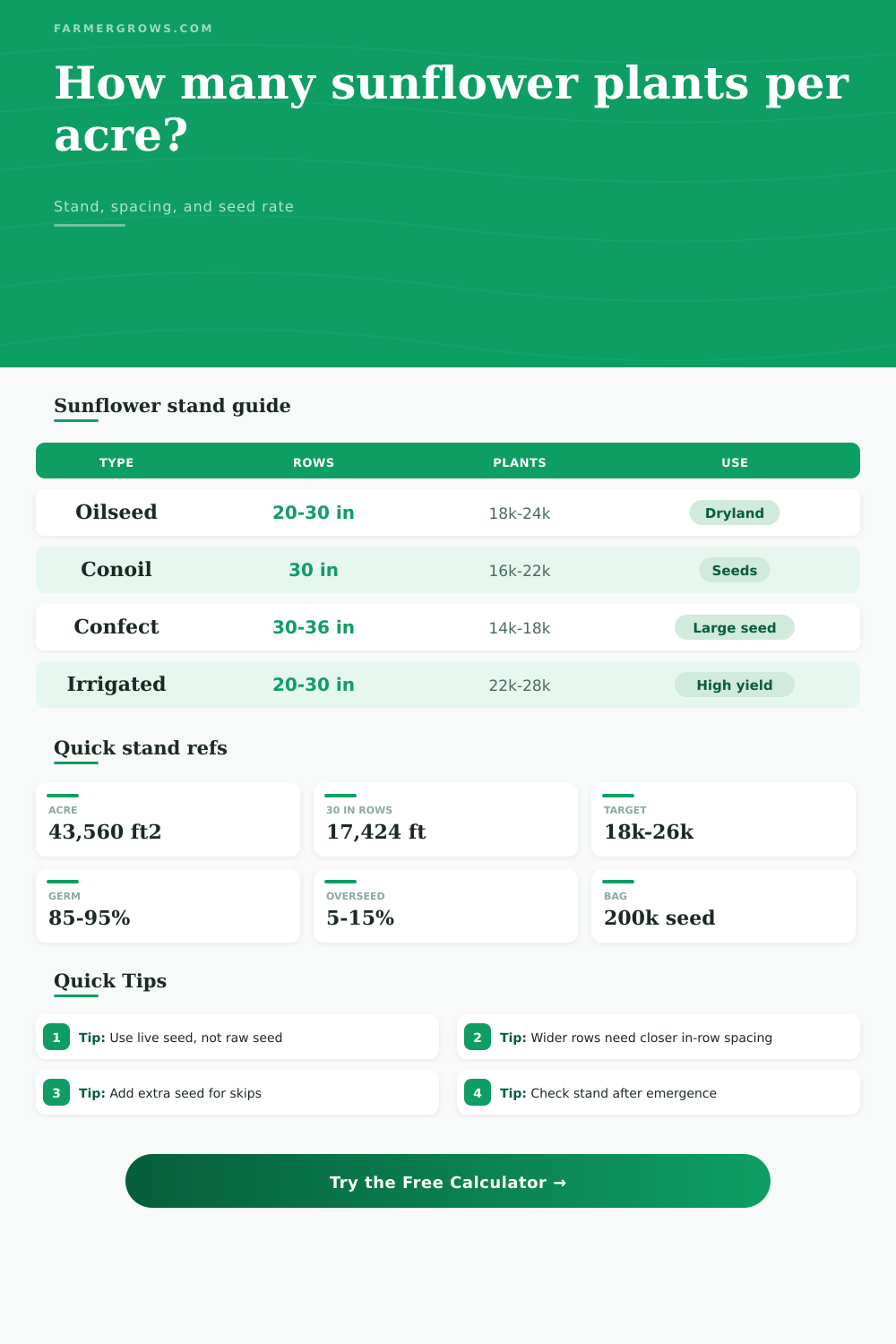
| 30 in | 12 in | 17,424 | Moderate dryland or confection target |
| 36 in | 12 in | 14,520 | Wide-row confection or cultivation |
📝 Market class reference
| Sunflower type | Typical final stand | Common rows | Planning note |
|---|---|---|---|
| Oilseed hybrid | 18,000-26,000 plants/ac | 20-30 in | Adjust upward with reliable moisture and fertility. |
| Confection large seed | 14,000-19,000 plants/ac | 30-36 in | Lower stands protect seed size and head fill. |
| Conoil or birdseed | 16,000-22,000 plants/ac | 30 in | Often managed between oilseed and confection targets. |
| Cut flower single stem | 35,000-90,000 plants/ac | Beds or drills | Dense blocks make smaller flowers and longer stems. |
| Wildlife strip | 8,000-18,000 plants/ac | Drilled or broadcast | Lower uniformity is normal in mixed habitat plantings. |
📦 Seed unit conversion table
| Seeds per bag | Seeds per acre | Acres per bag | Use case |
|---|---|---|---|
| 150,000 | 18,000 | 8.33 | Small lots or confection seed units |
| 200,000 | 20,000 | 10.00 | Common planning unit for many hybrids |
| 200,000 | 24,000 | 8.33 | High stand oilseed planting |
| 250,000 | 20,000 | 12.50 | Bulk unit or larger commercial order |
| 1,000,000 | 22,000 | 45.45 | Tote or mini-bulk planning |
✓ Stand planning notes
Seed drop should be higher than the desired final stand when germination, field emergence, and planter accuracy are below 100 percent.
Thin stands produce larger heads but may underuse the acre. Thick stands can raise competition, lodging pressure, and smaller seed size.
For a quick field audit, count plants over 17.4 feet of 30 inch row; the count multiplied by 1,000 approximates plants per acre.
The metric toggle converts hectares, centimeters, and kilograms back to acre-based results so planter settings remain easy to compare.
When the tires hit the ground, sunflower plans become real. The plants is quite forgiving, up to a point. Getting the population density right are all about striking a balance between yield potential and competition.
Plant too few, and you’ll be wasting that acre’s potential by leaving light and moisture untapped; plant too many and you’ll be stifling your plants, crowding them with one another until the heads fails to fill and the stalks start to lodge in the wind. Walk a line between suffocation and scarcity.
How to Plant the Right Number of Sunflowers
Most growers begin by looking at market class, because the end use dictates the biological ceiling. “So for example, if you’re growing an oilseed hybrid, you want a dense canopy to maximize ground cover, keep the weeds down, and have a lot of heads and a lot of oil. So tight spacing (between eighteen and twenty-four thousand plants per acre) is where they like to run.” Confection, on the other hand, is sold by seed itself, so size does matter. You want a stand of fourteen to eighteen thousand plant so that there is enough room for each head to expand and not starve itself out. Planting snack sunflowers at oilseed density results in shriveled, tiny seeds that processing equipment won’t accept.
Plug in your own hybrid type, and the calculator will do the rest for you, saving you from having to guess what type of biological target to apply to your contract.
Row spacing is where biology collides with the mechanical. The conventional wisdom; thirty inch rows, is a nice compromise between weed control and field capacity. Going to twenty inches is fine, too, as long as you plant seeds very close together. This create more leaf cover sooner. That help in rainy weather or when late weeds might grow.
With narrower rows comes the need for tighter control of your planter. Any inconsistency with down pressure or meter clogging show up in gaps in a narrow row. On the other hand, going wider; say, thirty-six inches, lets you cultivate a bit more easy, but you’ll have a bare row down the middle longer. Whether that’s friend or foe depends on what it is you’re cultivating: Cover crop…or losing moisture?
It’s all about knowing what you’re measuring, which is largely the trick. If your planter is set to drop twenty seeds per ten inches, fine, but that’s only half the story. What happens then? It depend on field conditions and germination rates. Warm germination numbers come from seed tags; they are the best case scenario. Field emergence, the rubber meeting the road, is something else entirely. A sudden cold snap, soil crusting or even wireworms can cause trouble with that starting number. Add some built-in safety margin of ten to fifteen percent more seed to cover those losses and it make sense.
Shortfalls are common when ordering up to the last digit what you think you’ll need. The silent yield killer is planter skips. One skip here or there in a long row doesn’t look like much but they adds up fast. After emergence you can use the tool to check your stand with its row-foot check feature. This helps you count plants in a fixed length of row and then multiply to get an accurat snapshot of reality versus hope. You cannot manage what you don’t measure.
Last but not least, take into account where you get your water from. If you irrigate fields, you can grow more plants because you eliminate the water stress that usually limits head size. On dryland, go conservative. You could of forced a high-density stand without moisture to back it up. The table on the page sets out the ranges and points out that irrigation moves the optimum up. A slight tweak in the inputs makes a huge difference in the outcome of the final checkbook.
It’s not just about agronomy, planting sunflowers is also about risk management. You’re taking bets: Will weather cooperate? Was the seed still viable? What will the soil temperature be? The calculator provides a structured process to work through those variables before the seed hits the box. It turns a vague feeling of uncertainty into something solid. Then you plant the seed, you wait for the rain, and at least you know exactly what number of chances you’ve given the crop to succeed.