Sun for Succulents Calculator
Score succulent light exposure, compare the plant against its preferred sun range, estimate burn risk from UV, heat, window direction, pot color, shade cloth, acclimation time, season, and current leaf stress, then get a week-by-week acclimation plan.
Use direct sun hours for the light that actually reaches the leaves. Indoors, window glass weakens UV and total intensity, while outdoors a hot dark pot can make the same sun exposure much harsher.
Succulent Light Results
The calculator will compare current sun with the selected succulent light range.
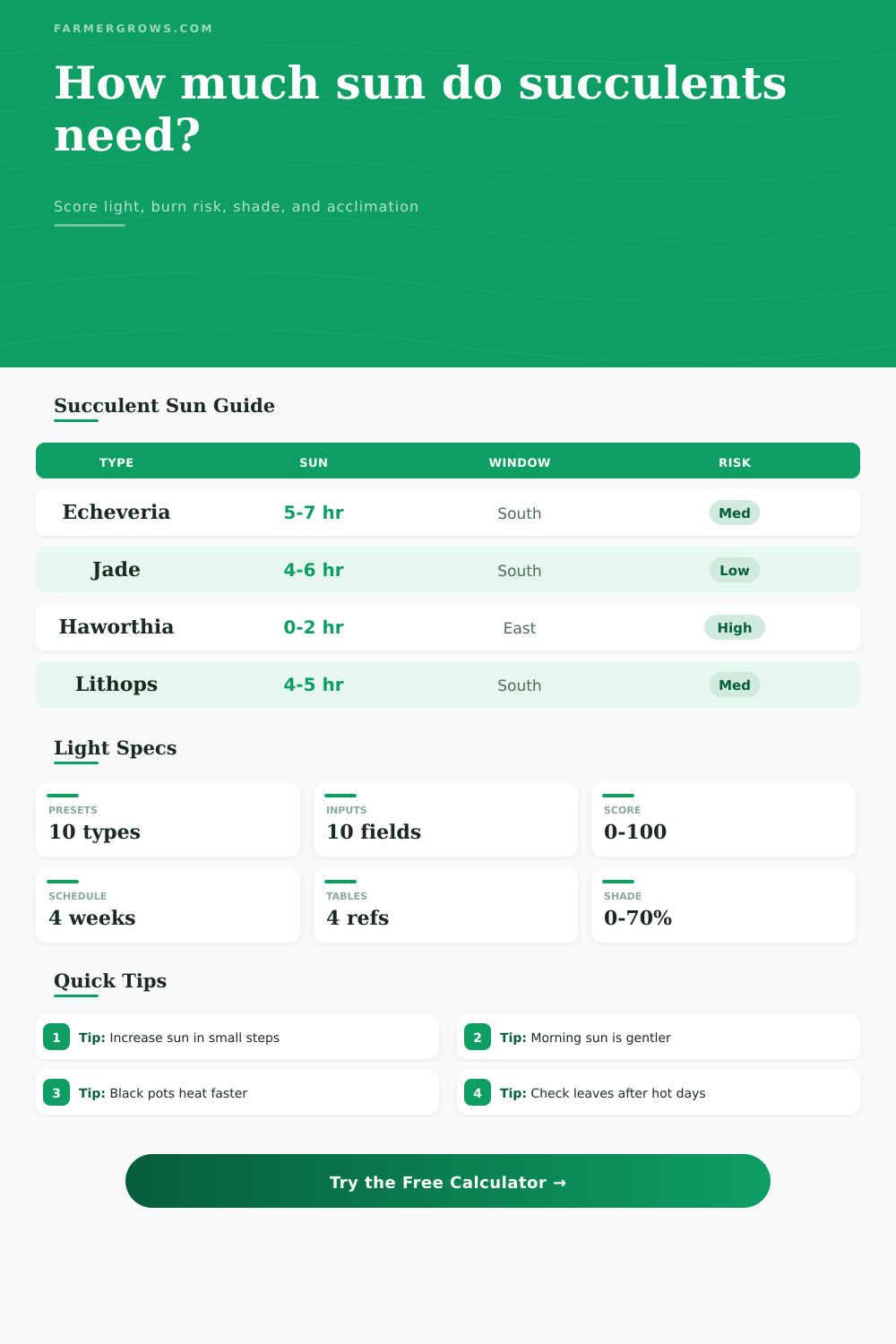
| Succulent type | Target direct sun | Best indoor placement | Notes for growers |
|---|---|---|---|
| Echeveria | 5-7 hours | South or strong west window | Needs strong light for compact rosettes, but new plants burn if moved abruptly. |
| Sempervivum | 6-9 hours | Usually better outdoors | Cold-hardy rosettes prefer full outdoor sun once rooted and watered correctly. |
| Sedum | 5-8 hours | South window or patio | Many sedums stretch indoors unless they receive direct sun or strong grow lights. |
| Graptopetalum | 4-7 hours | South or west window | Good sun improves color, but powdery leaves should not be rubbed while checking stress. |
| Jade plant | 4-6 hours | South window | Mature jade tolerates sun better than new cuttings or plants grown in shade. |
| Aloe | 4-6 hours | South or bright east window | Leaves bronze in strong light; bleached spots mean the move was too fast. |
| Haworthia | 0-2 hours | East window or bright shelf | Bright indirect light is safer than direct midday sun for most species. |
| Gasteria | 0-2 hours | East or north-bright window | Good choice for filtered indoor light and shelves close to a window. |
| Lithops | 4-5 hours | Very bright south window | Needs strong light and dry conditions; heat buildup behind glass can still scorch it. |
| Kalanchoe | 3-5 hours | East, south, or filtered west | Fuzzy leaves and flowering types often appreciate protection from hot afternoon sun. |
| Placement | Light multiplier | Burn modifier | Use this interpretation |
|---|---|---|---|
| Outdoor, open sky | 1.00 | Full UV | Use measured direct sun hours without indoor glass reduction. |
| Outdoor, morning sun | 0.90 | Lower heat | Good for sensitive succulents or plants recently moved outside. |
| Outdoor, hot afternoon | 1.10 | Higher heat | Afternoon exposure increases leaf temperature and sunburn risk. |
| South window | 0.70 | Glass buffer | Brightest common indoor placement in the northern hemisphere. |
| West window | 0.62 | Hot glass | Often shorter but hotter light; watch leaves close to glass. |
| East window | 0.45 | Gentle sun | Useful for haworthia, gasteria, and young plants. |
| North window | 0.18 | Low burn | Usually not enough for compact high-light succulents. |
| Grow light shelf | 0.85 | Low UV | Strong LED lighting can replace sun if distance and duration are tuned. |
| Bright indirect room | 0.25 | Low UV | Safe but often too dim for colorful rosettes and dense growth. |
| Factor | Low-risk range | Watch range | Common correction |
|---|---|---|---|
| Peak leaf-zone temperature | 65-85°F | 90-100°F | Add shade or move out of afternoon sun during heat. |
| White or tan pot | Cooler roots | Low heat gain | Usually no change unless UV is very high. |
| Terracotta pot | Moderate heat | Dries faster | Water timing matters more during acclimation. |
| Black plastic pot | Warm roots | High heat gain | Use cachepot shade or 20-40% cloth in hot sun. |
| Metal container | Variable | Very hot sides | Keep metal shaded or use an inner nursery pot. |
| 30% shade cloth | Bright filter | Good transition | Often enough for rosettes moving outdoors. |
| 50% shade cloth | Strong filter | Sensitive plants | Useful for haworthia, gasteria, cuttings, or heat waves. |
| Starting condition | Week 1 | Week 2 | Week 3-4 |
|---|---|---|---|
| Indoor shade-grown rosette | 1-2 hours morning sun | Add 30-60 minutes | Hold if color dulls or spots appear |
| Established south-window succulent | 2-3 hours outdoor morning sun | Add late morning light | Approach target range gradually |
| Outdoor plant after winter | Use 30% shade cloth | Remove shade for morning only | Return to normal if leaves stay firm |
| Haworthia or Gasteria | Bright indirect light | Only soft early sun | Keep out of midday direct sun |
| Plant with tan burn spots | Stop direct sun | Filtered recovery light | Restart only after new growth firms |
Acclimate before chasing color. Red edges and compact growth can be healthy stress, but tan, papery, or bleached patches are damage. Slow the increase whenever permanent spots appear.
Judge the whole microclimate. A plant in a black pot against a hot wall can burn at a sun-hour total that would be fine in a pale pot with moving air.
It’s a miniature jade statue! Who could resist? That’s why you bought that Echeveria. It is perfect, tight and colorfuly.
Six months later, it still sits on your shelf. It is pale and elongated. It reach out toward the light. It needs saving.
Why Succulents Burn in Sunlight
You put it in a sunny south window. You see its developing brown, papery spots. Sunburns! No, this isn’t neglect killing the plant. It’s killing it with kindness. Too much, too fast.
Light isn’t an on-off switch; most of us treats it as such. Instead succulents perceive it like they do temperature. Too-fast, too-hot heat scorch their tissue.
The calculator above does math for you. It figures in everything from the color of your pot to the UV index. Guessing stops. Understanding starts with knowing exactly what microclimate your plant is living in.
First of all: A south-facing window isn’t equivalent to a garden bed. Much of the ultraviolet spectrum doesn’t make it through glass, which plants rely on to make protective pigments. Moving a shade-grown thing straight into full-on afternoon sun means blasting it with heat radiation but not the ultraviolet signal that cues cells to make protection compounds. Thermal damage result. Is it time for adaptation through chemistry? Nope, the plant can’t keep up fast enough.
Acclimation is more important then light intensity. Step up exposure gradually, over a few weeks’ time.
That’s where the tool comes in: It calculates burn risk as a function of your current set-up; it doesn’t simply report whether or not the light is bright. It reports whether the combo of brightness, duration and heat will be tolerable for the particular species at this moment.
This includes a big factor called pot color. A black plastic nursery pot in full sun will have a large effect based off raising the soil temperature compared to the surrounding air temperature. This is what’s known as a dual attack on the plant: sun on the leaves above and the container below cooking the roots. A terracotta pot is better; it breathes better, but also retains heat. Reflective (white) pots cools off even more. So if you want hot-colored plants to grow compactly without burning their leaves, it is easier to avoid mistakes. Dark pots put more heat into soil, so the risk assessment in the calculator takes that into account. This hidden heat load. Reminds you: What happens under the ground is as important as what hits the leaf overhead.
Succulent not all succulents desire. Relatives such as Gasterias and Haworthia grow well in shade; they’ll fry out in the brutal midday sun where an Aloe or Jade might be happy. Get to know which plants goes where (the reference tables can help with this). Some plants want full sun (six to eight hours of it daily). Others is happier with bright indirect light.
It is no good putting some tender rosette in a west-facing window in July. It is also no good leaving a tough guy Sedum in a north-facing corner. It will grow leggy and weak, nothing like the ones in those photos you saw online.
It’s about finding the best fit between what a plant wants naturaly and the space you have to offer. You don’t want to get highest light score. Instead, you’re trying to find where the plant looks most compact and healthy. In other words, there are no signs of stress on the plant. Wrinkling due to underwatering can be reversed; tan spots won’t. Burn marks is not reversible.
Get the tool and use it to determine a safe starting point. Then observe your plants. If they appear happy, leave them be.
The trick is knowing what this thing is really measuring. It’s not hours of light. It’s about how intense the light is and its quality compared to how hardy the plant is right now. Start slowly and watch the leaves. Let the plant guide you when it wants more. The little jade sculpture you admired at the store will retain its form. It needs not just intensity but also time. It should of been handled with care.