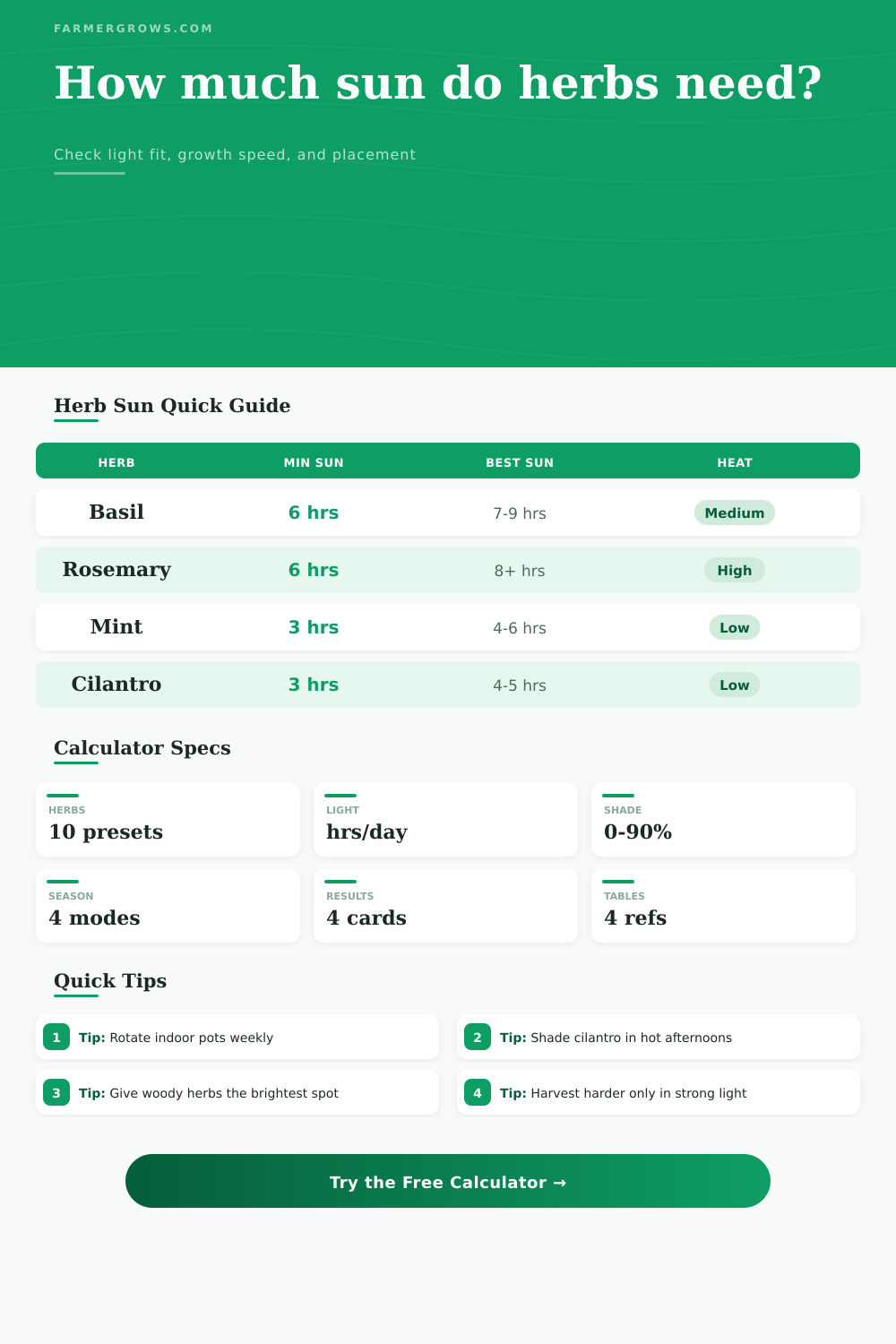
Sun for Herbs Calculator
Check whether a kitchen herb has enough light from daily sun hours, indoor window direction or outdoor bed exposure, season, harvest pressure, pot size, heat, shade, and moisture.
Pick a common herb and placement, then adjust the sun hours, season, shade, heat, harvest, container size, and moisture to match the actual growing spot.
Your Herb Light Plan
Results update after calculation.
Fast leafy growth needs bright sun, warmth, and steady moisture.
Best in the brightest dry spot with strong air movement.
Tolerates part sun and grows lush with moisture.
Prefers cool morning light; hot afternoon sun speeds bolting.
Reliable in part sun, especially with even moisture.
Compact growth improves with high light and leaner watering.
Flavor and stem strength improve in full sun.
Handles bright windows and part-sun planters well.
Needs open light to stay sturdy and aromatic.
Likes full sun, drier soil, and room around the crown.
| Herb type | Minimum direct sun | Best range | Too much sun warning |
|---|---|---|---|
| Basil | 6 hours | 7-9 hours | Wilts fast above 92°F unless moist |
| Rosemary | 6 hours | 8-10 hours | Usually handles heat if soil drains |
| Mint | 3 hours | 4-6 hours | Leaf edges scorch in hot dry sun |
| Cilantro | 3 hours | 4-5.5 hours | Bolts quickly in hot afternoon sun |
| Parsley | 4 hours | 5-7 hours | Can flag in small hot pots |
| Thyme | 6 hours | 7-9 hours | Handles heat if roots stay dry |
| Oregano | 6 hours | 7-9 hours | Flavor stays strongest in full sun |
| Chives | 4 hours | 5-7 hours | Tips may yellow in hot dry pots |
| Dill | 6 hours | 6.5-8 hours | Heat can shorten leaf harvest window |
| Sage | 6 hours | 7-9 hours | Good heat tolerance with airflow |
| Placement | Light factor | Best herbs | Usual adjustment |
|---|---|---|---|
| South-facing window | 0.85 | Basil, thyme, rosemary | Rotate pots weekly |
| West-facing window | 0.72 | Basil, oregano, chives | Watch afternoon heat |
| East-facing window | 0.70 | Mint, parsley, cilantro | Good morning light |
| North-facing window | 0.45 | Mint, parsley, chives | Add supplemental light |
| Outdoor open bed | 1.00 | Most herbs | Use shade for cool herbs in heat |
| Outdoor filtered bed | 0.78 | Mint, parsley, cilantro | Reduce shade for woody herbs |
| Condition | Effect on sun fit | Watering cue | Placement note |
|---|---|---|---|
| Winter indoor light | Counts about 20% lower | Water less often | Move close to glass or use grow light |
| Summer long days | Counts about 8% higher | Increase in small pots | Shade cool herbs after lunch |
| Heavy harvest | Needs 10-18% more usable light | Keep leafy herbs evenly moist | Brighten spot before cutting hard |
| Extreme heat | May reduce cool-herb fit | Increase checks, not sogginess | Morning sun is safer than afternoon |
| Score | Fit label | Expected growth | What to change |
|---|---|---|---|
| 90-100 | Excellent | Fast, compact, aromatic | Maintain placement and watch moisture |
| 75-89 | Good | Steady kitchen harvests | Small improvements help heavy harvests |
| 55-74 | Marginal | Slower, leggier growth | Move brighter or reduce shade |
| Below 55 | Poor | Weak stems and small leaves | Add sun, grow light, or switch herbs |
Brighten before harvesting: Heavy cutting asks the plant to rebuild leaves. If the calculator shows marginal light, move the pot brighter for a week before trimming hard.
Match sun to moisture: More light raises water demand, but wet roots still weaken woody herbs. Keep rosemary, thyme, oregano, and sage drier than basil or mint.
Most kitchen herb disasters start with a well-meaning pot of basil in a north-facing window. You get the seedling, tuck him next to the glass, and pretty soon he stretch and goes pale. He reaches for missing light. That’s usually because you don’t understand what direct sun means, not because you didn’t care for him propery.
A lack of fuel (light) starve the plant’s chemical engine. Without sufficient fuel, the engine sputters to a stop. The leaves respond by stretching to reach nonexistent light and thinning out as a consequence.
How to Keep Your Kitchen Herbs Happy
Enter the calculator: Plug in your window direction and number of sun hours, and math is done for you. You will no longer have to guess about conversions or coefficients and you won’t need fuzzy terms like bright shade. Now it all becomes practical growth expectations.
First, what are you measuring? Many gardeners find this tricky: brightening up a room does not necessarily mean providing direct sunlight. Walls may block the direct beam, and while the room appears bright, plants sits deep in shade. Direct sunlight provide more energy then scattered light. This energy drives photosynthesis, which in turn fuels heavy leaf production.
Tender annuals such as dill or basil requires this high-energy input to stay in shape (and taste good). They’ll get by in less light, but won’t make enough of the compounds that create flavor. “Is the plant alive?” people ask; yes. But alive doesn’t mean thriving.
Though thyme and rosemary are woody herbs, they is built for efficiency and drought tolerance, often originating from Mediterranean climates where sun is fierce and soil is lean. They come from climates where they are made to survive on poor soil under intense sun, so they are designed to be efficient and drought-tolerant. They can adapts well to slightly reduced light (though not indefinitely: If it’s weak for too long, they’ll go sparse instead of bushy). Unlike basil, though, they tolerate lower light better.
The tool takes all this into account when it measures how much light you get compared to what the specific herb family require. It knows that roughly eighty-five percent of sunlight outdoors makes its way through a south-facing window. That same glass blocks UV rays; even a sunny window is less strong then an open area in the garden.
The formula gets more complicated with seasonal variations. In July, an 8-hour day of direct sun may become a 3-hour day in December. Shorter, weaker winter light also means slower growth, which is why indoor herb gardens tends to sputter at holiday time. To account for the decline in vigor, the calculator adjusts effective light score to take the season into account. Will it work as-is all winter? Or do you need an extra grow light?
It takes heat into account, too: Water demand go up with high light, but only when surrounding air is warm. Dry soil plus hot light equals wilting; wet soil plus cool light equals root rot.
Another variable that many people don’t think about much is harvest pressure. Cut off some leaves, and the plant will has to make more, which it’ll do with energy reserves it has stored up. And it want to be as efficient as possible with the light it gets. If you’re cutting way back on your basil (for making pesto, say), then your plant wants more sun than if it’s just being decorative.
That intensity is what the tool uses to suggest where to place things when you’re really pushing the plant hard. Maybe move it a little bit nearerer the glass. A slight change in position can mean a large difference in light exposure, enough to help it grow aggressively.
There’s nothing wrong with growing a few herbs in imperfect conditions. More accurately, adjust your environment based off the biology of the plant rather than the other way around. You won’t be able to adjust the length of your winter days nor the orientation of your windows. Instead you’ll select the appropriate herb for the location. That way when it comes time to use the herb, you aren’t frustrated by a fading, desperate plant reaching for what little light there is. Your kitchen garden will smell good and produce well. Let the data inform where you put things.