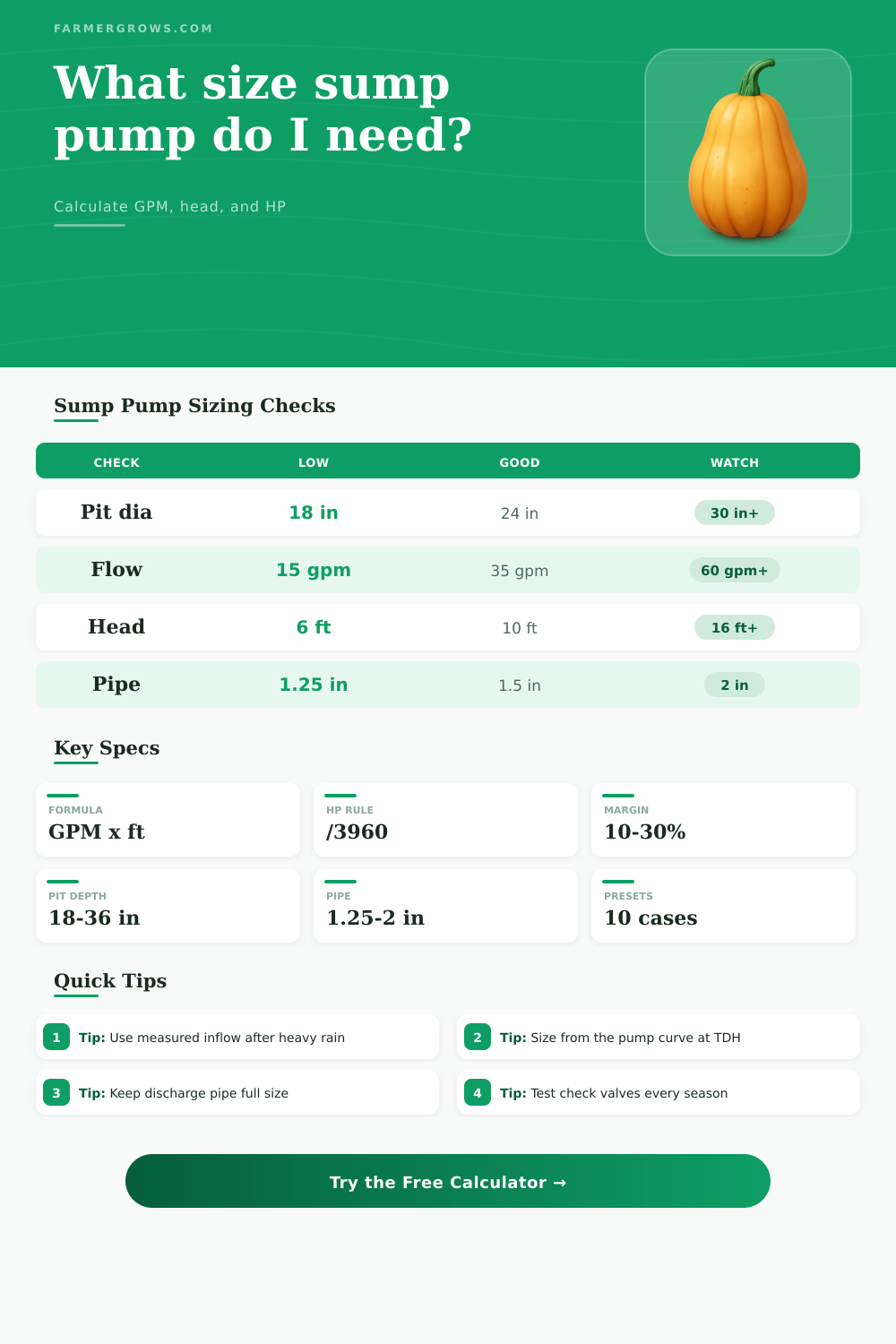
Sump Pump Size Calculator
Estimate required GPM, total dynamic head, pump horsepower, and pit drawdown using sump pit dimensions, storm inflow, lift, pipe friction, fittings, check valve loss, and safety factor.
The calculator sizes a pump from required drawdown flow plus incoming water, then computes total dynamic head from vertical lift, discharge rise, pipe friction, fitting allowance, and check valve loss.
Sump Pump Sizing Results
Use these values to compare pump curves at the calculated head, not just the open-flow rating printed on the pump box.
Best for: Small pits and low lift.
Typical range: 20 to 35 gpm at moderate head.
Watch: Narrow pipe can add friction quickly.
Best for: Standard home basements.
Typical range: 30 to 50 gpm at usable head.
Watch: Confirm actual curve at your TDH.
Best for: Higher inflow or long pipe runs.
Typical range: 45 to 70 gpm at lower head.
Watch: Pit may short cycle if drawdown is tiny.
Best for: Deep lift, long discharge, duplex pits.
Typical range: 60 gpm and higher when matched.
Watch: Check switch spacing and basin volume.
| Pit diameter | Gallons per inch | Gallons per 6 in | Liters per 150 mm |
|---|---|---|---|
| 18 in basin | 1.10 gal/in | 6.61 gal | 25.0 L |
| 24 in basin | 1.96 gal/in | 11.75 gal | 44.5 L |
| 30 in basin | 3.06 gal/in | 18.36 gal | 69.5 L |
| 36 in basin | 4.41 gal/in | 26.44 gal | 100.1 L |
| Pipe size | Good sump flow | Approx velocity at 40 gpm | Practical note |
|---|---|---|---|
| 1-1/4 in | 15 to 30 gpm | 10.5 ft/s | Use only for short, low-head runs. |
| 1-1/2 in | 25 to 55 gpm | 7.3 ft/s | Common balance for residential pumps. |
| 2 in | 45 to 90 gpm | 4.1 ft/s | Better for long runs and high inflow. |
| 3 in | 90 gpm plus | 1.8 ft/s | Often used for larger basins or shared drains. |
| Scenario | Peak inflow | Typical TDH | Starting pump class |
|---|---|---|---|
| Small basement with short discharge | 10 to 18 gpm | 7 to 10 ft | 1/4 to 1/3 HP |
| Standard perimeter drain | 18 to 35 gpm | 9 to 13 ft | 1/3 to 1/2 HP |
| High water table or clay soil | 35 to 60 gpm | 10 to 16 ft | 1/2 HP or duplex |
| Deep lift or long buried outlet | 40 to 80 gpm | 15 to 25 ft | 1/2 to 3/4 HP |
| Component | Typical allowance | Calculator input | Why it matters |
|---|---|---|---|
| Pipe friction | Hazen-Williams estimate | Length, diameter, material | Small pipe can consume pump capacity. |
| Elbows and fittings | 20D to 50D each | Count and fitting allowance | Sharp turns act like extra pipe length. |
| Check valve | 1 to 4 ft head | Check valve loss | Spring valves often add more restriction. |
| Discharge rise | Measured vertical feet | Discharge height | Every vertical foot adds one foot of head. |
For final selection, compare the required GPM to the pump curve at the calculated TDH. Open-flow ratings do not represent installed performance.
This calculator is for planning drainage capacity. Local codes, pump curves, backup pump requirements, discharge routing, and electrical ratings should be checked before installation.
When a basement collect water at a faster rate than a pump can remove the water, there is typically a mismatch between the inflow of the water and the drainage capacity of the pump. A mismatch between the inflow of the water and the capacity of the pump will cause either the float switch to continuously run the pump, or the water level will rise within the pit even though the pump is running. To fix this problem, you’ll need to understand the inflow of the water that enters the basement and understand the resistance that the plumbing system creates.
To determine the proper size of the pump that should be installed in the basement, there are several different input field that can be used in a pump sizing calculator. One of these fields asks for the dimension of the basement pit. The diameter and depth of the pit will determine the volume of water that can be contained within the pit between the on and off points of the float switch.
Pick the Right Pump for Your Basement
A pit with a small volume of water that can be contained between the on and off points of the switch mean that the pump will have to cycle on and off more frequently to remove all of the water from the pit. A larger volume of water that can be contained between those two points will allow for the pump to rest for longer periods of time between cycles. Longer periods of rest for the pump will reduce the chance of damaging the motor, as well as the switch that control the pump.
The rate at which water enters the pit is referred to as the inflow of that system. Inflow is often underestimate when designing basement pump systems. Inflow is not a constant figure; it can change based off the type of soil into which the basement was constructed, the amount of drainage on the roof of the structure, and how much water is present in the perimeter tile.
You can measure inflow by observing the pit during periods of rainfall, as well as by measuring how much water accumulate within the pit over a set period of time if the pump is turned off. The pump sizing calculator will use the inflow of the pit and the drawdown rate to calculate the necessary pump size. Additionally, the calculator will also incorporate a safety margin into the calculation.
This safety margin accounts for the fact that rainfall does not always fall at an average rate to the basement, and that the screen that cover the basement drain may contain debris that is capable of reducing the flow of water into the pit. The total dynamic head of a system represent the total resistance that the pump must overcome to effectively drain the basement of its accumulated water. Many error are made in the calculation of this value.
One component of the total dynamic head is the vertical lift of the water that is to be drained from the basement. However, another component of the total dynamic head is the friction created by the movement of the water through the plumbing system. Any length of horizontal pipe or any small diameter of the discharge pipe will increase the resistance of that system.
You can estimate such resistance by the length of the pipe, the diameter of the pipe, the type of material from which the pipe is formed, and the number of fittings along the pipe run. The pump sizing calculator will provide for the allowance of friction in the system; the pump may be able to move 50 gallon of water per minute if the total dynamic head is zero, but the actual flow may be much less if the total dynamic head increases. The horsepower of a pump can be calculated from the flow of water in the system and the total dynamic head of that system.
The flow and the total dynamic head can be multiplied together, and the product can be divided by a constant to find the horsepower of that pump. The calculation will also account for the efficiency of the pump. The efficiency will allow for the determination of the electrical power that is required for the pump to develop the necessary horsepower.
The brake horsepower that is calculated will allow for the pump to be compare to the nameplate ratings for different model of pump. Additionally, the calculator will provide a recommendation for the size of pump class that should be used in the basement. However, the curve on pumps of different manufactures may not be the same.
The shape and size of the basement pit will impact the way that the pump and the system function. Not all pit are created with the same dimensions and shape. For instance, a pit with a 24 inch diameter will contain more water per inch of depth than a pit with a diameter of 18 inches.
Because more water is contained within a 24 inch diameter pit, the pump will have to work more frequently to remove that water from the pit. The pit will also be able to absorb more inflow without the pump having to work as often. The amount of water that the pump can move is also impacted by the size of the pipe.
For instance, 1.5 inch diameter pipes are often used for residential basement drains. However, if the basement pit drains into a long horizontal pipe, or if the pipe that drain the water is small in diameter, a two inch diameter pipe may be required to efficiently remove the water. When installing a basement drain system, there are often differences between the calculated conditions of the system and the real world.
For instance, the pipe that drains the water may be buried in the landscaping, there may be check valve that collect mineral scale, or there may be different height at which the float switches are mounted. Each of these factor will increase the resistance within the system. The safety factor that is built into the calculations is built to account for these differences, but they can still occur over time.
For instance, a pump that was sized for an installation in the past may no longer be able to effectively drain the basement if those check valves stick when attempting to allow the water to leave the basement. Due to the difference between the various manufacturers of pumps, there is a balance that must be struck between the size of the pump and the amount of reserve capacity within the basement. A large pump will move a large amount of water from the basement.
However, if the basement has a small pit that must be emptied, a large pump will empty that pit at a rapid rate. If a pump empties a pit at a rapid rate, the motor will be short-cycled. Short-cycling is not as advantageous to the motor as cycling at a more moderate rate.
The pump sizing calculator calculates the target time for the pump to empty the basement. If the target time for the pump to remove all of the water from the pit is too short, the pump will have to work to move the water at such a rapid rate. However, if the target time for the pump is too long, there is a potential for the basement to overflow.
The best way to choose the proper pump for the basement is to match the pump to the conditions within the basement. Each of the input into the pump sizing calculator require the user to measure the conditions within the basement. The outputs from the calculator will provide a target to which the flow and the head of water within the basement should be set.
Once the target for the head and flow is established, the manufacturer’s curves can be referenced to determine a pump that will work effective within the parameters established. Following these step will ensure that the basement will remain dry during periods of heavy rain.