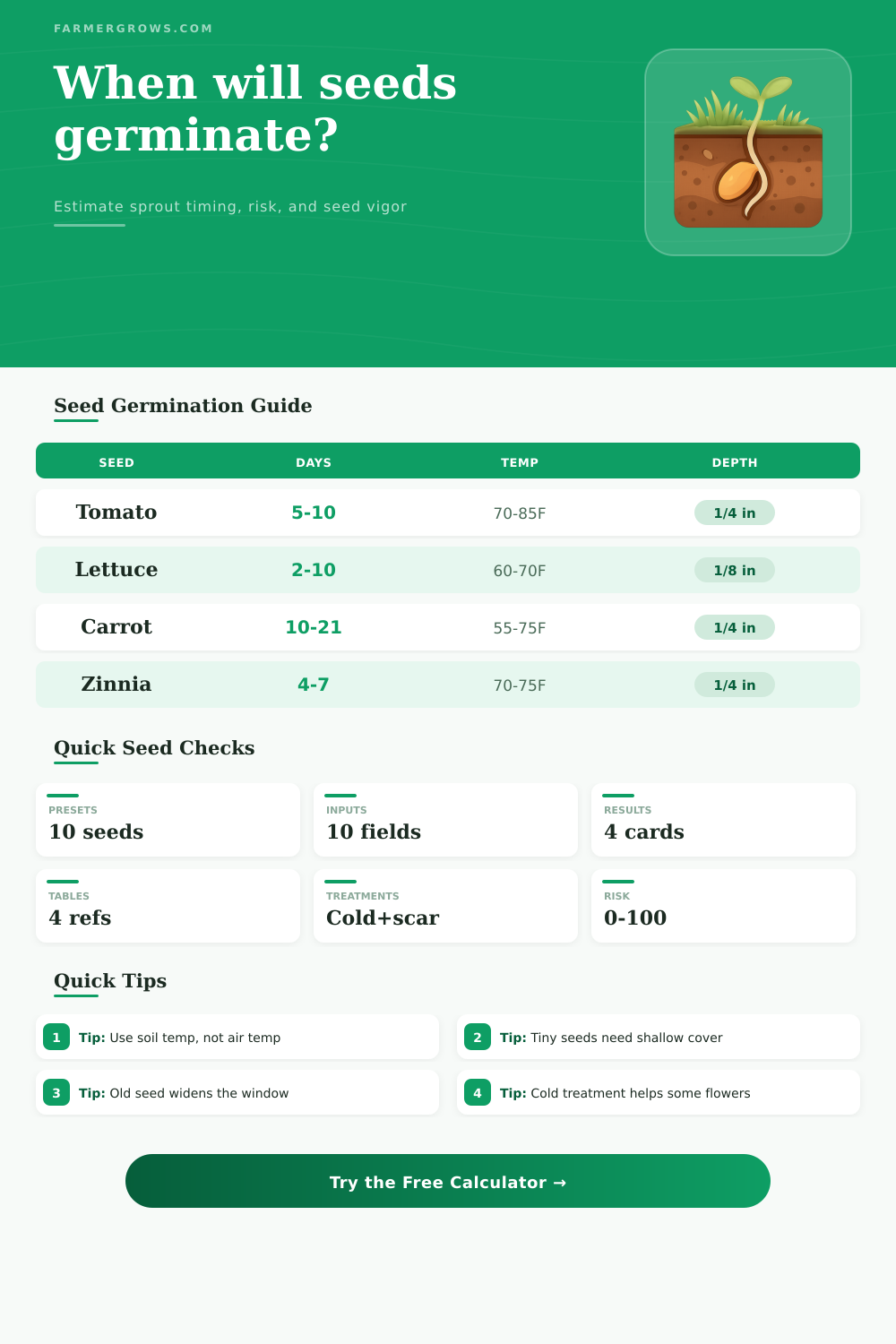
Seed Germination Time Calculator
Estimate sprouting windows, stand potential, recheck timing, and risk for vegetable, herb, and flower seeds using soil temperature, age, depth, moisture, light, medium, treatment, and season.
Use this as a planning estimate for seed trays, direct sowing, and flower starts. Final emergence still depends on seed lot quality, oxygen, disease pressure, soil crusting, and local weather swings.
Seed Germination Estimate
Your adjusted seed timing appears here after calculation.
| Seed type | Typical germination days | Best use | Light note | Field caution |
|---|---|---|---|---|
| Tomato | 5 to 10 days | Indoor trays or warm transplants | Cover lightly | Cool media slows emergence sharply. |
| Pepper | 7 to 21 days | Heat mat or warm indoor tray | Cover lightly | Slow seed can still be viable after two weeks. |
| Lettuce | 2 to 10 days | Cool beds or shallow trays | Often benefits from light | High heat can reduce germination. |
| Carrot | 10 to 21 days | Direct-sown rows | Cover shallowly | Crusting and drying are common failures. |
| Snap bean | 6 to 10 days | Direct sow after soil warms | Cover fully | Cold wet soil can rot large seed. |
| Sweet corn | 4 to 12 days | Warm direct-sown blocks | Cover fully | Planting early often delays stands. |
| Basil | 5 to 10 days | Warm trays or late spring beds | Cover very lightly | Chilled media leads to uneven starts. |
| Onion | 7 to 14 days | Flats or early beds | Cover lightly | Old seed loses vigor quickly. |
| Sunflower | 7 to 10 days | Warm direct sowing | Cover fully | Birds and rodents can remove shallow seed. |
| Zinnia | 4 to 7 days | Warm trays or flower beds | Cover lightly | Wet crowded trays invite damping off. |
| Seed group | Minimum soil temperature | Optimal temperature | Too warm concern | Practical cue |
|---|---|---|---|---|
| Cool leafy seeds | 40 to 45°F | 60 to 70°F | Above 80°F may inhibit lettuce | Good for spring and fall sowing. |
| Root crops | 45 to 50°F | 55 to 75°F | Dry crust forms quickly in heat | Keep rows evenly damp until emergence. |
| Warm vegetables | 60 to 65°F | 75 to 85°F | Above 95°F stresses seedlings | Use bottom heat for indoor starts. |
| Large legumes | 55 to 60°F | 70 to 85°F | Hot dry soil hardens surface | Wait for warm soil before sowing beans. |
| Sweet corn | 55 to 60°F | 70 to 90°F | Very hot dry beds reduce uniformity | Uniform soil warmth matters for blocks. |
| Warm flowers | 60 to 65°F | 70 to 80°F | Wet heat raises disease pressure | Vent domes once seedlings show. |
| Seed size or crop | Target planting depth | If too shallow | If too deep | Best covering method |
|---|---|---|---|---|
| Tiny seed, lettuce | Surface to 1/8 inch | Surface dries quickly | Light may be blocked | Press in and dust with fine mix. |
| Small seed, basil or onion | 1/8 to 1/4 inch | Poor contact and drying | Weak delayed sprouts | Sifted mix or vermiculite. |
| Medium seed, tomato or zinnia | 1/4 inch | Helmet heads and drying | Slower emergence | Fine cover firmed lightly. |
| Carrot rows | 1/8 to 1/4 inch | Washout or drying | Patchy stand | Thin cover kept moist. |
| Beans and sunflower | 1 to 1.5 inches | Bird loss and drought | Cold wet rot in heavy soil | Firm soil, full cover. |
| Sweet corn | 1 to 2 inches | Rootless lodging risk | Delayed in cold soil | Deeper in warm dry soil. |
| Seed type | Typical useful life | Fast loss warning | Storage target | When to test |
|---|---|---|---|---|
| Onion | 1 year | Vigor drops quickly after the first season | Cool, dry, sealed | Test before sowing old packets. |
| Carrot | 2 to 3 years | Slow rows make weak seed hard to spot | Dry and cool | Test if emergence is critical. |
| Lettuce | 3 to 5 years | Heat storage hurts performance | Dry, cool, dark | Test after warm storage. |
| Tomato | 4 to 6 years | Usually stores well if dry | Airtight and cool | Test if older than four years. |
| Bean and corn | 2 to 4 years | Moisture damage causes rot | Dry and protected | Test before large plantings. |
| Zinnia and sunflower | 2 to 5 years | Oil-rich seed dislikes heat | Cool, dry, dark | Test old saved seed lots. |
Carrot, onion, and pepper can still be normal when faster crops are already up. Check the adjusted window before disturbing seed rows or re-sowing.
Germination needs water and oxygen together. Saturated trays, crusted clay, or repeated dry-down cycles can all slow seeds even when temperature is right.
Germination time isn’t a fixed number on a seed packet. It’s variable, and different factors plays into it: The temperature, the moisture, the size, the strength of the seed, etc. Each little factor can delay or advance germination by a few days or even weeks.
Now what? You’ve sown the row, watered, and there they sits, looking very much the way they did right after planting. Are they dead already? Are they ever going to emerge?
Why Seeds Take Different Times to Grow
The biggest single influence is temperature of the ground where seeds will be planted. Lettuce (and things like carrots) slow down when that soil rise above about eighty. Peppers and tomatoes (all warm crops) respond well to getting started after a longer stay in the upper seventies. Enter your true temperature reading into calculator and it crunches the numbers for you. This stops the guessing that causes us to dig up our rows way too soon.
Seed age is almost as important. Stored in its cells are reserves to help it overcome less-than-perfect circumstances, but by the second year after packing, seed has depleted those stores somewhat. Older seed germinate more slowly and will form thinner stands under same moisture and temperature conditions. This is why both stand percent and expected range is adjusted to match each other. A look at the seed-pack date tells you if it’s still good enough to waste precious space on, or should of been saved for a test row instead.
That’s where depth and moisture come into play, and both are easy to forget. Small seeds has no reserves to pull themselves up through several inch of cover; just a light coat will do them fine, but leaving their tiny selves out in the open air means they’ll dry out quickerer. Bigger seeds, such as beans, can handles deeper depths, but not when those soils becomes cold and wet, starving them of oxygen. To see whether your set-up is helping or hindering, the calculator consider both.
There’s also the little detail of light requirement, which trips up people: Some seeds require light to break dormancy; some are inhibited in light. If you cover the first group too thickly and block all the light, or leave the second group exposed on top, you might mistake a delay for poor seed quality. The real problem is wrong handling. The tool flags that mismatch before you wait and wait and wait for something that was never set up to work.
There’s also a layer of medium and time of year. Moisture-holding soil like garden loam behaves different than sterile seed-starting mix, which dries out at different rates than sandier beds crust over quickly. Something planted in a cool spring that suits lettuce will slow down warm crops that require late-spring heat. The calculator includes the season in its risk score. Knowing this, you can opt to add bottom heat, or maybe wait instead. Best of all, it teaches the skill of waiting patiently, but with your crop’s calendar in mind.
Basil may emerge weeks before carrots and onions, so don’t rush them. If you check too early, you might sow again unnecessarly. But if you miss the adjusted timeline, you will never catch up.
So, let some things go wrong. Forget it. Your best chance at a successful seed is to know what factors is within your control, and to realize that germination isn’t just about having ideal conditions, but about checking if you actualy have them. Use the estimate, then use its reference tables on the page to put your answer next: Do I need to just give it a bit more time (or maybe not?)…make sure it drains better…start another test?
Germinating isn’t necessarily about having ideal conditions, but about understanding which conditions you actualy have. The calculator makes those conditions a concrete window rather than a guess.