Lawn Watering Duration Calculator
Estimate sprinkler minutes per watering, weekly gallons, cycle-soak timing, and seasonal adjustment from lawn area, catch-can rate, turf type, soil, slope, weather, and watering days.
Measure sprinkler output with straight-sided cans when possible. Flow, area, and pressure help estimate gallons, but catch-can precipitation gives the best runtime for a real lawn zone.
Watering Duration Results
Runtime is based on net weekly need, irrigation efficiency, catch-can precipitation, soil intake, and slope runoff risk.
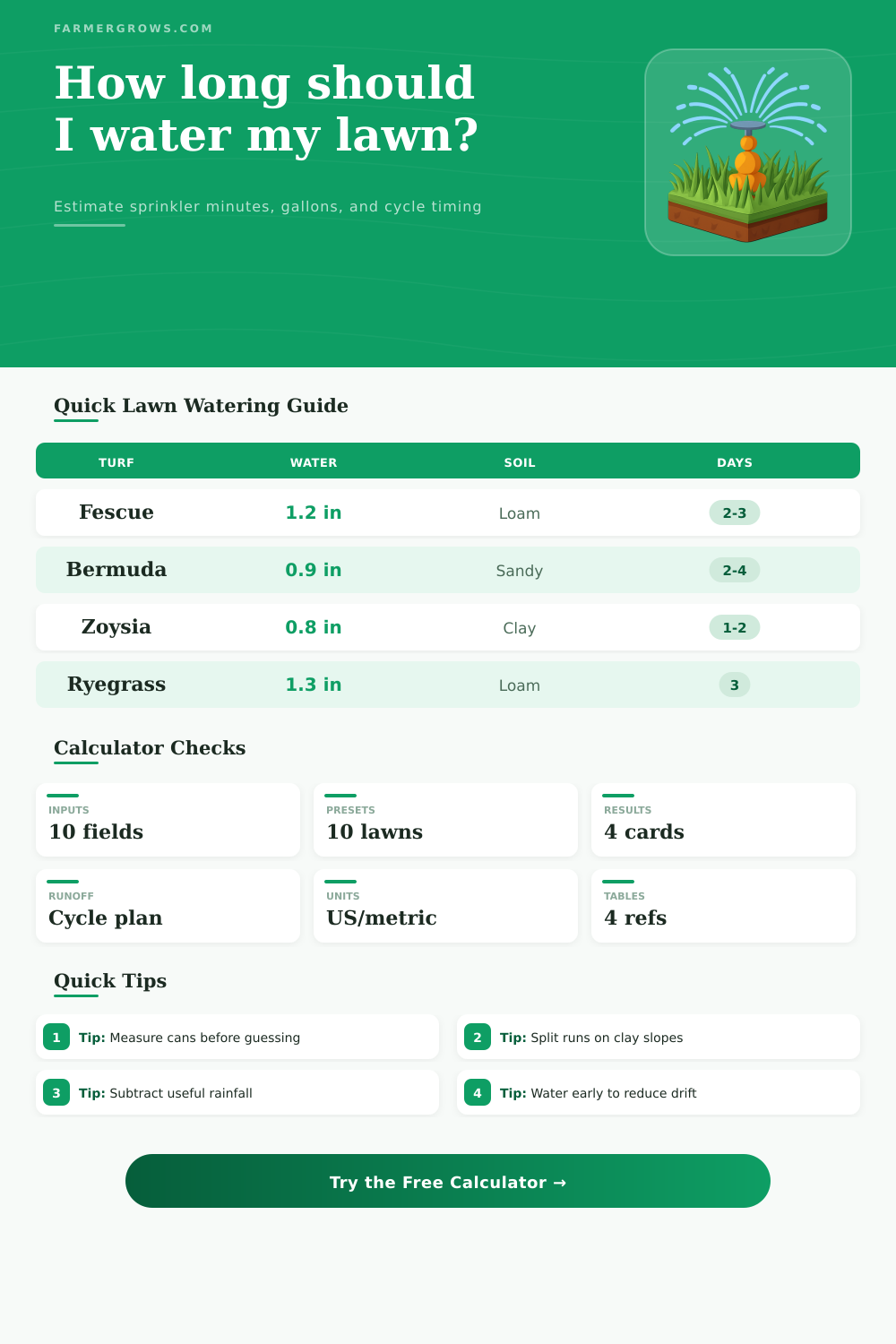
| Turf type | Typical weekly water | Rooting tendency | Scheduling note |
|---|---|---|---|
| Tall fescue | 1.0 to 1.3 in | Moderate to deep when trained | Better with deeper, less frequent watering |
| Kentucky bluegrass | 1.0 to 1.4 in | Moderate, may go dormant | Use more care during heat and wind |
| Perennial ryegrass | 1.1 to 1.4 in | Moderate, steady moisture | Often needs more frequent summer watering |
| Bermuda grass | 0.7 to 1.1 in | Deep and drought tolerant | Can stretch intervals when soil is deep |
| Zoysia | 0.6 to 1.0 in | Dense, moderate demand | Avoid shallow daily watering |
| Buffalograss | 0.4 to 0.8 in | Drought tolerant | Good candidate for reduced irrigation |
| Soil type | Approx. intake rate | Water holding behavior | Runtime strategy |
|---|---|---|---|
| Sand | 1.5 in/hr | Fast intake, low storage | Shorter intervals may be needed |
| Sandy loam | 1.0 in/hr | Good intake, moderate storage | Usually tolerates normal sprinkler runs |
| Loam | 0.6 in/hr | Balanced intake and storage | Often ideal for deep lawn watering |
| Silt loam | 0.4 in/hr | Moderate storage, crust risk | Watch for puddling under sprays |
| Clay loam | 0.3 in/hr | Slow intake, good storage | Use cycle-soak if spray rate is high |
| Clay | 0.2 in/hr | Very slow intake | Split watering into several cycles |
| Sprinkler type | Common precipitation rate | Usual runtime feel | Best fit |
|---|---|---|---|
| Fixed spray heads | 1.3 to 2.0 in/hr | Fast application, short runs | Small turf areas with matched nozzles |
| Rotary nozzles | 0.4 to 0.8 in/hr | Moderate, more soil friendly | Mixed slopes and retrofit spray zones |
| Gear rotors | 0.25 to 0.65 in/hr | Longer runtime | Large lawns and open rectangles |
| Impact sprinklers | 0.3 to 0.7 in/hr | Variable by spacing and pressure | Temporary farmyard or large lawn watering |
| Subsurface drip | 0.15 to 0.35 in/hr | Slow and efficient | Windy sites and narrow turf strips |
| Season or weather | Adjustment factor | Typical signal | Scheduling note |
|---|---|---|---|
| Cool or cloudy | 0.70 | Low ET, mild wind | Reduce runtime or skip a day after rain |
| Mild normal week | 1.00 | Average active growth | Use target depth as entered |
| Warm or breezy | 1.15 | Higher evaporation | Add modest runtime and inspect dry edges |
| Hot dry week | 1.30 | High ET and visible wilt | Increase depth while avoiding runoff |
| Extreme heat | 1.45 | Stress weather | Prioritize early morning watering |
Before changing runtime: Run a 15-minute catch-can test across the zone and average the cans. Uneven cans mean coverage problems, not just a schedule problem.
Before adding days: Check the soil 4 to 6 inches down. If it is moist below the surface, train deeper roots with fewer, longer irrigations.
To check your turf, match its weekly water need with what you put down with your sprinklers. Chances are, if you’re guessing, it’s going to be wasteful. Unless you know true factors at play in the equation: your soil type, grass variety, and rate that water hits ground. Instead of simply running system a little longer next time you see brown spots, pay attention to these details first and avoid those backfiring results.
Why do two lawns with same sprinkler system have different watering needs? It matter how fast the soil absorbs water. Sandy soils suck it up fast but retain almost none so run the sprinkler on short cycles several times rather then long ones. Clay soils holds a lot once they slowly accept some moisture, but they won’t take any faster than about a quarter-inch an hour. Water delivered by the sprinkler that’s too fast for soil to use just runs off surface, not down to the roots where it is needed.
Why Your Lawn Needs Different Watering
You plug in the catch-can results and your soil type into calculator, and then let the calculator do the math. No more trying to remember number for your specific soil type, and no more ignoring fact that your system might be delivering water faster than it can be used. One more twist: Different turf types has different needs, which changes what is required from week to week. In general, cool-season turf such as Kentucky bluegrass and tall fescue prefers more water then warm-season species like zoysia or Bermuda, but most people irrigate all their grass at the same pace anyway, out of force of habit. Bad news for everybody: The hard-grass gets overwatered (a waste!), and thirstier stuff remains dry when hot.
A mellow slope also favors runoff over soaking in; the higher the grade, the greater the risk that water won’t have time to work into ground. That’s why tool tacks on adjustments to the cycle recommendation if you mark your yard as having a moderate-to-steep incline. That soak interval isn’t just random wait time. It provides enough delay to let surface absorb next round without forming puddles that either run off or evaporate.
Then there’s weather: It changes quicker then most people can update their timer settings. Demand goes down 20 to 30 percent with an overcast, cool week; it goes way up; by the same percentage or more, with a hot, breezy one. Subtracting useful rainfall from target depth prevents overwatering (after a storm), but most systems continues ticking away at their preset pace anyway.
The efficiency percentage reflect that not even everything coming out of those heads makes its way into ground in first place. Uneven coverage, evaporation, and wind drift diminish the total count. This is why value you put in this field will directly impact number of minutes recommended.
The best part: It teaches you to measure instead of assume. You’ll soon know if your flow calculation matches rate from a simple 15 minutes in a catch-can in any area. And you’ll quickly see if the area’s getting covered at all. You will also see if it’s uneven, though it will be a long time before you notice that on the grass. With that baseline measure, then everything else starts making sense because now you’re seeing real-world rate that translates into a practical runtime for how long you’ll need to run the thing.
There are so many variables in this equation. Getting it just right isn’t really about finding any magic number; it’s more about observing what the lawn do for a week or two. When the area has been watered and soil feels moist to finger depth (four inches), that means the roots is growing downward and the timing between cycle can be extended. And when the lawn looks hungry but top surface is dry, it could of be time to look at schedule again. That’s where the calculator comes in to eliminate math, keeping the focus on the lawn instead of the math behind the minutes.