🍯 Sugar to Maple Syrup Conversion Calculator
Convert sugar mass into finished syrup, sap demand, and evaporation load using maple-specific Brix reference data.
Pick a real batch size or sap run. Each preset loads sugar source, purity, target finish, sap sweetness, available sap, RO target, and loss allowance.
The calculator uses a Brix finish for syrup, a Rule of 86/87 estimate for sap, and a small-loss allowance so the output stays closer to real batches.
Projected conversion
See syrup output, sap demand, water removal, and how much syrup your entered sap batch can actually make.
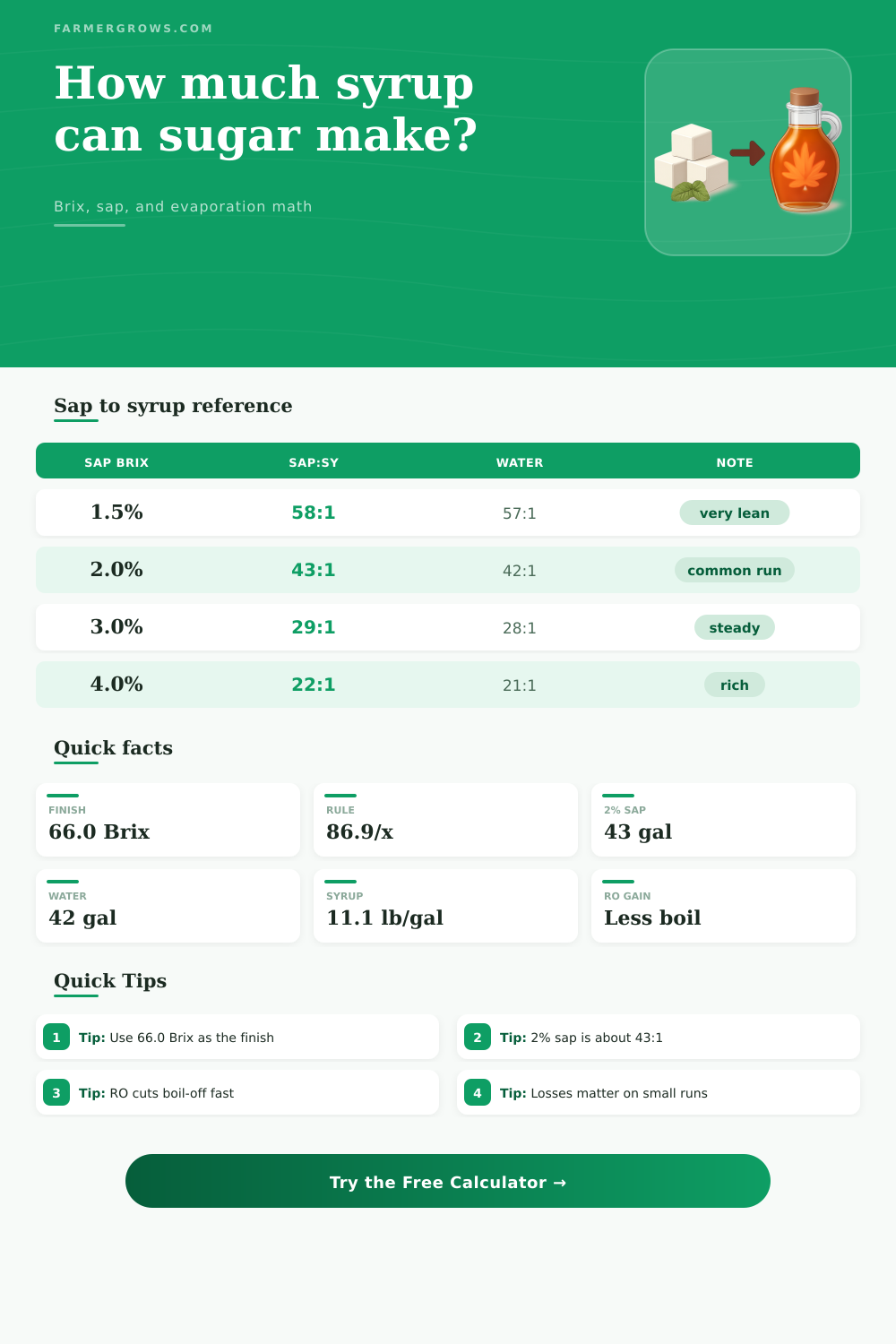
These cards show how yield changes as sap gets sweeter. The same syrup gallon takes much less sap once Brix rises above the low-2 percent range.
1.5% sap
58.1 gal sap, 57.1 gal water
2.0% sap
43.6 gal sap, 42.6 gal water
3.0% sap
29.0 gal sap, 28.0 gal water
4.0% sap
21.8 gal sap, 20.8 gal water
| Brix | SG | lb/gal | Note |
|---|---|---|---|
| 66.0 | 1.347 | 11.09 | Standard finish |
| 66.5 | 1.333 | 11.12 | Light boil |
| 67.0 | 1.335 | 11.15 | Tighter set |
| 68.9 | 1.340 | 11.25 | Upper limit |
| Sap Brix | Sap gal | Water gal | Use |
|---|---|---|---|
| 1.5% | 58.1 | 57.1 | Lean |
| 2.0% | 43.6 | 42.6 | Common |
| 2.5% | 34.8 | 33.8 | Sweet |
| 3.0% | 29.0 | 28.0 | Sweet |
| Sap gal | Syrup gal | Water gal | Batch |
|---|---|---|---|
| 10 | 0.23 | 9.77 | Small |
| 25 | 0.57 | 24.43 | Backyard |
| 50 | 1.15 | 48.85 | Mid run |
| 100 | 2.30 | 97.70 | Long boil |
| Sugar lb | Syrup gal | Qt | Note |
|---|---|---|---|
| 5 | 0.68 | 2.7 | Small |
| 10 | 1.37 | 5.5 | Small |
| 25 | 3.42 | 13.7 | Backyard |
| 50 | 6.83 | 27.3 | Bulk |
Maple syrup production are the process of removing water from the sap that maple trees produce. The sap that is produce by these trees contain a small amount of sugar but a large amount of water. In order to produce maple syrups, the producer must boil the sap to remove the water so that the sugar remain.
This evaporation of the water from the sap is necessary in order to at least concentrate the sugar in the sap for produce maple syrup. Managing the relationship between the sugar mass and the liquid volume in the sap is a difficult task for many maple syrup producer, as the sugar content in the sap isnt always consistent. One of the ways that maple syrup producer can determine the amount of sugar in the sap is by use Brix measurements.
Using Brix to Make Maple Syrup
Brix is a measurement that allow the producer to know the concentration of the sugar in they maple syrup. In addition, the Brix measurements help to prevent the producer from guessing at the amount of sugar that are present in there maple syrup. Producers often aim for a Brix level of 66; this level of Brix are required to allow the maple syrup to remain shelf stable.
If the maple syrup contains too low Brix level, the syrup will be thin and may spoil. However, if the Brix level is too high, the syrup may scorch or become too thickly. Thus, using Brix measurements will allow the producer to ensure that the maple syrup contains an apropiate amount of sugar.
Calculators can help to map out the sugar mass that the producers must produce, as well as help to predict how much syrup the producer can makes. The type of sugar used to adjust the maple syrup can have an impact on these calculations. For instance, if the sugar contain water and impurities, then the density calculations for the maple syrup will be incorrect.
As a result, the amount of maple syrup that is produced will also be incorrect. Thus, it is important to account for the purity of the sugar that is use to make maple syrup; the purity will impact the amount of maple syrup that are produced. The sap-to-syrup ratio allow producers to estimate the amount of sap that is required to create one gallon of maple syrup.
For instance, if the sugar concentration in the sap is 2 percent Brix, 43 gallons of sap will produce one gallon of maple syrup. If the Brix level is lower than 2 percent, however, more gallons of sap will be required to create one gallon of syrup. Because more gallons of sap is required if the Brix level is low, the producers will require more fuel to evaporate the water in the sap.
Thus, if the sap has a high Brix level, less fuel will be required in the boiling process to make maple syrup. Reverse osmosis can be used to remove a large amount of water from the sap before it reach the evaporator. By using this process, the producer can reduce the amount of fuel that is required to boil the sap to make maple syrup.
In using reverse osmosis, however, it is still necessary to account for the loss of maple syrup that occur during packaging. For instance, the syrup may become stuck to the sides of the pans in which it is boiled, or it may be lost during the filtering of the syrup. Thus, it is important to account for the loss that occur during packaging; otherwise, there may be a shortage of the syrup when it is being bottle.
Finally, it is important to use a refractometer to measure the Brix level of the maple syrup that is being produce. The refractometer will allow the producer to ensure that the syrup contains the apropiate amount of sugar. While it is true that producers can use mathematics to calculate the amount of fuel, labor, or bottles of syrup that will be require for the production of maple syrup, Brix measurements will allow producers to confirm that the maple syrup has the correct sugar content.
The amount of sugar that is contain in the sap can change for any number of reasons; the sugar content can change with the temperature of the environment in which the maple trees grows, for instance, or the age of the trees themselves. Thus, producers need to use Brix measurements to ensure that their maple syrup maintain it’s quality and consistency.