Fescue Grass Seed Germination Time Calculator
Estimate cool-season fescue sprout timing from soil temperature, fescue type, seedbed contact, shade, and area, then size seed and plan the first mow.
Fescue establishes best in cool weather, usually fall or early spring. Unlike Bermuda, zoysia, or centipede grass, fescue does not need hot soil to wake up; heat can slow emergence and dry the seedbed before roots are ready.
Fescue Germination Estimate
Results combine fescue type, cool-season soil temperature, seed depth, shade, seedbed texture, and your area calculation.
| Fescue type | Typical sprout window | New-seed rate | Best use | Establishment note |
|---|---|---|---|---|
| Turf-type tall fescue | 5 to 14 days | 6 to 8 lb per 1,000 sq ft | Durable cool-season lawns | Fastest common fescue for full renovations |
| Kentucky 31 tall fescue | 7 to 16 days | 6 to 8 lb per 1,000 sq ft | Utility turf, pasture edges | Coarser leaf; tough but less refined |
| Creeping red fine fescue | 10 to 21 days | 3 to 5 lb per 1,000 sq ft | Shade and cool low-input lawns | Spreads slowly by short rhizomes |
| Chewings fine fescue | 10 to 24 days | 3 to 5 lb per 1,000 sq ft | Dry shade and low mowing pressure | Bunch-type fine fescue with slower fill-in |
| Hard or sheep fescue | 12 to 28 days | 2 to 4 lb per 1,000 sq ft | Low-maintenance slopes and roughs | Slow but persistent once rooted |
| Soil temperature | Cool-season response | Timing factor | Watering tendency | Field note |
|---|---|---|---|---|
| Below 40°F | Very slow or paused | 2.40 | Low evaporation | Seed may sit until warmer soil arrives |
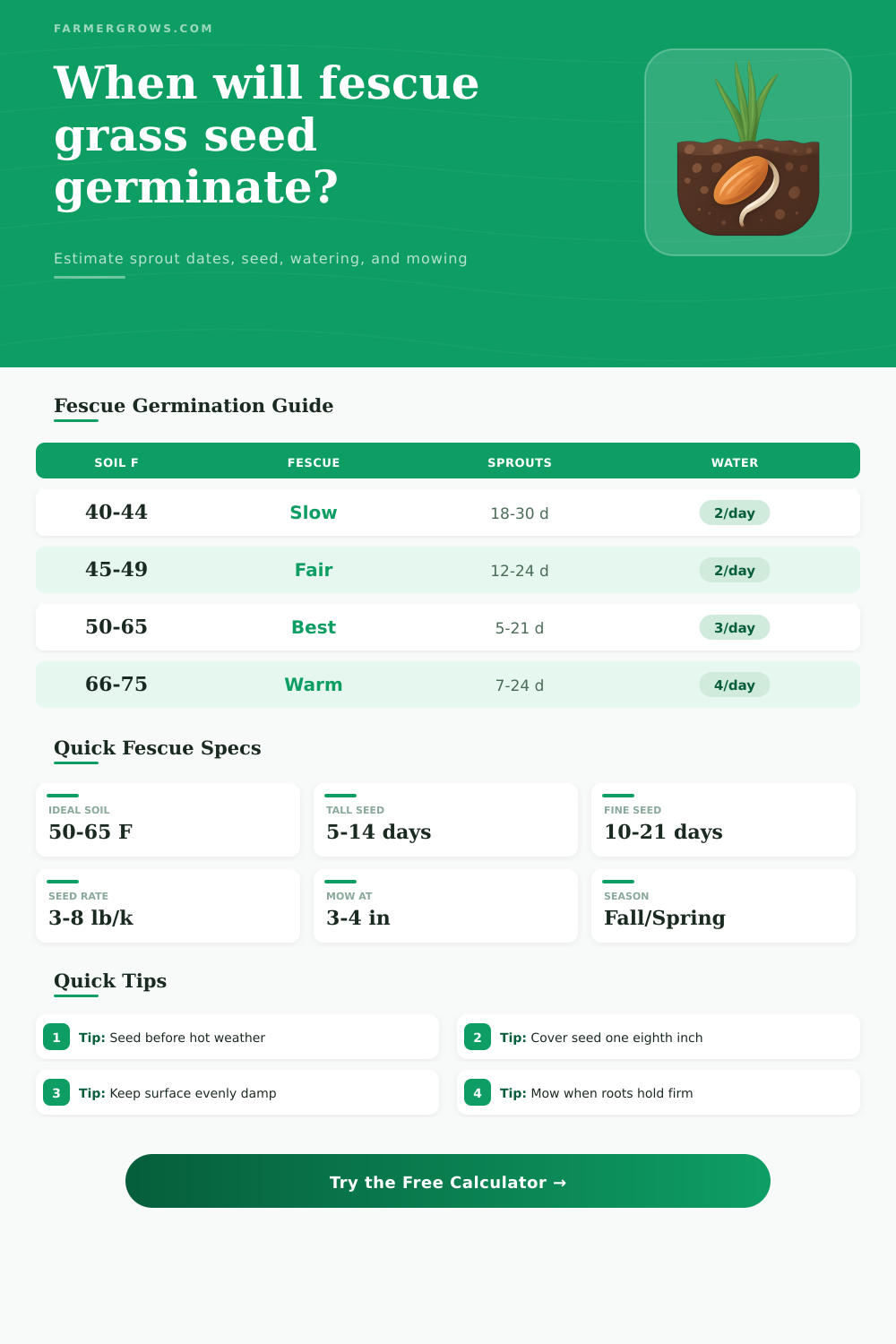
| 40 to 44°F | Slow start | 1.80 | Light cycles only as needed | Good moisture matters, but patience matters more |
| 45 to 49°F | Fair germination | 1.35 | Usually 2 cycles per day | Common early spring shoulder range |
| 50 to 65°F | Best fescue range | 1.00 | 2 to 3 cycles per day | Ideal fall renovation window for many areas |
| 66 to 75°F | Warm but workable | 1.12 | 3 to 4 cycles per day | Watch surface drying and heat stress |
| Over 75°F | Heat risk rises | 1.35 | Short, frequent cycles | Different from Bermuda: hotter is not better |
| Seed rate task | Tall fescue | Fine fescue | Coverage per 10 lb | Use this when |
|---|---|---|---|---|
| Full renovation | 6 to 8 lb/k | 3 to 5 lb/k | 1,250 to 3,333 sq ft | Bare soil or mostly dead turf |
| Thin overseed | 3 to 5 lb/k | 2 to 4 lb/k | 2,000 to 5,000 sq ft | Existing turf still covers the soil |
| Shade repair | 4 to 6 lb/k | 3 to 5 lb/k | 1,667 to 3,333 sq ft | Canopy areas with filtered light |
| Utility strip | 5 to 8 lb/k | 2 to 4 lb/k | 1,250 to 5,000 sq ft | Edges, slopes, or non-show turf |
| Spot repair | 6 to 10 lb/k | 4 to 6 lb/k | 1,000 to 2,500 sq ft | Small bare patches with extra loss risk |
| Establishment stage | Approximate timing | Moisture target | Mowing or traffic note | Cool-season check |
|---|---|---|---|---|
| Seed contact | Day 0 to 2 | Firm, damp top soil | No traffic over loose seed | Roll or press lightly; do not bury deeply |
| Germination | Day 5 to 28 | Top 1/4 in evenly moist | Avoid footprints in wet clay | Cool soil is fine; hot dry soil is the risk |
| Rooting | After visible green haze | Shift slowly toward deeper watering | Stay off until seedlings resist tugging | Reduce cycles gradually after emergence |
| First mow | About 3 to 6 weeks | Water the day before, not right before | Mow at 3 to 4 in with sharp blade | Remove no more than one-third of height |
| Early stand | 45 to 75 days | Deep watering as roots expand | Light use before heavy traffic | Protect from heat and drought during grow-in |
Timing tip: For fescue, a cool fall seedbed usually beats a hot summer seedbed. Soil near 50 to 65°F gives emergence without the warm-season heat demand of Bermuda, zoysia, or centipede.
Depth tip: Fescue seed needs firm contact and a very light cover. If seed is buried deeper than 1/4 inch, emergence slows and the calculator adds risk to the schedule.
‘why doesn’t mine come up?’ you say of your lawn, comparing it to that of a neighbor’s. ‘I throw down seed and I water, but…nothing.’ The secret: Fescue is a cool-season grass. That means it awakens in late spring or earliest fall and doesn’t like hot July ground. To really get the biology here, you need to check soil temperature.
How does it work? You enter your fescue type into the calculator, which then adds your soil information. It factors in shade, depth, and texture to estimate when things should of popping up. “Most folks believe that all grass emerges the same.” But they don’t: Tall fescue can pop up within a couple of weeks. Creeping red (a fine fescue) are slower, sometimes three times slower. Will this take you three times longer to see action? How will you know if it’s on schedule? The calculator takes that into account.
How to Grow Fescue Grass
The main variable is soil temperature. When the top inch of soil are less than fifty degrees Fahrenheit, those seeds will go dormant. They are waiting for warmth. From about fifty to sixty-five degrees they begin to move faster. Those home gardeners think something’s wrong with them when their seedlings is slow getting going in cool soil. They are not dead, just on pause. Tables of references shows that cool soils prolong everything. A warm spring accelerate it all provided soil surface remains moist.
The time window is the key to when and how you water: A quarter-inch of moisture should be maintained at all times in the top part of the soil where seeds is starting to grow. That means regular light spritzes rather than a once-a-week drench. Remember: Too much will drown them, washing away seedlings; too little will kill them by drying out medium. Depending on your air temp and type of soil (sandy soils drains quickly so require more frequent watering), the tool calculates roughly how often each day to provide water.
Heavy clay soils retain moisture longer, but may crust in rain. Water matters, and so does depth. Fescue seed is small. If buried more than an eighth of an inch deep, it can’t sprout through. Raked in deeply, it’ll die from lack of air. A shallow covering like a thin layer of compost or a light press will do. How deep? That’s where the calculator comes into play, adjusting for emergence time according to the type and thickness of cover. Too thickly mulched? It lets you know.
When root systems is established (after three to six weeks), shift toward less-frequent but deeper waterings. Transitioning to deeper watering are critical for long-term health. Wait until the turfgrass is about three inches tall and mow again. Don’t cut too soon or you’ll pull up young roots. Wait so there’s still some leaf to do job of photosynthesis.
Growing fescue requires one mechanical necessity: patience. Don’t get carried away. Fescue is an unpredictable thing. It doesn’t need hotdogging; it just needs steady moisture and cool soil conditions. Don’t buy some wacky product. Relax and let the seed take its time. Match your timing to what the turf needs. Nature will have it greening up on its timeline, and you’ll see it happen.