New Lawn Watering Calculator
Plan establishment watering for seed, sod, hydroseed, sprigs, or plugs using turf species, soil type, sprinkler output, weather, rain credit, slope, and lawn size.
New lawns need frequent light watering at first, then fewer deeper cycles as roots knit into the soil. This calculator estimates planning amounts; always adjust if the surface puddles, runoff starts, or the seedbed dries between cycles.
New Lawn Watering Plan
Run the calculator to size watering cycles for the establishment phase.
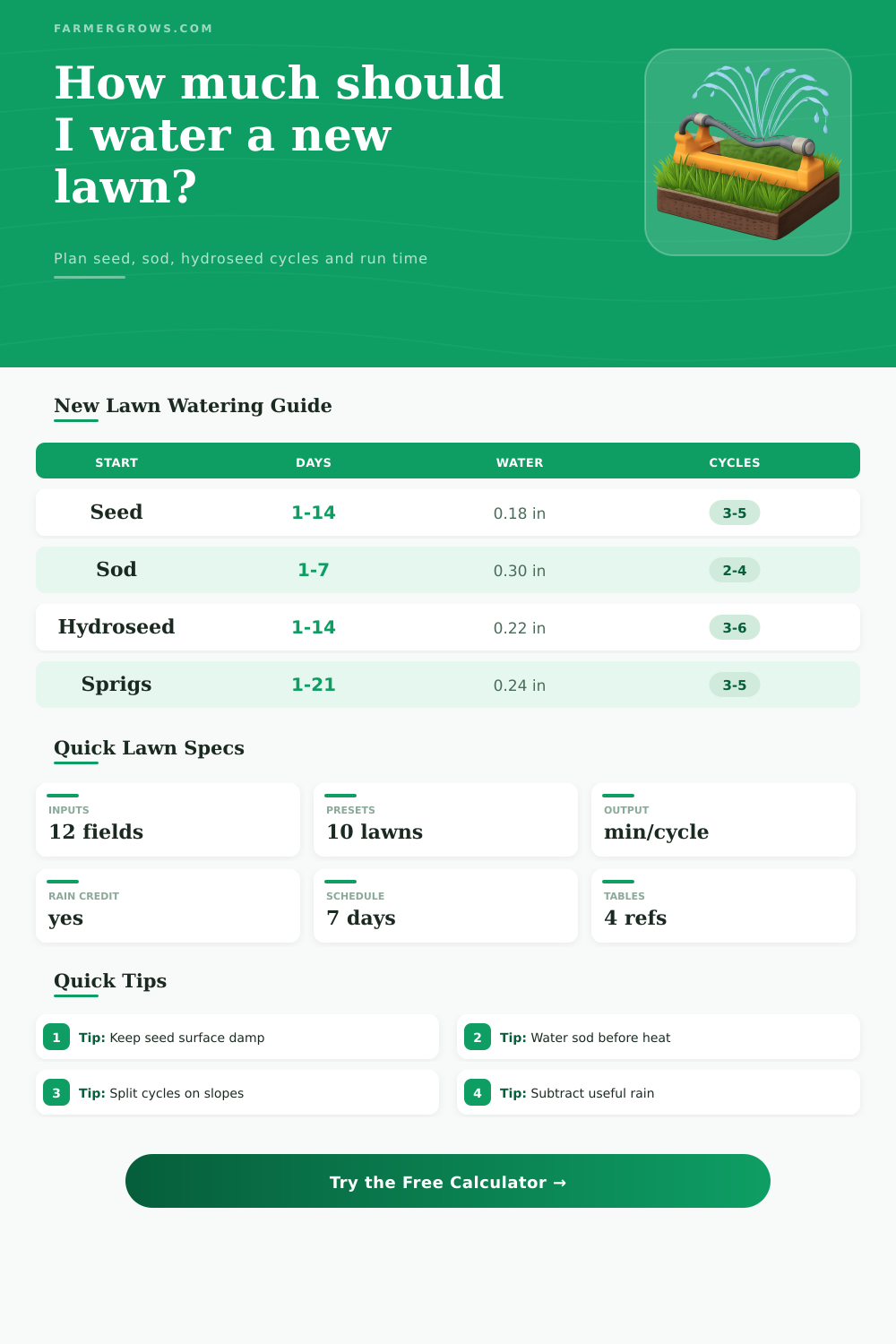
| Establishment method | Early phase target | Taper phase target | Watering note |
|---|---|---|---|
| Seeded lawn | Days 0 to germination: 0.15 to 0.25 in/day | After emergence: 0.25 to 0.45 in every 1 to 2 days | Keep the top quarter inch damp without moving seed. |
| Fresh sod | Days 0 to 7: 0.25 to 0.35 in/day | Days 8 to 21: deeper watering every 1 to 2 days | Lift a corner: soil below the mat should be moist, not muddy. |
| Hydroseed | Days 0 to 14: 0.18 to 0.28 in/day | After green haze: reduce cycles and deepen water | Mulch protects seed but exposed edges dry quickly. |
| Sprigs or plugs | Days 0 to 21: 0.20 to 0.30 in/day | After rooting: soak between runners and open soil | Patchy coverage means bare soil can crust if it dries hard. |
| Turf species | Typical germination or rooting | Water sensitivity | Establishment caution |
|---|---|---|---|
| Perennial ryegrass | 5 to 10 days from seed | Fast to show, shallow at first | Do not stop light cycles just because the first sprouts appear. |
| Tall fescue | 7 to 14 days from seed | Moderate surface moisture need | Good fall starter; heat and wind can thin a young stand. |
| Kentucky bluegrass | 14 to 28 days from seed | Long germination window | Needs patience; keep seedbed evenly moist longer than rye or fescue. |
| Bermuda grass | 7 to 21 days from seed when warm | High heat drying risk | Seed only after warm soil; sandy soil may need more cycles. |
| Zoysia plugs | 2 to 4 weeks to anchor | Localized root-zone need | Water plug zones without keeping open soil saturated. |
| St Augustine sod | 10 to 21 days to root | Mat and seam drying risk | Watch sod edges and shaded spots separately. |
| Soil or slope condition | Water behavior | Cycle adjustment | Field check |
|---|---|---|---|
| Sandy soil | Drains fast and warms early | Add cycles, keep each run shorter | Surface should darken again before it turns dusty. |
| Loam | Balanced holding and drainage | Use standard cycles | Best target is damp but not shiny or puddled. |
| Clay soil | Holds water but seals and puddles | Shorter cycle with soak breaks | Stop if water beads, runs, or smears the seedbed. |
| Moderate to steep slope | Runoff starts before target depth | Split into extra cycles | Look for seed movement, rills, or wet curb gutters. |
| Sprinkler type | Typical output | Example 0.06 in cycle | New lawn caution |
|---|---|---|---|
| Fixed spray heads | 1.2 to 1.8 in/hr | 2 to 3 minutes | Very short cycles; runoff can happen fast on clay. |
| Gear rotors | 0.35 to 0.60 in/hr | 6 to 10 minutes | Check overlap because dry stripes show quickly in seed. |
| Rotary nozzles | 0.35 to 0.55 in/hr | 7 to 10 minutes | Good for slopes when cycles are separated by soak time. |
| Oscillating hose sprinkler | 0.25 to 0.75 in/hr | 5 to 14 minutes | Catch-cup test matters because pattern edges are weak. |
| Impact sprinkler | 0.20 to 0.50 in/hr | 7 to 18 minutes | Large droplets can move light seed if pressure is high. |
| Temporary dripline | 0.15 to 0.35 in/hr | 10 to 24 minutes | Works for sod or plugs, not even enough for broadcast seed alone. |
Check with cups: Place several straight-sided cups in the zone and run one cycle. Use the average catch depth to confirm the sprinkler output before trusting any minute estimate.
Taper deliberately: After visible germination or sod rooting, reduce cycle count before reducing total weekly water. The goal shifts from damp surface to deeper root growth.
So you try to grow a lawn by broadcasting some seed, or laying down new sod, hoping for a carpet of green. And then you realize that it’s not so simple, that the stuff on top quickly loses its moisture and your lawn just isn’t holding up very well at all.
Most lawns don’t fail from bad grass; they fail from bad watering during establishment, when things is barely anchored in place and those roots is struggling to take hold. You get it wrong, you pay. Get it right, it’s a breeze.
How to Water New Grass
Watering things as they are being established gets complicated: There’s too little (drying out seed; washing sod away) and there’s too much (runoff on slopes; drowning young roots). To do it right, the equation depend on many variables (weather), soil, your particular sprinklers, and here’s where the calculator does the heavy lifting for you, translating inches of desired water into real minutes of how long to let ‘er rip.
No more guessing if five minutes will be a flood or just a mist. That difference matter because it can either starve young roots or suffocate them.
The other factor that is bigger than folks let on is the nature of your soil. For instance, sandy soil will warm early (it also dries out early) but it also drain rapidly. That calls for repeated short cycles to maintain the surface moisture without making a mess. On the other hand, clay hold water like a sponge, but infiltrates poorly, so blasting it with a single long cycle results in run-off before soak-in occurs.
The device considers such factors; on clay soils, it suggest shorter, more frequent bursts so there’s some time to soak in-between. This avoids puddles that could smother sod seam or rot seedlings.
Another concealed variable: How efficient are those sprinklers? If you have a traditional impact sprinkler, higher pressure may cause it to throw big drops that can knock off lightweight seedling. For example, a rotary nozzle will deliver a gentler spray that works well on a slope where runoff is always a concern. The tool’s reference tables helps explain the output rates and explain how you may need longer or shorter run times depending on whether you’re using an in-ground system or your neighbor’s hose-end sprinkler.
Knowing what your sprinkler deliver helps avoid overwatering the outsides and underwatering inside. Flexibility is required of weather patterns, as well: Evaporation is lower during a cool, cloudy week (stretch those cycles a bit); hot, windy days rob the surface of moisture in hours. Predicted rain is credited on the calculator, so no need to go spritz things if it’s headed that way anyway.
And again, it will help you back off once roots have been established. At first, the goal is to keep the top quarter-inch moist but not soaked. Later, water less often but more deeply to encourage roots to grow downward instead of staying shallow and vulnerabl. That’s where many new lawns falter, by continuing to mist long after germination, impeding root development.
Plan B is visual inspections. There’s no substitute for your finger in the ground. Is the underlying soil moist but not muddy? On dry mornings after a night without rain, do you see signs of darkening on the seedlings’ surface? Is the area still dusty between cycles, or slick and shiny? Adjust up or down accordingly; tiny tweaks outsmart mechanical schedules all day long.
In short, creating a lawn has as much to do with time (not forcing) and attention to detail (no brawn) as anything else. Instead of guessing, use a little math to calculate your run times so you can deliver exactly what the grass needs to take root. Then when the roots weave in and out of the ground, all that effort would of paid off in a hearty turf that stands up to summer heat without help from you.
Good seeds alone won’t make for that thick carpet…smart water use does.