💧 Submersible Pump Cable Size Calculator
Estimate copper or aluminum cable size from pump amps, one-way run length, voltage drop target, start factor, and conduit temperature.
Recommended Cable Estimate
The selected AWG is the smallest size that meets both voltage drop and temperature-adjusted ampacity in this calculator.
| Phase | Formula | Variables | Use |
|---|---|---|---|
| Single-phase | VD = 2 x K x I x D / cmil | K, amps, ft, circular mils | 2-wire pump circuit |
| Three-phase | VD = 1.732 x K x I x D / cmil | K, amps, ft, circular mils | 3-phase motor circuit |
| Percent drop | VD% = VD / voltage x 100 | Line voltage | Compare to target |
| Start check | Start VD% = VD% x start factor | Motor start multiplier | Shows momentary dip |
| Size | Circular mils | Copper amps | Aluminum amps |
|---|---|---|---|
| #14 | 4110 | 20 A | - |
| #12 | 6530 | 25 A | 20 A |
| #10 | 10380 | 35 A | 30 A |
| #8 | 16510 | 50 A | 40 A |
| #6 | 26240 | 65 A | 50 A |
| #4 | 41740 | 85 A | 65 A |
| #2 | 66360 | 115 A | 90 A |
| 1/0 | 105600 | 150 A | 120 A |
| 2/0 | 133100 | 175 A | 135 A |
| 4/0 | 211600 | 230 A | 180 A |
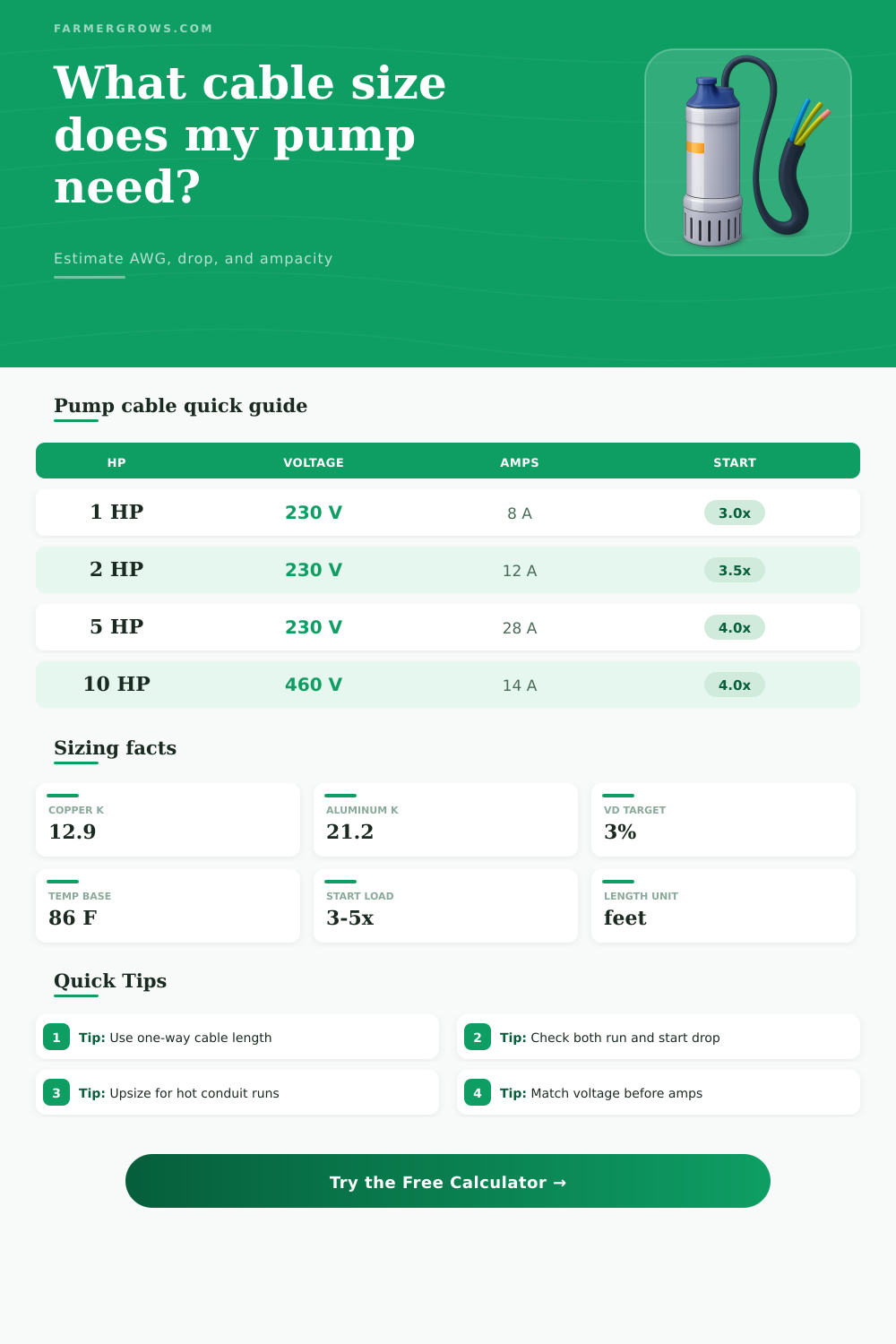
| Motor HP | 230 V 1-phase | 230 V 3-phase | 460 V 3-phase |
|---|---|---|---|
| 1 HP | 8 A | 4.2 A | 2.1 A |
| 2 HP | 12 A | 6.8 A | 3.4 A |
| 3 HP | 17 A | 9.6 A | 4.8 A |
| 5 HP | 28 A | 15.2 A | 7.6 A |
| 7.5 HP | 40 A | 22 A | 11 A |
| 10 HP | 50 A | 28 A | 14 A |
| 15 HP | 74 A | 42 A | 21 A |
| 20 HP | 96 A | 54 A | 27 A |
| Conduit temp | Metric temp | Factor | Effect |
|---|---|---|---|
| 86 F or less | 30 C or less | 1.00x | Base ampacity |
| 95 F | 35 C | 0.94x | Small reduction |
| 104 F | 40 C | 0.88x | Moderate heat |
| 113 F | 45 C | 0.82x | Hot conduit |
| 122 F | 50 C | 0.75x | Upsize likely |
| 131 F+ | 55 C+ | 0.67x | Heavy derate |
Use the full one-way distance, including the drop pipe lead, buried run, and any control box or starter distance.
If start voltage looks tight, compare the next larger size even when the running drop is within target.
The submersible pump that is placed at the bottom of a well or irrigation line need to be connected to a cable that carries electrical current to the submersible pump. The cable that is use to supply electrical current to the submersible pump has a load that the submersible pump creates while in operation. However, the cable also carries a heavy surge of electricity that the submersible pump creates each time it is started.
The correct size of the electrical cable that is used to supply current to the submersible pump must balance the voltage drop that is created along the distance that the current must travel, the amperage of the submersible pump motor, and the amount of heat that builds up within the conduit that contains the electrical cable. If the wrong size electrical cable is used to supply current to the submersible pump, the submersible pump may labor while performing its task, the submersible pump may slowly start, or the electrical cable may trip the circuit breakers that protect the submersible pumps electrical circuit. By choosing the correct size cable, the voltage will be stable along the distance that the current travels to the submersible pump, and the motor will be protected from failure during its normal service life.
How to Choose the Right Cable for a Submersible Pump
The distance between the electrical panel that supplies power to the submersible pump and the submersible pump itself is one of the main variable in the selection of the correct size electrical cable. Electrical current decrease with distance. Thus, if the distance between the power panel and the submersible pump is relatively short, it is easier to make mistakes in the sizing of the electrical cable.
However, if the distance between the power panel and the submersible pump is longer then a few hundred feet, each additional unit of resistance in the cable becomes important. Voltage drop becomes the most important factor to consider for submersible pumps that is installed at distances that are longer than a few hundred feet. For example, if the submersible pump that is installed in the well is rated to run at 230 volts, but the voltage that reaches the pump is only 210 volts, the submersible pump will be required to draw more current to perform its task.
As a result of the submersible pump drawing more current, the submersible pump will reach higher temperatures, and will wear out more quick. The voltage drop calculator that is provided allows for the length of the run, the amperage of the submersible pump, and the percentage of drop in voltage along the distance for which the submersible pump will operate to be entered. The calculator will then provide recommendations based on those entered variables.
The voltage drop recommendations will also take into account the ampacity of the cable at different temperatures. The horsepower of the submersible pump provides a general estimate of the amperage of the submersible pump motor. However, the figure that should be used is the amperage of the submersible pump that is manufacture on the motors nameplate.
Submersible pumps with the same horsepower may have different amperage rating. Thus, by using the amperage of the submersible pumps motor, a designer or installer of the submersible pump will ensure that they dont make the common mistake of undersizing a high-efficiency submersible pump. The voltage drop calculator allows for the use of the amperage of the submersible pumps motor instead of the estimated amperage based off the horsepower of the pump.
It is important to also consider the electrical current that the submersible pump draws when it is starting. The start current for most single-phase submersible pumps is higher than the running current that the motor draws while the pump is in operation. The start current for these types of submersible pumps is three to five times higher than the running current of the motor.
This initial surge in current when the submersible pump starts can cause the voltage to drop to a level that is lower than the running voltage of the pump. If the voltage is too low, the submersible pump motor will not be able to reach its rated running speed. Thus, the start drop percentage of the voltage and the running drop percentage of the voltage must be entered into the calculator to ensure that the electrical cable can endure these start surges of voltage.
The material from which the electrical cable is made impacts the performance of the cable. Copper can carry the same amount of current as aluminum but requires a smaller diameter. Thus, copper is often the material of choice for submersible pumps that are to be installed in wells.
However, if the electrical cable that is used to supply current to the submersible pump is made of aluminum, the size of the cable must be larger than the size of a copper cable. The voltage drop calculator accounts for the type of electrical cable that is to be used; either copper or aluminum. It is also important to consider the temperature within the conduit in which the submersible pumps electrical cable is installed.
If the temperature increase, the amount of current that the cable can carry decreases. For instance, if the submersible pumps electrical cable is exposed to sunlight, the temperature within the conduit will be higher than if the submersible pump is installed in soil that remain cool. Thus, the temperature within the conduit of the submersible pumps electrical cable will impact the ampacity of the cable.
The derating of the ampacity of the submersible pumps electrical cable is accounted for in the voltage drop calculator. The table that is included in the voltage drop calculator shows the results of using a submersible pump electrical cable that is one size larger or smaller than the size that the calculator recommends. Using this table, the designer or installer can ensure that the chosen size for the electrical cable to supply current to the submersible pump will both significantly reduce the voltage drop along the distance that the current must travel, as well as keep the cost of the electrical cable to a minimum.
If the voltage drop calculators recommendation of one size of electrical cable significantly reduces the voltage drop along the distance that the current must travel, but the cost of that cable is significantly higher than another size of electrical cable, then the designer or installer may still choose to use the smaller size of electrical cable. Thus, the table helps to minimize the cost of the electrical cable while ensuring that the voltage drop along the distance that the current must travel is minimized. As with any installation, there are always additional variables or complications to the installation of a submersible pump.
For instance, soil movement along the length of the conduit in which the submersible pump is installed may create resistance within the conduit. Resistance within the conduit will lead to a voltage drop along the distance of the submersible pumps electrical cable. Thus, it is recommended that some margin be left within the voltage drop target for the installation of the submersible pump.
Additionally, if margin is left within the voltage drop target, that margin will allow for the possibility of replacing the submersible pump with one that has a higher horsepower. It is common for individuals to size the electrical cable based upon the solutions that have worked in the past. However, there are a few issues with this solution.
For instance, if the distance between the power panel and the submersible pump has changed in the past, or if the submersible pump motor has changed, that solution will no longer work. However, by performing a systematic calculation of the voltage drop along the distance that the current must travel, as well as the ampacity of the cable that will supply that current, the designer or installer can ensure that the sizing of the electrical cable will be accurate and remove the guesswork from the installation of the submersible pump. The goal is not to use the smallest size of electrical cable for the submersible pump.
Instead, by choosing the size of electrical cable that will allow for the voltage to remain stable along the distance that the current must travel, the motor will be cooler to the touch, will draw less current from the power panel, and will last for the life of the submersible pump installation.