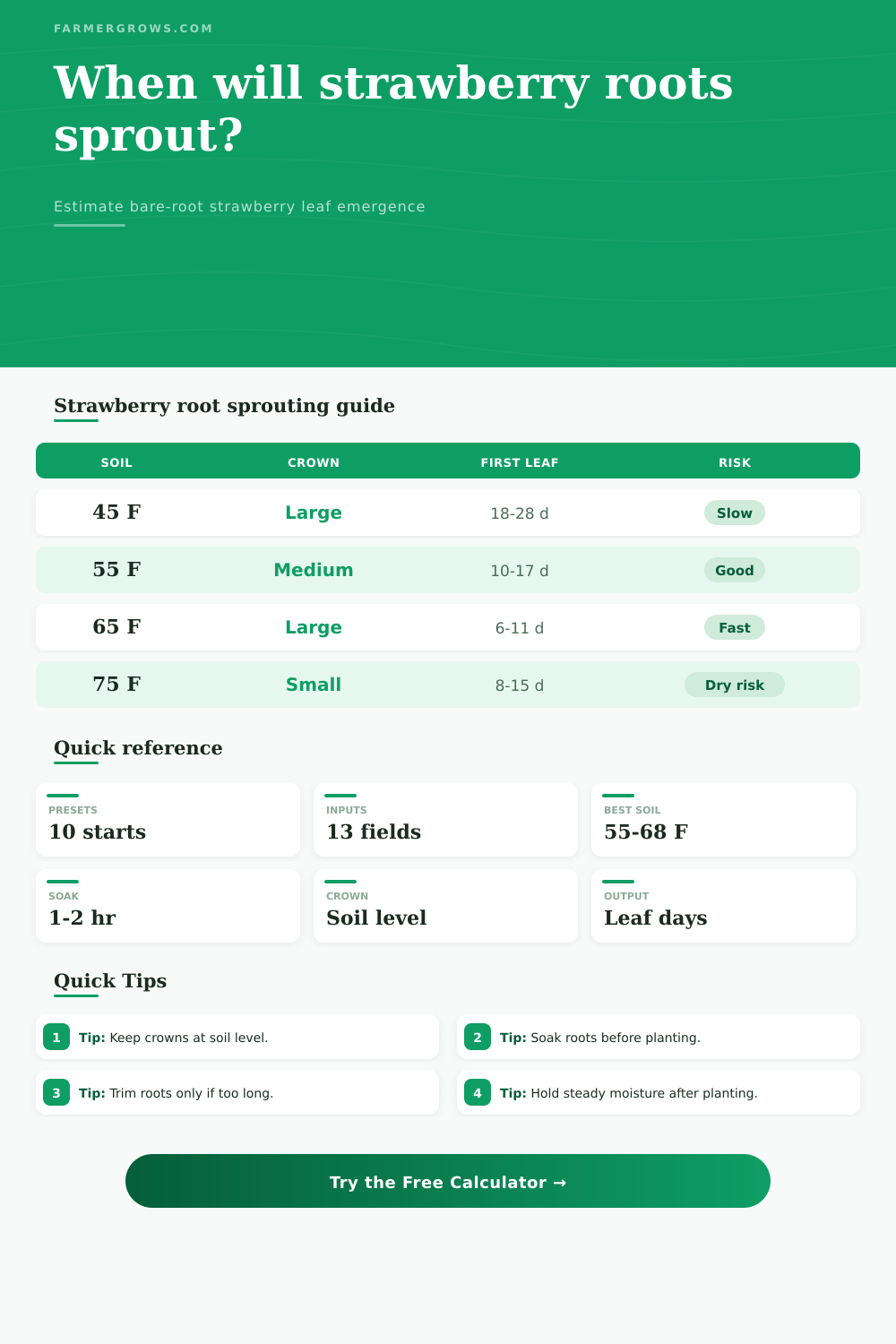
Strawberry Root Sprouting Time Calculator
Estimate how many days a bare-root strawberry crown needs to wake up, push new white roots, and show first leaves after planting from crown size, root trimming, soak time, soil temperature, planting depth, mulch, moisture, and winter zone pressure.
Load a bare-root strawberry planting profile, then adjust the crown diameter, root condition, soak time, soil warmth, mulch, moisture, and planting depth to match your bed.
Use the average soil temperature at crown depth. The calculator models leaf emergence from stored crown energy, root hydration, root restart speed, and stress from depth, mulch, moisture, and temperature swings.
Strawberry root sprouting estimate
Enter bare-root planting conditions to estimate leaf emergence and root restart timing.
These cards compare your current inputs against a cooler soil, warmer soil, and better root-prep scenario so you can see which factor is driving the leaf emergence estimate.
| Soil temperature | Typical first leaves | Root behavior | Planting note |
|---|---|---|---|
| Below 45°F | 18 to 35 days | Roots restart slowly and crowns stay dormant longer. | Planting is possible, but check for frost heave and crown drying. |
| 45 to 54°F | 12 to 24 days | Cool root growth with a wide emergence window. | Use light mulch and steady moisture, especially in windy beds. |
| 55 to 68°F | 6 to 14 days | Best balance of root restart and leaf push. | This is the target range for most bare-root strawberry starts. |
| 69 to 78°F | 7 to 16 days | Leaf growth can be quick, but roots dry faster. | Shade, water consistency, and crown placement become more important. |
| Above 78°F | 10 to 22 days | Heat stress may slow rooting even when leaves appear. | Plant in the evening, water deeply, and protect from hot wind. |
| Factor | Faster sprouting setup | Slower sprouting setup | Why it matters |
|---|---|---|---|
| Crown diameter | Firm crown over 1/2 inch wide | Thin crown under 1/4 inch wide | Larger crowns hold more stored energy for the first leaf flush. |
| Root condition | Flexible roots with pale inner tissue | Shriveled, brittle, or broken roots | Dry roots need rehydration before new feeder roots can grow. |
| Root trimming | Light trim only when roots fold | Heavy trim below 4 inches | Cut roots restart, but severe trimming removes stored reserves. |
| Soak time | Clean water for 1 to 2 hours | No soak or overnight soaking | A short soak hydrates roots without depriving them of oxygen. |
| Planting depth | Crown at soil level | Crown buried or roots exposed | The crown must breathe while root initials stay covered. |
| Condition | Good signal | Delay signal | Adjustment |
|---|---|---|---|
| Moisture | Soil feels damp but not sour | Surface crusts, dries, or stays soggy | Water lightly and often until leaves appear, then deepen intervals. |
| Mulch | Straw around, not over, crowns | Heavy mulch packed into the crown | Pull mulch back so the crown top is visible. |
| Cold zones | Crowns firm after cold nights | Heaved crowns or exposed roots | Press plants back in and re-cover roots after thaw. |
| Hot exposure | Leaves emerge green and compact | Wilting before roots grip | Use temporary shade and keep root zone evenly moist. |
| Drainage | Water drains but soil remains moist | Mud, sour smell, or black crown tissue | Lift crowns only if rot risk is active and soil cannot drain. |
| Day after planting | Expected sign | What to inspect | Decision cue |
|---|---|---|---|
| Day 3 to 5 | Crown stays firm | Check moisture and crown height. | Do not pull plants up just to check roots. |
| Day 7 to 14 | First green tips in warm soil | Look for swelling buds at crown center. | Uneven beds may still be normal in cool soil. |
| Day 15 to 24 | Most viable crowns leafing | Gently check one weak crown if no growth appears. | Firm white crown tissue means keep waiting. |
| Day 25 to 35 | Late crowns should show signs | Slice one suspect crown to inspect color. | Brown mushy crown tissue points to replacement. |
| After day 35 | Only stressed cold starts lag | Check roots, crown tissue, moisture, and planting depth. | Replant missing spots if crowns are dead or hollow. |
Crown height is the make-or-break detail. Set the crown at soil level, spread roots downward, and firm soil around roots without burying the growing point.
Short soaking is enough. A 1 to 2 hour soak helps dry roots rehydrate; overnight soaking can reduce oxygen if the plants already arrived in good shape.
Leaves are not the whole story. Fast leaves in warm weather still need new root growth, so keep moisture steady after the first green tips appear.
Do not bury slow crowns deeper. If a crown is late, correct moisture and temperature first; extra soil over the crown raises rot risk.
This calculator estimates bare-root strawberry leaf emergence and early root restart timing. Cultivar, nursery storage, disease, shipping heat, soil salts, herbicide residues, and local weather can move real results earlier or later.
Bare-root strawberry planting has its particular kind of worry. You take your time positioning each crown just so, spreading out the roots a bit and making good contact between the crown and the soil, firming gently around them; but then you wait…wait…and wait some more. Weeks go by. No green shows itself. A few weeks after finishing up work in the bed, there’s not one bit of change from what the ground looked like before: nothing. How can they be alive? They must all have perished, right?
Usually, the drama isn’t nearly so extreme. In fact, it’s actualy pretty biologically normal. Before it will think of putting up any leaves at all, the plant has business down below, converting stored energy into brand-new root tips. Knowing that helps me treat the bed different than, and wait.
Why Your Strawberries Are Not Growing Yet
But how does it know? That’s where the nitty gritty math kicks in. This site has a calculator for just that. It will estimate an underground timeline based off moisture, temperature, and the soil (above), all those tricky things. Then, it will tell you, for example, when to really expect your first leaves. Because let’s face it: Our gut feeling doesn’t work here very well; we want instant gratification with our plants, but strawberries are on their timing. The tool helps us fill in the gap between what we think and biology of what they’re doing.
Now you have a target date, day 15 or so, and then you can quit fretting at day 10 or so and start watching closely.
The number one factor in all of this is soil temperature. Below forty-five degrees, the roots is barely functioning. It’s just too cool out there for them to expand; they’re going to be dormant and holding onto their energy reserves. Once it starts warming up into the mid-fifties, though, things wake up. That’s the sweet spot for most springtime plantings: the roots gets moving again fast and before long, so will the leaves.
If it warms up more than about seventy degrees, sure, you may notice quick leaf growth… But many times that’s at the cost of root development. Those roots won’t focus on soil; they’ll focus on air. And guess what happens in summer, when we need water, and a lot of it? Problems.
Just as important as the weather is the condition of the crown itself that you’re planting. When you’ve got a plump, firm crown, full of stored energy, it will have plenty of fuel to start growing again. If you have a dry or shriveled crown, there’s no more where that came from. Rehydrating the roots by soaking in a bucket for an hour or two before planting will help re-expand the tissue so it can start taking up water again. Don’t soak longer than that (overnight if they arrive bone-dry) or you risk depriving the roots of oxygen, which can be as bad as drying them out. It’s a fine line: too wet vs. It is too dry.
Most gardeners fatally mistake planting depth. The crown should be planted at soil level exactly. If you bury it (and the growing point) it will rot. If you leave it above ground (too high), your roots will dry out and die. This is shown in the reference tables on the page, which show how much growth is delayed (or even killed off) if a plant is buried too deep or not covered enough. Ideally you want to adjust the surrounding soil so the bud is visible but covered by a thin layer of fine dirt.
The key in that early period was good watering. The soil should be moist but not soaked, and moist but not dry as a bone. With drip irrigation, a good system, it’s relatively easy to ensure even moisture in the root zone (not around the crown). Occasional watering, where the soil dries out entirely between sessions, means you kill off the tender young root tips every time you turn on the tap. It’s all root-replacement work; no leaf-growth action. Moisten steadily so the delicate white roots can thicken and get established.
If it’s been warm, about two weeks in, go out and check on things: Do you have swollen buds in the middle of the crown? If so, and the crown feels firm (not mushy and brown inside), let it have some more time. Going out and pulling a plant up and inspecting its roots damages the plant worse than just letting it be.
Growing strawberries can require patience more then anything. Your eyes and hands will tell you when it’s ready; the timeline on the calculator tells you what should happen, but then there’s the waiting. When those first true leaves emerge, it’s all good. It’s over. Roots is doing their job. The fruit cycle starts.