Strawberry Growth After Flowering Time Calculator
Estimate how long strawberry flowers take to become ripe berries, with adjustments for day-neutral versus June-bearing varieties, pollination, temperature, fruit size, irrigation, and harvest flush pattern.
Use this after first open flowers appear. The calculator starts from bloom date and returns a practical harvest window, because strawberry ripening is driven by weather, pollination quality, berry load, and water consistency.
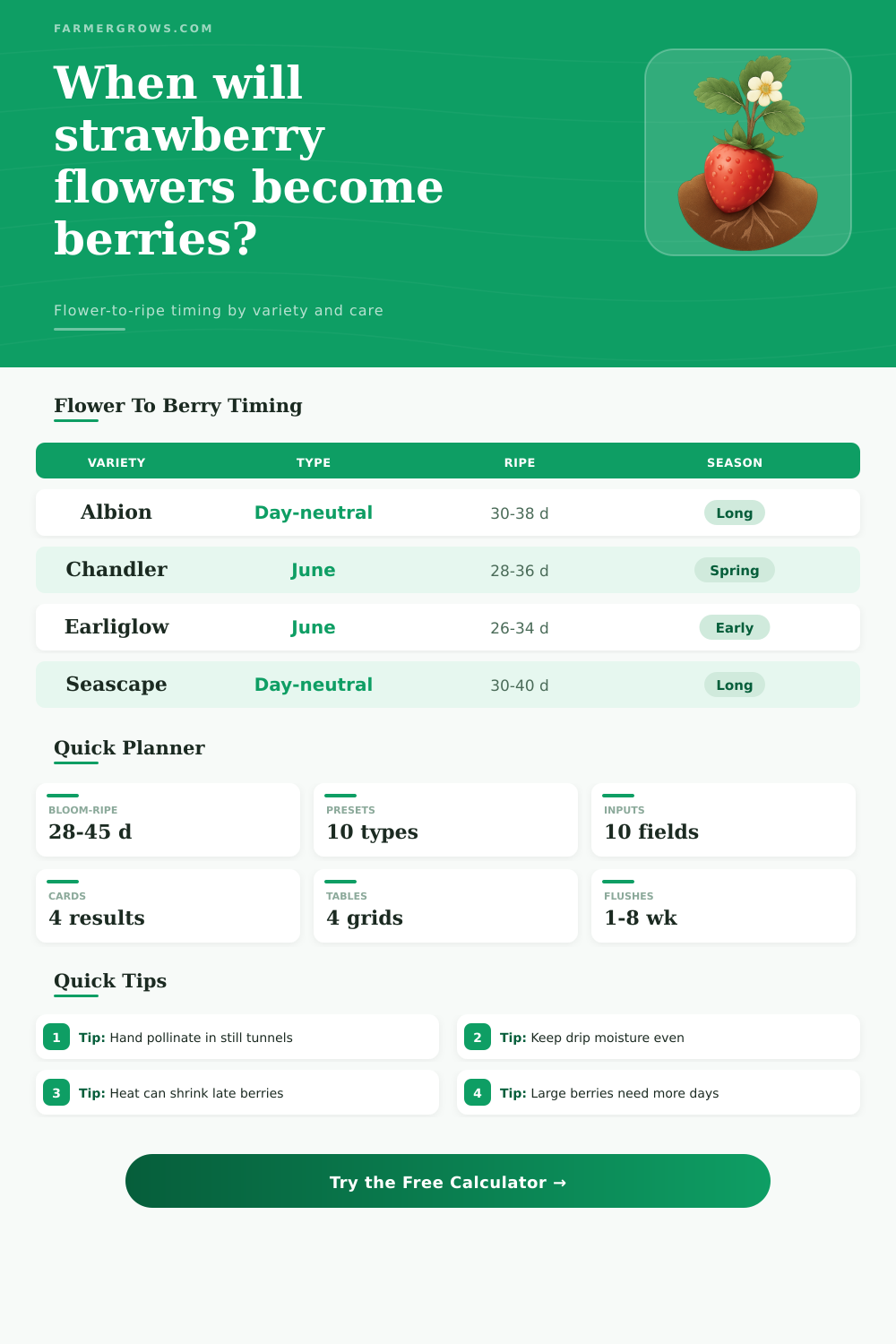
| Variety | Type | Typical flower-to-ripe days | Usual flush behavior | Timing note |
|---|---|---|---|---|
| Albion | Day-neutral | 30 to 38 days | Repeat picks across a long window | Very responsive to steady irrigation and runner control |
| Seascape | Day-neutral | 30 to 40 days | Long but weather-sensitive | Cool cloudy weather can spread the ripe window |
| Monterey | Day-neutral | 29 to 38 days | Strong recurring flushes | Heavy fruit load can add a few sizing days |
| San Andreas | Day-neutral | 29 to 37 days | Even repeat production | Often steady in protected coastal or mild climates |
| Chandler | June-bearing | 28 to 36 days | Concentrated spring crop | Warm spring days move color quickly after sizing |
| Earliglow | June-bearing | 26 to 34 days | Early compact flush | Small-to-medium berries can ripen sooner than large cultivars |
| Honeoye | June-bearing | 27 to 35 days | Early-to-mid harvest | Good fit for cool regions with short early seasons |
| Jewel | June-bearing | 29 to 37 days | Midseason flush | Renovated beds usually crop more evenly |
| Mara des Bois | Everbearing | 31 to 42 days | Small recurring flushes | Aromatic fruit benefits from moderate temperatures |
| Cabot | June-bearing | 32 to 42 days | Large berry flush | Large berries need more cell expansion before full color |
| Season condition | Day-neutral effect | June-bearing effect | Harvest flush pattern | Watch point |
|---|---|---|---|---|
| Cool spring | Add 3 to 8 days | Add 2 to 6 days | Slower color, longer picking spread | Cold nights delay sugar and red color |
| Mild spring | Baseline timing | Baseline timing | Best balance of size and flavor | Keep flowers open to pollinators |
| Warm spring | Subtract 1 to 3 days | Subtract 1 to 4 days | Faster first red berries | Moisture stress can shrink fruit |
| Summer heat | Add 2 to 6 days, lower quality | Usually late tail only | Smaller, uneven later fruit | Shade cloth may protect size |
| Fall flush | Add 2 to 7 days | Not typical | Small repeat waves | Short days and cool nights stretch ripening |
| Protected winter | Add 4 to 10 days | Possible in warm zones | Slow but steady under cover | Vent tunnels for pollination and humidity |
| Pollination quality | Typical sign | Timing adjustment | Fruit shape result | Best action |
|---|---|---|---|---|
| Excellent bee activity | Flowers visited often | 0 to 1 day faster | Uniform shoulders and tips | Keep covers open during bloom |
| Good natural pollination | Several visits per flower | Baseline | Mostly even berries | Protect blossoms from spray and wind |
| Fair or partly covered | Some still or rainy bloom days | Add 1 to 3 days | Some small misshapen fruit | Vent covers and invite pollinators |
| Poor set | Still tunnel, rain, or few bees | Add 3 to 6 days | Button berries and poor tips | Hand pollinate or improve airflow |
| Hand-assisted | Brush or vibration used | 0 to 2 days faster | More complete seed set | Repeat every open-flower day |
| Fruit size and water | Ripening effect | Quality effect | Harvest effect | Practical threshold |
|---|---|---|---|---|
| Small early berries | 1 to 3 days faster | Can be sweet if not heat-stressed | First pick arrives earlier | Do not over-thin strong plants |
| Medium berries with drip | Baseline timing | Best balance for most beds | Reliable every 2 to 3 days | Keep soil evenly moist |
| Large berries | Add 2 to 5 days | Better size when nights are cool | Peak pick shifts later | Thin weak flowers on young crowns |
| Dry spells | Add 3 to 7 days | Small fruit, pale shoulders | Gaps between pickings | Avoid wilt between irrigations |
| Frequently wet soil | Add 1 to 4 days | Soft fruit and disease pressure | More culls during peak | Improve drainage and air flow |
Pollination tip: If flowers open under row cover or inside a still tunnel, vent during warm daylight hours or hand-pollinate open flowers. Better seed set usually means fuller berries and a tighter ripe window.
Irrigation tip: Keep moisture steady from petal fall through full color. Dry swings delay sizing, while soggy crowns can soften fruit and stretch harvest into uneven small pickings.
Strawberry blossoms becomes strawberries (but not instantaneously); there are factors that can slow or speed up their development (temperature, water, pollination). Knowing what happens will help you time your picking. And it can help you avoid the frustration of finding shrivelled fruit.
How big it gets: What kind of plant did you put it in? If it’s a June-bearing, like Earliglow or Chandler, that’s a lot of berry all at once, in springtime. If it’s day-neutral (like Albion or Seascape), it’ll have more throughout the season. They are taking turns, balancing energy between current fruit and buds to come. Some berries will ripen later then others. Know your variety, and this will help explain variation from one year to the next.
How to Grow Better Strawberries
The rate of ripening is weather-controlled. A warm spring accelerates it (sugar and color), while a cool one slow it (paler berries). A few sunny days won’t help; it’s average daytimes that count. Total heat in a few weeks is what counts; the plant are responding. If you have an extra week with pinkish-white berries in a cool period, don’t panic. It’s stashing reserves for a later ripening.
Consistency of water matters for fruit size. If moisture is steady, cells can stretches first then fill with sugar. Dryness halts expansion prematurely; fruit will be small. It may ripen sooner, but not hold up as well. Disease and rot are issues if it’s too wet. So: find that happy medium where roots has access to moisture but aren’t drowned, which is also an energy expense in service of the change of flower to food.
Fruit quality depend on pollination quality, which affects yield and shape. Poor pollination results in misshapen or smaller berries that fails to develop. Full seed set (signaling the plant to invest in the berry) means good bee activity. If you are growing under covers, hand-pollinate to mimic nature and ventilate. The result: uniform fruit that ripen at once. That makes harvesting efficient rather than a scavenger hunt for hidden gems.
The timing for all the changes shift from season to season (reference tables), but you need to learn to read them. Look at fresh blossoms compared to what’s been open and setting fruit a couple weeks back. There are fewer or smaller new blooms. Something’s not right. It doesn’t matter as much when by the calendar; it matters that you adjust accordingly.
Strawberries can be quick to change from green to red some years, slow to blush pink the next. That’s just how they grow…and accept their variability. Managing expectations is about predicting ripeness, and there’s math involved in that. Knowing when initial ripe period will be, and for how long, helps turn waiting from something unmanageable to something manageable.
You should of known it would take time. What do you want? When should you pick? It’s all here. Each time another flower opens the process starts over, but this time you’re ready.