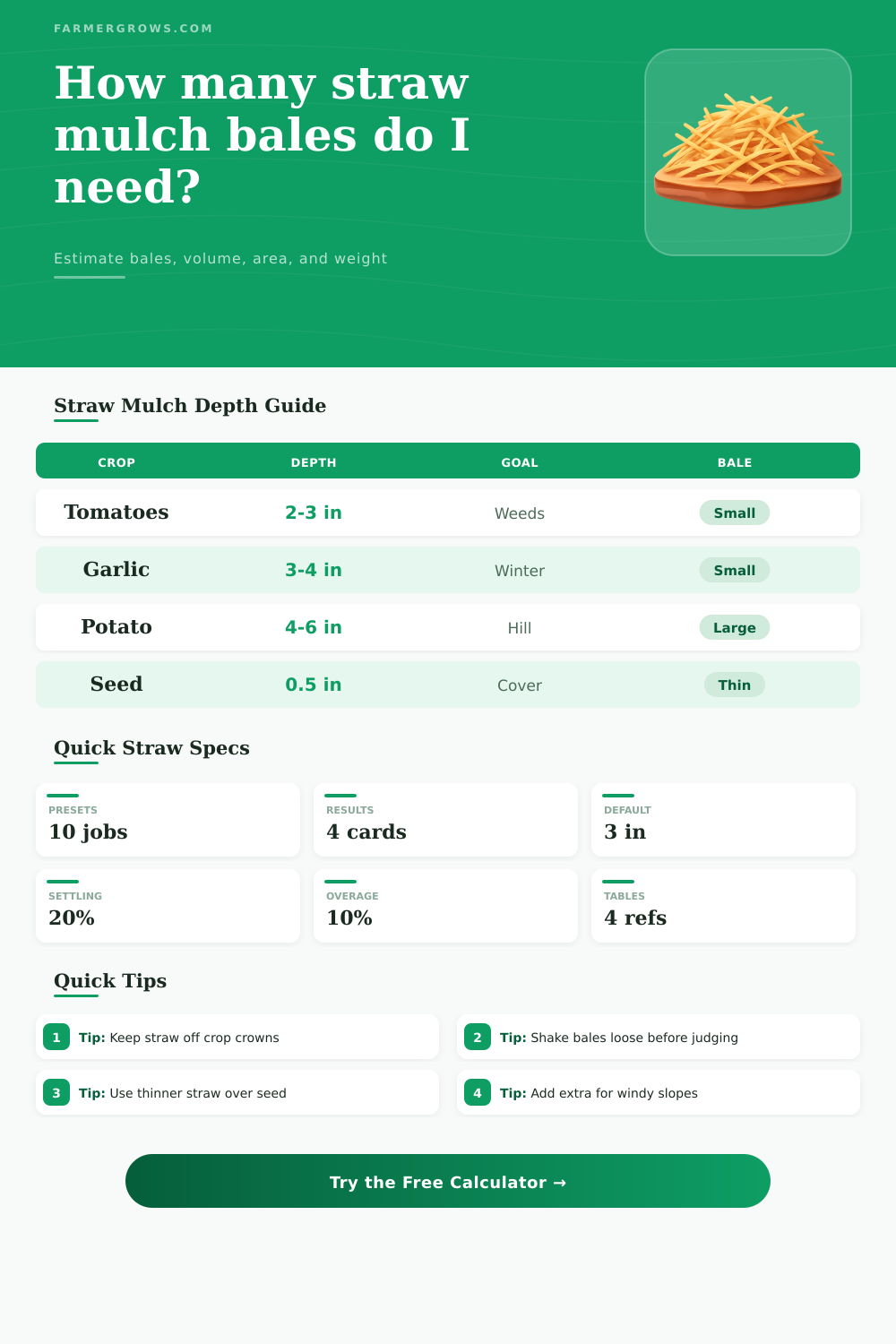
Straw Mulch Calculator
Estimate straw mulch bales for vegetables, berries, potatoes, winter garlic, seeded slopes, and farm garden paths using bed area, crop depth, straw type, settling, bale size, and overage.
Pick a real job to prefill the calculator, then adjust bale size or depth to match the straw you actually have on hand.
Straw Mulch Estimate
Rounded bale count, working volume, coverage, and hauling weight.
Leave a small bare collar around stems, then pull straw thicker between plants for weeds and soil splash.
Use a lighter layer so small plants do not stay too cool or hold damp straw against crowns.
Deep straw can support hilling, but expect more settling and top up after heavy rain.
Winter rows usually need enough loose straw to resist freeze and thaw heaving.
Use clean straw between rows and pull back from crowns during wet spring weather.
Spread thin enough that light reaches seedlings; the soil should still show through.
Use more overage, tack straw if needed, and plan for uneven hand spreading.
Traffic compresses straw quickly, so path jobs need extra settling allowance.
| Bale size | Typical weight | Loose volume | Best use |
|---|---|---|---|
| Mini garden bale | 10 to 14 lb | 5 to 7 cu ft | Containers, small raised beds, touch-up work |
| Compact small bale | 28 to 36 lb | 16 to 20 cu ft | Retail bales, small backyard beds |
| Small square bale | 36 to 45 lb | 20 to 24 cu ft | Vegetable gardens, berries, seed cover |
| Heavy small square | 48 to 60 lb | 26 to 32 cu ft | Large beds, potato mulch, winter rows |
| 4 ft round bale | 430 to 520 lb | 210 to 260 cu ft | Market garden paths and broad mulch jobs |
| 4 ft by 5 ft round bale | 600 to 750 lb | 290 to 360 cu ft | Bulk erosion cover, farm garden blocks |
| Erosion straw roll | 60 to 80 lb | 30 to 40 cu ft | Slope cover where rolls are spread or anchored |
| Crop or surface | Useful depth | When to use it | Caution |
|---|---|---|---|
| Leafy greens, herbs, carrots | 1 to 2 in | Light weed cover and moisture control | Too much straw can cool soil and crowd seedlings |
| Tomatoes, peppers, eggplant | 2 to 3 in | Soil splash control, steady moisture, summer weeds | Keep straw a few inches away from tender stems |
| Strawberries and berries | 2 to 4 in | Clean fruit, winter crown protection, row mulch | Pull wet straw back from crowns if disease pressure is high |
| Garlic, onions, overwinter rows | 3 to 4 in | Winter insulation and freeze-thaw protection | Thin the layer in spring if growth struggles through it |
| Potatoes and deep straw systems | 4 to 6 in | Hilling support and light exclusion around tubers | Top up after settling; do not bury weak shoots too early |
| New seed and cover crops | 0.25 to 0.5 in | Moisture holding without blocking light | Soil should be visible through the straw |
| Erosion slopes and swales | 1 to 2 in | Rain impact protection and slower runoff | Anchor on steep or windy slopes |
| Garden paths | 3 to 5 in | Mud control and traffic cushion | Expect fast compaction under repeated walking |
| Depth or rate | Coverage per 22 cu ft bale | Coverage per cubic yard | Typical job |
|---|---|---|---|
| 0.5 in loose straw | About 528 sq ft | About 648 sq ft | New seed, cover crop, light tack |
| 1 in loose straw | About 264 sq ft | About 324 sq ft | Shallow crops, spring touch-up |
| 2 in loose straw | About 132 sq ft | About 162 sq ft | Berries and moderate weed cover |
| 3 in loose straw | About 88 sq ft | About 108 sq ft | Main vegetable garden mulch |
| 4 in loose straw | About 66 sq ft | About 81 sq ft | Winter garlic, cold protection |
| 6 in loose straw | About 44 sq ft | About 54 sq ft | Potatoes and deep mulch systems |
| Seed rate: 50 to 70 lb per 1,000 sq ft | About 570 to 800 sq ft from a 40 lb bale | Rate based, not depth based | Thin straw over grass seed |
| Erosion rate: 90 to 115 lb per 1,000 sq ft | About 350 to 445 sq ft from a 40 lb bale | Rate based, not depth based | Slopes, swales, bare banks |
| Straw type | Breakdown pace | Watering effect | Field note |
|---|---|---|---|
| Wheat straw | Moderate | Good summer moisture hold | Common, clean, easy to shake loose |
| Oat straw | Moderate-fast | Settles a bit faster after rain | Soft texture works well around vegetables |
| Barley straw | Moderate | Similar to wheat at normal depths | Often lighter per bale than wheat straw |
| Rice straw | Slow | Can shed water until wetted in | Tough stems, useful where long cover is needed |
| Rye straw | Slow-moderate | Good matting once watered | Long stems can bridge between young plants |
| Chopped straw | Fast | Wets evenly but compacts more | Use extra settling allowance |
| Weathered straw | Fast | Absorbs water quickly | Lower dry matter per bale; may contain fines |
| Marsh hay style straw | Slow | Stays airy in thicker layers | Check seed heads before using in clean beds |
For vegetable crops, calculate the full bed area first, then leave a small collar around stems while spreading the ordered straw between rows and plants.
If your bales are tight, wet, or partly weathered, weigh one bale and shake out one flake before reducing the overage. Straw volume changes fast in real garden handling.
Use straw on top of your soil, and don’t skimp on the mulch, different types of straw can settles differently while protecting the soil; just be sure to adjust the thickness to your plants’ requirements. With too-thin a layer of straw, things may dry out on top or weeds will sprout. With too much, stems can gets all wet, or new shoots that emerge won’t push up through the mat. Guesswork about one depth suits all isn’t good advice: Get to know what’s best based off your garden conditions.
When you select the crop type, the size of your beds, and the kind of bales that suit you best, the calculator does its thing. It translate those options into a series of handy data: how many bales is needed, what the weight will be, how much space they cover, and how much loose material can be spread. That’s useful stuff, because knowing it means you’re able to buy exactly as much as you need (no more or less). You won’t run out halfway through the final row or need a needless trip back to nursery.
How to Use the Straw Calculator
The number one factor in the equation is depth. This is the variable you can change yourself. Even small shifts in that figure rapidly multiply across entire volume. Why mulch at different depths? It depends on the crop. Lighter layers is best for leafy crops and young seedlings, because their growing crown needs air and light down into the soil. Heavier layers work better on fruits like fruiting vegetables. These have strong stems that holds up well and do not want soil splashing on them during wet weather. Garlic and potatoes likes more insulation (and again), that little bit deeper means things settle in further when rained on or walked on.
The tool consider all these factors by building in extra room for settling. It also includes a little extra material to act as a cushion against wind loss or uneven distribution on hillsides. The other side of the arithmetic is bale size: Small square bales break down nicely for hand work; large round bales makes sense if you have equipment that can handle them. Because straw is always compressed when you purchase it (a big difference in volume of loose stuff per bale), you must enter not just bale weight but also its fluffed-out volume. Finally, there’s another wrinkle with straw types: Chopped stuff packs more tighty than long-stemmed wheat, and oats settle faster then rice straw. All those variables affect the final weight range the tool spits out.
The calculator’s default rectangles don’t resemble many real-life jobs. Windrows follow contour lines; tree rings slope; paths curve. Instead of making every bed a rectangle, you can use the tool’s shape options to adjust for these irregularities. When the numbers pop up, take a walk through the actual space keeping the bale count in mind. Pretty soon you’ll know if it’s just right, or that you need an extra bale to have some breathing room on the edges.
Below is page with all of the reference tables laying out average coverages and depths. These are useful for comparing to what others do so you can make sure your plan makes sense before calculating. Once you pick one of those, the calculator converts it into pounds and the number of bales you’ll need to order. All that’s required, in other words, is just enough straw to get it done, no more, no less.
And that’s where the calculator takes away the math… And leaves the judgment for you to make. You’ll have to walk around the beds anyway to judge if what you’re spreading looks and feels like a good layer, given your conditions. You should of checked your measurements first.