🪨 Stone Edging Calculator
Calculate exactly how much stone edging material you need for any garden or landscape project
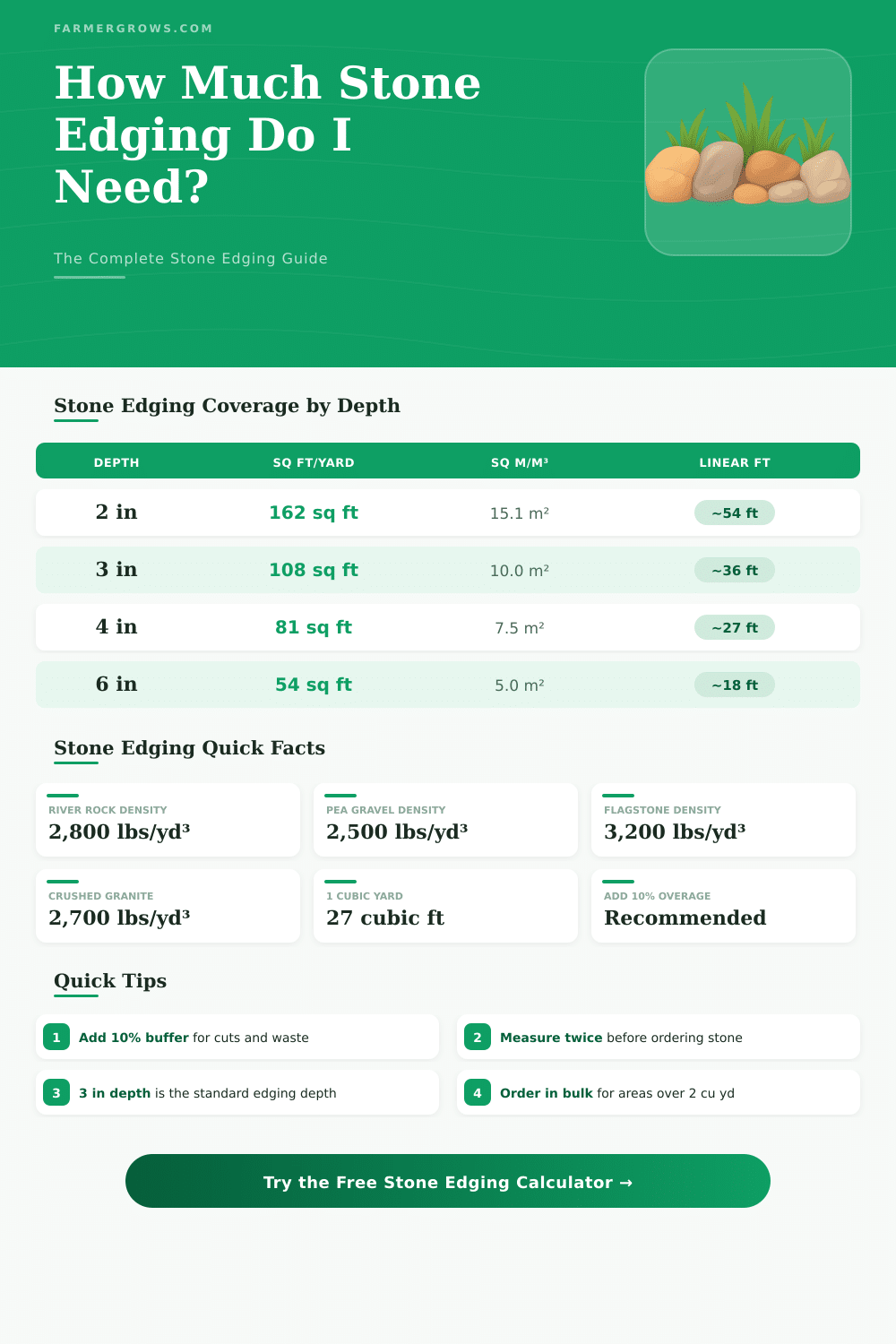
| Depth | Sq Ft / Cu Yd | Sq M / Cu M | Linear Ft (2 ft wide) | Linear M (60 cm wide) |
|---|---|---|---|---|
| 1 in (2.5 cm) | 324 sq ft | 30.1 m² | 162 ft | 50.1 m |
| 2 in (5 cm) | 162 sq ft | 15.1 m² | 81 ft | 25.0 m |
| 3 in (7.6 cm) | 108 sq ft | 10.0 m² | 54 ft | 16.7 m |
| 4 in (10 cm) | 81 sq ft | 7.5 m² | 40.5 ft | 12.5 m |
| 6 in (15 cm) | 54 sq ft | 5.0 m² | 27 ft | 8.3 m |
| Bag Size | Volume per Bag | Bags per Cu Yd | Coverage at 3 in (sq ft) | Coverage at 3 in (m²) |
|---|---|---|---|---|
| 0.5 cu ft bag | 0.5 cu ft | 54 bags | 2.0 sq ft | 0.19 m² |
| 0.75 cu ft bag | 0.75 cu ft | 36 bags | 3.0 sq ft | 0.28 m² |
| 1 cu ft bag | 1.0 cu ft | 27 bags | 4.0 sq ft | 0.37 m² |
| 2 cu ft bag | 2.0 cu ft | 13.5 bags | 8.0 sq ft | 0.74 m² |
| 3 cu ft bag | 3.0 cu ft | 9 bags | 12.0 sq ft | 1.11 m² |
| Project | Dimensions | Area | Cu Yards | 2 cu ft Bags |
|---|---|---|---|---|
| Narrow Garden Strip | 20 ft x 1 ft | 20 sq ft | 0.19 yd³ | ~3 bags |
| Small Flower Bed | 10 ft x 4 ft | 40 sq ft | 0.37 yd³ | ~5 bags |
| Tree Ring | 6 ft diameter circle | 28.3 sq ft | 0.26 yd³ | ~4 bags |
| Medium Border | 30 ft x 3 ft | 90 sq ft | 0.83 yd³ | ~12 bags |
| Large Garden Edge | 50 ft x 4 ft | 200 sq ft | 1.85 yd³ | ~25 bags |
| Driveway Border | 60 ft x 2 ft | 120 sq ft | 1.11 yd³ | ~15 bags |
| Patio Surround | 40 ft x 2 ft | 80 sq ft | 0.74 yd³ | ~10 bags |
stone edging can fully change the feeling of your garden, pavement or patio. They create clear lines between flower beds, meadows, paths and hard areas. Although everything seems only nice look more deeply: those stone edging borders indeed keep mulch, soil, grit and decorative materials here, where they must be, and stop everything from spreading and looking messy over time.
When you choose stones for borders, you have many color choices; imagine gray, beige, black and purple-rose. Granite and sandstone are reliable in this area, giving natural stone range, that feels lasting and natural. Andesite also appears, and depending on your location it can be a cheaper option with a look alike to slate, that gives the same clean and precise edge.
Easy Stone Edging for Your Garden
There truly is something for every taste about beauty.
To truly build such stone edging, folks usually use two main methods. Some dig a trench of around 30 cm wide, later fill it with small stones or river gravel, what forms something like a rocky ditch. Others like to stack big stones or rock pieces standing up.
Stacked stone edging. From slim boards up three or four levels, recently got big popularity, especially around flowery areas, where one wants a strong visual impression.
stone edging borders mark property lines, flower beds, tree circles and paths. They make your whole landscape more polished and cared for, while they keep mulch, grass and stones from spreading. That border also sets bushes and flowers in place, what is more important, than one thinks, when rain ore watering loosens everything.
Here installation truly starts. Lay leveling sand in the trench and press it flat to give a stable base, the sand helps place the bits right without big trouble. A level and rubber mallet will become your reliable aids, so that each stone seats right.
When the stones already are set, fill the spaces with soil or grit, to set everything flat. Some choose to cement; others like dry stacking right in the ditch. In my experience, laying stones half underground and half showing looks cleanest.
Grit as backfill at inner sides helps against ground shifting through the seasons.
Good stone edging depends on care about details. Making sure that the tops of every stone match with the next one truly changes the impression. Especially around trees, avoid piling the material too high, what could choke the roots.
Also fake stone edging deserves attention, they do not rust, do not lose color or break down during years of good service. Some such products even bend around curves beside trees or sharp corners in flower beds. Cover the bottom with cardboard weed barrier and landscape fabric, so that weeds do not invade thewhole year.
Flat edging, that sits flat with the soil, even allows that your mower rolls over it without stopping.