Herbicide Calibration Calculator
Estimate treated area, spray rate, mix volume, and herbicide product needs for boom, backpack, wand, band, or spot spraying.
Pick a calibration scenario to seed the fields. Each preset sets dimensions, speed, swath, overlap, target spray rate, nozzle output, and product rate.
Herbicide Calibration Output
Calculated from the selected method, dimensions, speed, swath, overlap, target rate, and product rate above.
| Bed | 8 in | 12 in | 18 in | Notes |
|---|---|---|---|---|
| 2x4 | 4.00 ft3 | 6.00 ft3 | 9.00 ft3 | Small herb box |
| 3x6 | 9.00 ft3 | 13.50 ft3 | 20.25 ft3 | Handy narrow bed |
| 4x4 | 8.00 ft3 | 12.00 ft3 | 18.00 ft3 | Square planter |
| 4x8 | 16.00 ft3 | 24.00 ft3 | 36.00 ft3 | Standard layout |
| 3x10 | 13.33 ft3 | 20.00 ft3 | 30.00 ft3 | Long kitchen row |
| 4x12 | 24.00 ft3 | 36.00 ft3 | 54.00 ft3 | Large market bed |
| Nozzle output | 6 in depth | 8 in depth | 12 in depth | Use note |
|---|---|---|---|---|
| 0.75 cu ft | 1.50 sq ft | 1.13 sq ft | 0.75 sq ft | Top-off only |
| 1.50 cu ft | 3.00 sq ft | 2.25 sq ft | 1.50 sq ft | Small beds |
| 2.00 cu ft | 4.00 sq ft | 3.00 sq ft | 2.00 sq ft | Common bag |
| 3.00 cu ft | 6.00 sq ft | 4.50 sq ft | 3.00 sq ft | Heavy duty |
| 40 L | 1.41 cu ft | 1.06 cu ft | 0.71 cu ft | Metric bag |
| 1000 L | 35.3 cu ft | 26.5 cu ft | 17.7 cu ft | Bulk tote |
| Crop type | Depth | Root note | Bed fit |
|---|---|---|---|
| Lettuce | 6-8 in | Shallow roots | Quick turnover |
| Herbs | 6-8 in | Compact root zone | Great edge rows |
| Strawberries | 8-10 in | Even moisture | Low profile |
| Beans | 10-12 in | Moderate roots | Easy fit |
| Tomatoes | 12-18 in | Deep feeder | Stakes help |
| Root crops | 12-16 in | Loose soil | Choose fine mix |
| Squash | 12-18 in | Wide feeder | Needs room |
| Asparagus | 18-24 in | Long-lived crowns | Deep bed only |
| Blend | Topsoil | Compost | Coir | Aeration | Use note |
|---|---|---|---|---|---|
| All-purpose | 50% | 30% | 15% | 5% | Targeted control fill |
| Veg boost | 40% | 40% | 10% | 10% | Feeding beds |
| Tomato rich | 35% | 45% | 10% | 10% | Heavy feeders |
| Berry light | 45% | 30% | 15% | 10% | Moist but airy |
| Seed start | 30% | 35% | 25% | 10% | Soft texture |
| Dry climate | 50% | 20% | 20% | 10% | Drains fast |
| Waterwise | 55% | 20% | 15% | 10% | Retains more |
| Loamy deep | 45% | 35% | 10% | 10% | Strong structure |
Calibration are the process of matching the actual output of the herbicide to the rate that herbicide labels require to be applied to the crops. Calibration is necessary because unevenly application of the herbicide will cause various problems for the person that apply the herbicide. If the amount of herbicide applied to the field is too much, then the person is wasting money on the herbicide, as well as creating the potential for drift of that herbicide.
However, if the amount of herbicide are too little, the weed will not die, forcing the person to return to treat the area. Through calibration, the person ensure that the herbicide that is applied to the field matches the requirements of the label. A person must account for several variable when calibrating the sprayer.
How to Calibrate a Herbicide Sprayer
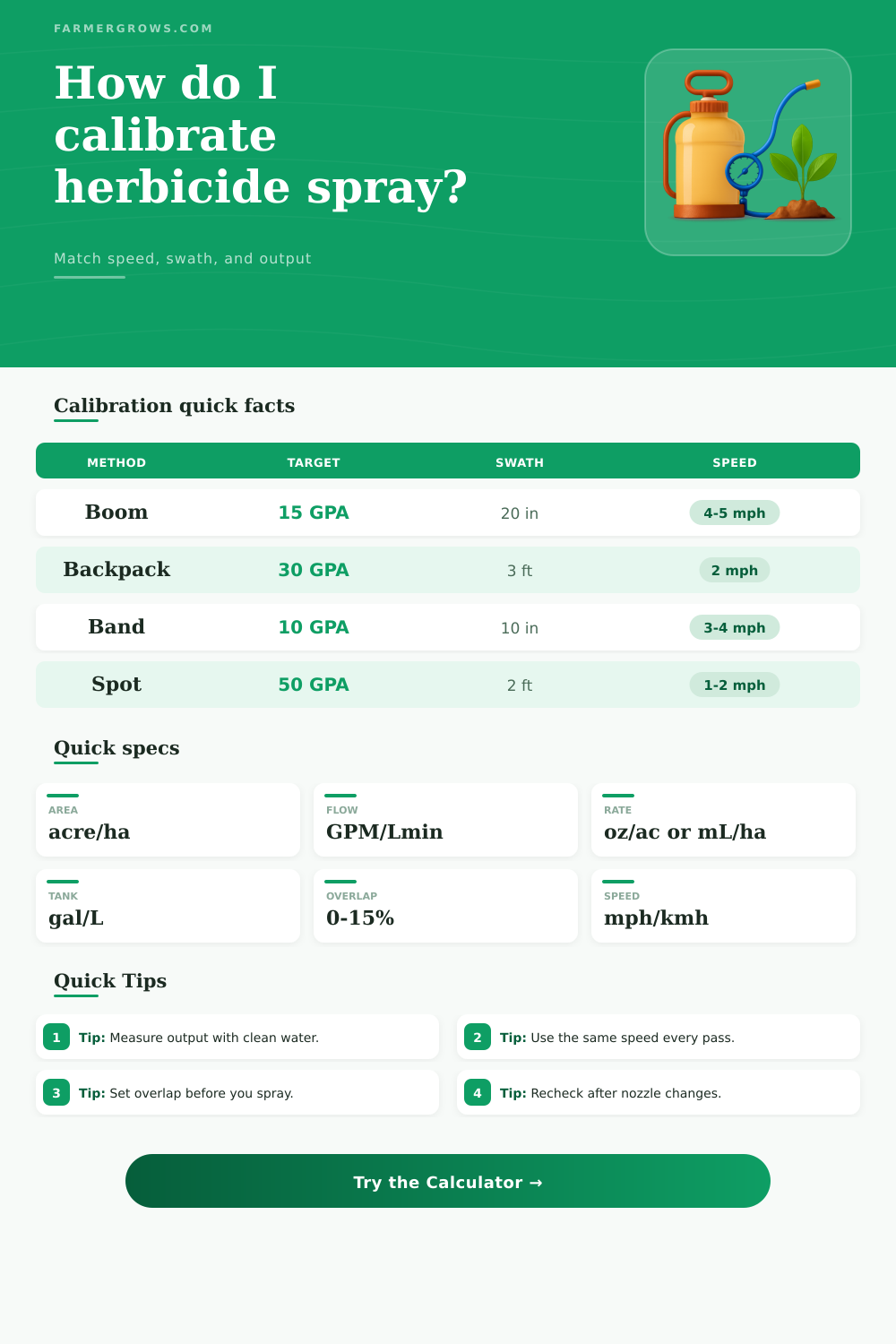
These variables includes the speed of the sprayer, the swath width that is applied to the ground, and the amount of overlap between the nozzle of the sprayer. The swath width is the amount of the ground that the sprayer covers, while the overlap is the area in which the nozzles of the sprayer overlap. If the amount of overlap is high, then the person will likely adjust the rate at which the sprayer travels.
Speed is one of the most important variable to account for during calibration. The relationship between the amount of gallons of herbicide that are applied per acre and the speed at which the sprayer moves is inversely proportional. Thus, if the person doubles the speed of the sprayer, the gallons of herbicide that is applied per acre will be halved.
Boom sprayers are typically used for treating large area of crops or pastures. For these types of boom sprayers, the person must account for and calibrate the nozzle output of the boom sprayer. The person must calculate the amount of gallons per minute that each nozzle will output in order to ensure that the pump of the boom sprayer can maintain the necessary pressure for that output.
Furthermore, if the nozzle output is not correctly calibrated, the edge of the rows of crops may not be treated with the proper amount of herbicide, causing those edges to experience weed growth. The overlap for boom sprayers should be in the range of 10 to 15 percent; too much overlap, however, will result in wasted herbicide. Backpack sprayers and hand-held wands are typically used in spot spraying for targeted area of interest.
Spot spraying techniques and methods is different than boom sprayer methods. For instance, a person using a backpack sprayer will walk at a speed of approximately 2 miles per hour. Furthermore, the person can target a swath width of interest, such as 3 feet.
To calibrate the backpack sprayer, a person can time themselfs as they walk a distance of interest, such as 100 feet, and collect the amount of herbicide that is dispense from the wand into a container. Because a person can easily change their speed when using backpack sprayers, they must maintain a consistent speed to ensure that the herbicide that is applied is even. The nozzles of a sprayer are an important component of the spraying process.
The type of nozzles that is attached to the sprayer will change the droplet size of the herbicide that is applied to the crops. For instance, flat fan nozzles are typically used with contact herbicides, while air-induction nozzles are used with systemic herbicides to reduce the drift of that herbicide. The nozzles must be inspected and cleared of any clog or wear.
If the nozzle becomes clogged, the output of the nozzle will decrease; if the nozzle wears with time, the output will increase. The sprayer should be tested with water before the use of the herbicide; testing the sprayer with water prevents the need to rinse the sprayer after its application of the herbicide. External factors in the spraying process include terrain and weather.
For instance, if the terrain on which the sprayer will be traveling is uphill, the sprayer will move at a slow rate. Wind is another external environment factor; the wind could lead to drift in the movement of the herbicide. Additionally, another factor to consider is how many times the person will need to refill the tank of the sprayer with the herbicide solution.
If a person is aware of the total area that will be treated and the rate of the herbicide that will be applied, then the person can calculate the total amount of herbicide that will be required. Calibration is a task that the person should of perform regular. For instance, a person should recalibrate their sprayer after every change in the sprayer settings.
By ensuring that the person hits the rate listed on the herbicide label, the person ensures that the weeds will die. By hitting the rate listed on the herbicide label, money will be saved on the purchase of herbicide, and the person will remain in compliance with legal regulation for the use of herbicide.