🌱 Greenhouse Ventilation Calculator
Estimate greenhouse air changes, fan count, opening area, and heat-removal capacity for hoop houses, polyhouses, nursery bays, and glasshouses. The calculator uses the larger of ACH airflow and heat-load airflow so the design stays practical on hot days.
Pick a real greenhouse layout to seed the fields. Each preset sets dimensions, target ACH, fan capacity, temperature rise, face velocity, and free-area assumptions for a fast starting point.
Greenhouse Ventilation Output
Sizing summary will appear here.
| Type | Typical size | Target ACH | Notes |
|---|---|---|---|
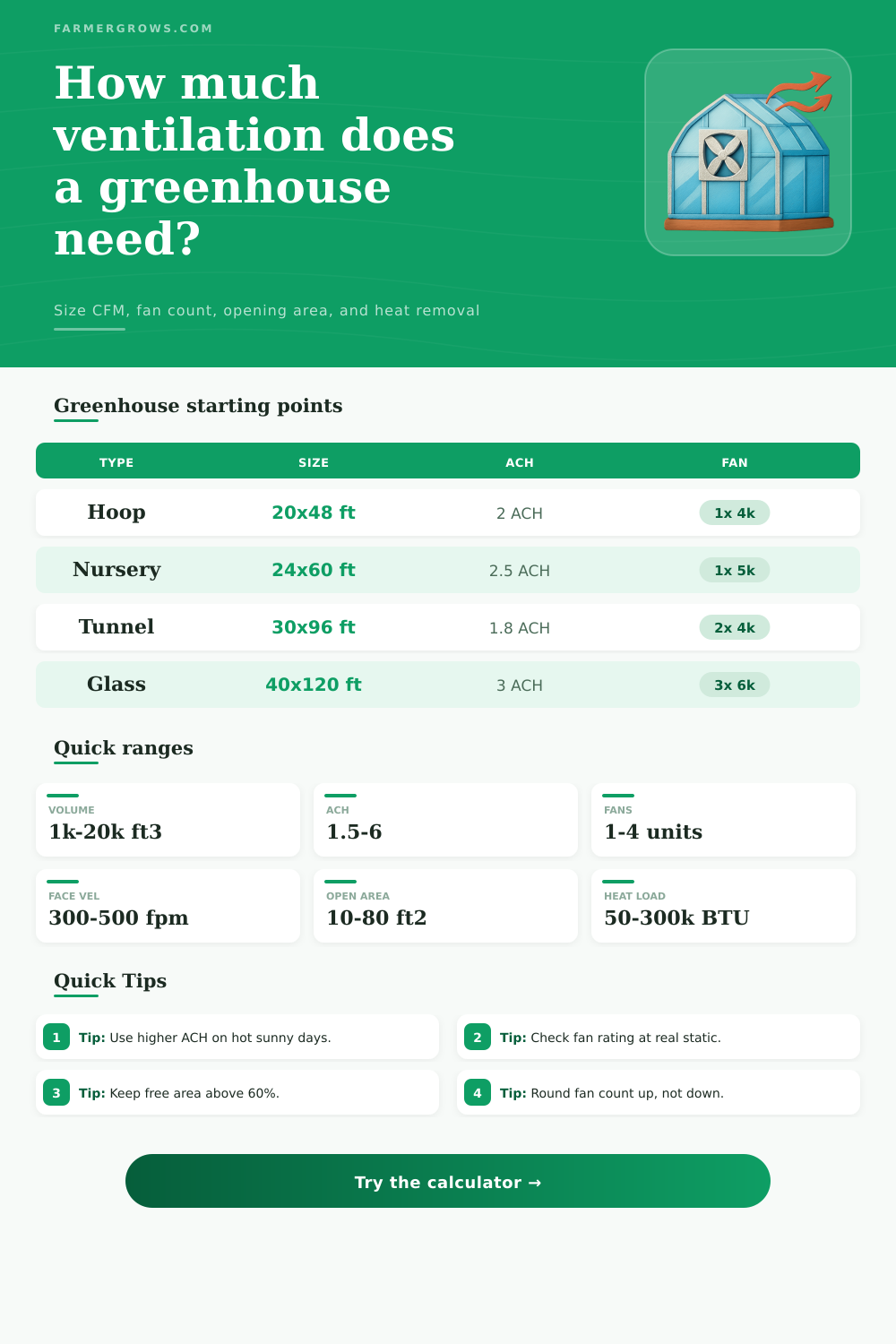
| Hoop house | 20-30 x 48-100 ft | 1.5-2.5 | Simple exhaust |
| Polyhouse | 24-36 x 60-120 ft | 2.0-3.5 | Common farm use |
| Nursery bay | 12-24 x 40-80 ft | 2.5-4.0 | High crop density |
| Glasshouse | 36-60 x 120+ ft | 3.0-6.0 | Hot weather control |
| Fan size | Typical CFM | Metric | Use |
|---|---|---|---|
| Small | 2,500-4,000 | 4,250-6,800 | Benches |
| Medium | 4,000-7,500 | 6,800-12,700 | Hoop houses |
| Large | 7,500-12,000 | 12,700-20,400 | Wide spans |
| High output | 12,000+ | 20,400+ | Glasshouses |
| Face velocity | Net area | Gross area | Notes |
|---|---|---|---|
| 250 fpm | Net high | Big opening | Quiet draw |
| 300 fpm | Balanced | Moderate | Good default |
| 400 fpm | Compact | Smaller vent | Fan-wall use |
| 500 fpm | Tight | Very small | Emergency purge |
| Delta T | BTU/h per CFM | Metric note | Use case |
|---|---|---|---|
| 10 deg F | 10.8 | 3.17 W per CFM | Mild control |
| 15 deg F | 16.2 | 4.75 W per CFM | Warm day |
| 20 deg F | 21.6 | 6.34 W per CFM | Hot peak |
| 25 deg F | 27.0 | 7.92 W per CFM | Emergency purge |
Greenhouse ventilation is the process of moving air through a greenhouse. Greenhouse ventilation are necessary because greenhouse ventilation removes excess moisture from the greenhouse, greenhouse ventilation dilutes the carbon dioxide that builds up in the greenhouse from the plants respiration, and because greenhouse ventilation removes the solar heat that enters the greenhouse. If you dont provide adequate greenhouse ventilation for your plants, the temperature within the greenhouse can significantly rise above the outside temperature, which can harm the plants and cause them to wilt or die.
A person must balance two specific requirements for greenhouse ventilation: air changes per hour and heat removal. Air changes per hour, also known as ACH, is a measurement of the number of times the air within a greenhouse is changed every hour. For most greenhouses, especialy in the summer, the ideal air changes per hour is between 2 and 4.
How to Vent a Greenhouse
Heat removal, however, require a higher number of air changes per hour because the solar radiation enter the greenhouse through the greenhouse glass or plastic. The airflow requirements for most greenhouses are determined by sizing the fans to meet the requirement of air changes per hour or heat removal, whichever is higher of the two requirements. Another specification that must be considered when installing fans for a greenhouse is the efficiency of those fans.
The fan manufacturers provides inaccurate ratings for the airflow that their fans will achieve within the greenhouse. Their ratings are usually provided for 0 static pressure. However, within the greenhouse, there are static pressures created by the screens that the fans must push the air through.
For example, a fan company may rate a fan as achieving 5,000 cubic feet of airflow per minute at 0 static pressure. However, when the fan is pushing air through greenhouse screens, the airflow may be 4,000 cubic feet per minute. Thus, the person who purchases fans for the greenhouse will have to increase the number of fans to account for these losses in airflow.
Finally, the face velocity of the vents must also be controlled. Face velocity is the rate of airflow through the opening of the vent. The face velocity should be between 250 and 400 feet per minute; if the face velocity is too high, the moving air within the greenhouse will harm the plants; if the face velocity is too low, the fans will not push enough air through the greenhouse.
The different types of greenhouses will require different types of ventilation strategies. For example, hoop houses and tunnels often use exhaust fans and vent walls to move air uniformly throughout the greenhouse. Polyhouses use side shutters and roof vents, as hot air rises within the greenhouse creating the stack effect.
With glasshouses, more air changes per hour are required, such as 4 to 6 air changes per hour. This is because glasshouses need to be sealed more tightly to maintain the greenhouses internal temperature. The type of plants that are within the greenhouse will also affect the requirements for ventilation.
For example, tomatoes require more stagnant air within the greenhouse than orchids, which require constant but gentle air exchange within the greenhouse to avoid developing fungal spots on there orchid leaves. Many people make mistakes when they build greenhouse ventilation systems. One mistake is the ignoring static pressure when they purchase fans for the greenhouse.
For example, most people will purchase fans based off the airflow that they can create at 0 static pressure. However, static pressure will reduce the airflow that is provided to the plants. Thus, when purchasing fans for the greenhouse, the grower must consider static pressure at the fans; it is usually between 0.1 and 0.2 inches of water gauge.
Another mistake is to use the same number of air changes per hour throughout the year. On hot sunny days, an increase in air changes per hour will be required. However, 1 air change per hour should be provided at night to conserve the humidity within the greenhouse.
Additionally, some form of controls should be used to manage the fans within the greenhouse, such as thermostats or humidity sensor. Calculating the heat load that must be removed from a greenhouse by the ventilation system is a difficult task. The heat load for a greenhouse comes from many different sources.
For example, the greenhouse will receive heat from the solar radiation that enter through the greenhouse roof. The greenhouse will also lose heat through the walls and the plants within the greenhouse will release more heat as their leaves transpire. A general rule for the heat load is 20 to 40 BTU per square foot of the greenhouse per hour.
The psychrometric constant for the rate of airflow in the greenhouse relative to the change in the temperature of the air in the greenhouse is 1.08 BTU per cubic foot per minute of temperature rise in the greenhouse. Thus, for a large heat load, large amounts of airflow will be required in the greenhouse. For a greenhouse ventilation system to operate correctly, maintenance is necessary.
Insect screens need to be cleaned every month to ensure that there is no reduction of airflow through the screens of as much as 50 percent. Sensors within the greenhouse can be used to monitor the health of the system; if a fan should break, the sensor will alert the grower before the plants are harmed. Additionally, if the ventilation system utilizes variable frequency drives for the fans, 30 percent of energy cost can be saved.
The advantage of using variable frequency drives is that the fans will automatically adjust to the load of air that is within the greenhouse. Finally, the grower must install fans in the direction of the wind so that the hot air will naturally move out of the greenhouse and the airflow will be increased throughout the structure.