Squash Seed Germination Time Calculator
Estimate squash sprout dates, main emergence, seedling count, mound spacing, and direct-sow or transplant timing from soil warmth, seed age, moisture, and row cover.
Squash seed is quick when the seed zone is warm, but it stalls in cold soil. Use actual soil or media temperature at planting depth, then adjust for variety type, seed age, sowing method, cover, depth, moisture, and hill spacing.
Squash Germination Estimate
Results combine squash soil-temperature timing with modifiers for variety, seed age, sowing method, moisture, cover, and spacing.
| Seed-zone temperature | Expected germination | Stand expectation | Field note |
|---|---|---|---|
| 55 to 59°F (13 to 15°C) | 14 to 21 days or failure | Low, uneven | Too cold for dependable squash stands; wait or warm the bed. |
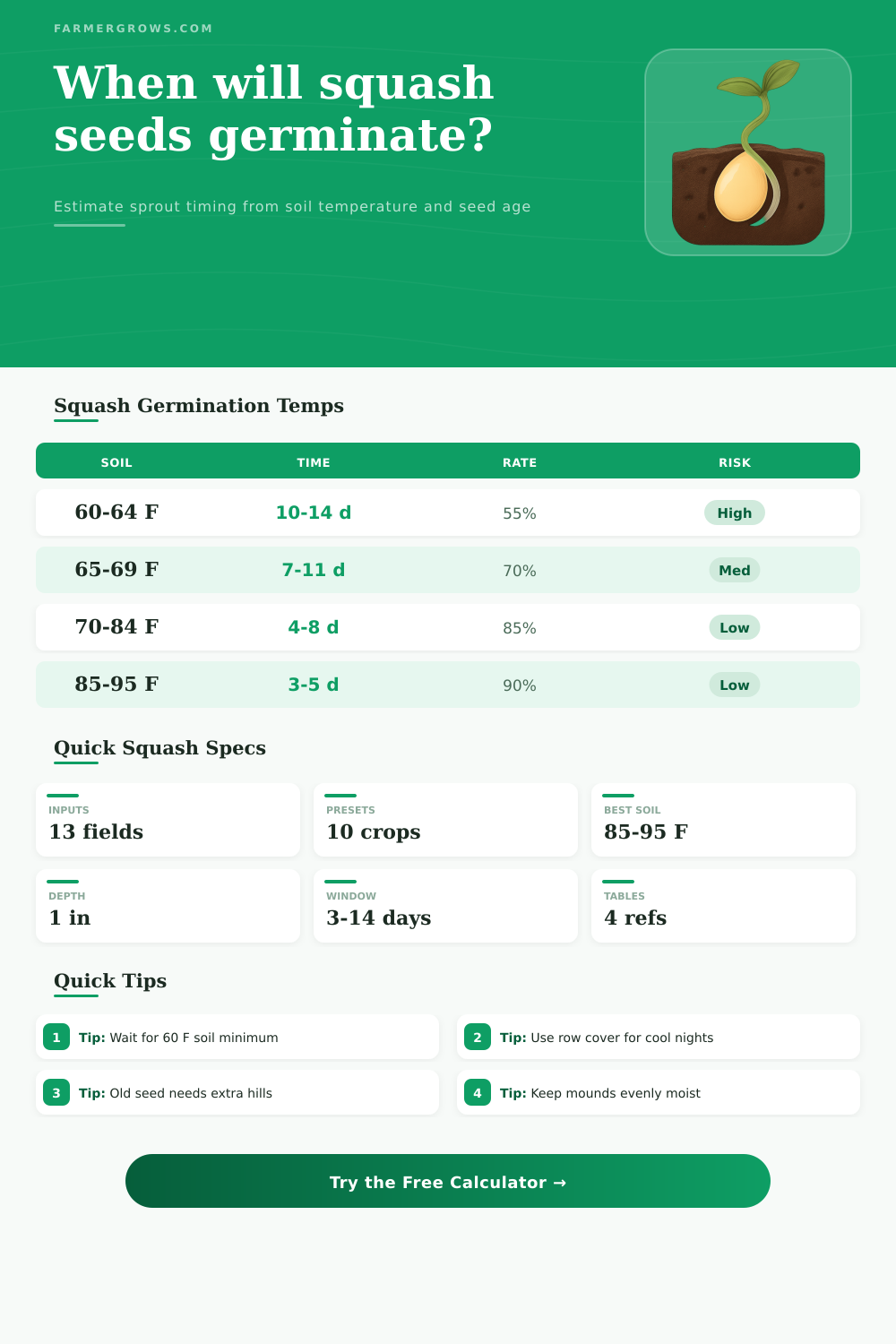
| 60 to 64°F (16 to 18°C) | 10 to 14 days | About 50 to 60% | Minimum direct-sow range; use row cover and avoid wet soil. |
| 65 to 69°F (18 to 21°C) | 7 to 11 days | About 65 to 75% | Usable but still slow for old seed or heavy soil. |
| 70 to 74°F (21 to 23°C) | 6 to 9 days | About 75 to 85% | Good field range for zucchini and summer squash. |
| 75 to 84°F (24 to 29°C) | 4 to 7 days | About 85 to 90% | Reliable range for most summer and winter squash seed. |
| 85 to 95°F (29 to 35°C) | 3 to 5 days | About 88 to 94% | Fastest range if media stays moist but airy. |
| 96 to 100°F (36 to 38°C) | 3 to 6 days | Variable | Can dry media quickly; vent covers and watch heat mats. |
| Squash group | Typical timing at 75°F | Seeds per mound | Spacing guidance |
|---|---|---|---|
| Zucchini, bush summer squash | 4 to 7 days | 2 to 3, thin to 1 or 2 | 3 to 4 ft between stations, 4 to 5 ft rows. |
| Yellow crookneck or straightneck | 4 to 7 days | 2 to 3, thin after emergence | 3 to 4 ft between plants or hills. |
| Pattypan or scallop | 5 to 8 days | 2 to 3 in warm soil | 3 to 4 ft spacing, slightly wider for large plants. |
| Delicata or sweet dumpling | 5 to 8 days | 3 to 4 per hill, thin to 2 | 4 to 6 ft hills or trellis where appropriate. |
| Butternut, C. moschata | 5 to 9 days | 3 to 4 per hill | 5 to 8 ft for long vines; starts help short seasons. |
| Acorn, kabocha, spaghetti | 5 to 9 days | 3 to 4 per hill | 5 to 8 ft hills depending on vine length. |
| Crop style | Best season use | Common row or mound plan | Calculator adjustment |
|---|---|---|---|
| Early zucchini under row cover | Late spring when soil reaches 60°F | 3 ft hills, 4 ft rows, cover removed at bloom | Shortens timing 1 day if cover warms nights. |
| Summer squash succession | Warm summer sowings | 3 to 4 ft between stations, direct sow every 2 to 3 weeks | Uses faster warm-soil window. |
| Winter squash main crop | After frost risk, long season beds | 5 to 8 ft hills or wide rows for vining types | Adds spacing footprint and stand-gap warning. |
| Indoor squash starts | Short-season or cool spring gardens | 1 seed per cell, transplant at 2 to 3 weeks | Uses warmer media but adds transplant timing note. |
| Black plastic squash bed | Cool soil, weed control, market rows | Plant through holes on 3 to 6 ft spacing | Raises effective seed-zone temperature modestly. |
| Dryland mound planting | Warm areas with drip or basin watering | Wide mounds, 2 to 3 plants after thinning | Penalizes dry seed-bed moisture. |
| Factor | Best range | Penalty range | Why it matters |
|---|---|---|---|
| Seed age | Fresh to 2 years | 4+ years | Squash seed stores fairly well, but old seed loses vigor and emerges unevenly. |
| Planting depth | 1/2 to 1 inch | Over 1.5 inches | Deep sowing slows emergence, especially in cool or crusting soil. |
| Moisture | Evenly moist and airy | Soggy or drying out | Waterlogged seed can rot; dry seed pauses before the radicle pushes. |
| Row cover | Warm nights, vented days | Overheated closed tunnels | Cover helps early soil warmth but should be removed for pollination at bloom. |
| Direct sow timing | After frost, 60°F+ soil | Cold wet spring soil | Cucurbits prefer warm soil and dislike sitting wet before germination. |
| Transplant timing | 2 to 3 week starts | Rootbound older plants | Young squash starts recover faster and avoid root disturbance setbacks. |
Warm the seed zone first: For direct sowing, a morning soil reading near 60°F is the minimum, while 70°F or warmer gives much steadier squash emergence.
Thin after true leaves: Sow extra seed in each mound for insurance, then keep the strongest 1 to 2 summer squash plants or 2 winter squash plants per hill.
For squash seeds, soil temperature is everything: They can germinate in as little as three days if soil’s already warm, or rot for a couple weeks if it isn’t. Before sowing them, know what seed wants, and remember that once up and running, cucurbits will be fast-growing…but slow if weather stays cold. Again, you want to have a minimum of 60 degree-Fahrenheit soil; otherwise: fail.
This tool takes into account variables, like how thick you cover the seed, where exactly it’s planted, and whether it’s old or new stock. It tells you when to expect something real to happen and how long that will take. No more guessing about when things will sprout.
Why Seed Age Matters
A lot of gardeners don’t know that seed age is a factor in whether their plants is going to come up successfully. While the seed may look strong, vigor declines rapidy starting in year two (and often by year three). What happens? The old seed doesn’t kill itself; it just emerges oddly. One plant emerge on Monday, and another on Friday. This makes thinning trickier and sets rest of the crop back, too. In the tool, the estimated days-to-emergence shift downward with each passing season of seed age, to take that lag into account.
So if you know your seed is old, the tool can help you determine whether to sow a little bit more on top off what you’d normally expect as backup. With last-season’s fresh stock, you’ll know you’re planting evenly, so there won’t be gaps when it all pops up, meaning less waste and less time spent filling them in.
A frequent cause of death is seeds planted too deeply, as the squash seed has to use some effort to get out of dirt. In cool mud or compacted clay, they burn up getting there if buried more than an inch; half an inch indoors, or where crumbliness causes a crust, is best. To compensate for deeper-than-recommended planting, tool adjusts the number of expected days to emerge, based off root length. Why not go deep? That’s what many first-timers think. In the garden with squash, it usually only means going slow, and you want to be fast. Slow plants is vulnerable to pest and disease; a fast start aboveground will help your plant take over bed.
In the seed zone, black plastic mulch and row covers alter temperature. They create a warmer condition for seeds (and also shield tender young sprouts from the coolness of an often-chilly late spring). Depending on whether you’re trying to thwart pests such as squash bugs, or just have a short growing season, this warming effect can save a few days of wait-time. To see what difference it makes on your timeline, the calculator factors those options into its calculations, too, assuming slightly faster emergence of your crop then would be the case with bare ground. In other words, you’ve got yourself a mini-climate in advance of actual early-summer conditions. Just remember to open up tunnels once things pop, because overheating may make them grow leggy.
The number of viable seeds determines how far apart they must be spaced, because dead seeds will leave spaces in your eventual stand. For example, if only half your seeds germinate, what would of been a four-foot spacing between mounds becomes an eight-foot gap. To estimate how many good seedlings you’ll end up with, it uses information about your seed variety, temperature, and moisture. Bush zucchini require less space than winter squash types such as butternut or delicata; thus poor germination is worse on these longer-season plants. Knowing that before-hand lets you go ahead and spread more seeds per hill with confidence, since you can always thin heavily then.
You can’t sow empty dirt! Timing is important. Once you get this part right, the rest of harvest happens at the pace of a full, bountiful season.